Durham in County Durham, England, United Kingdom — Northwestern Europe (the British Isles)
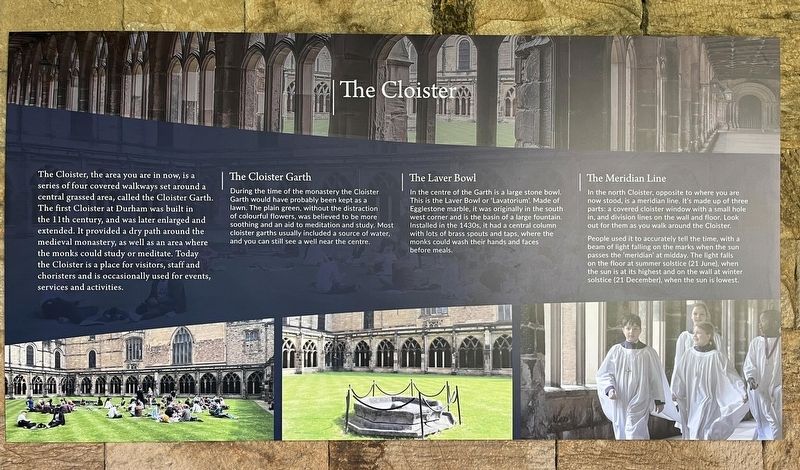
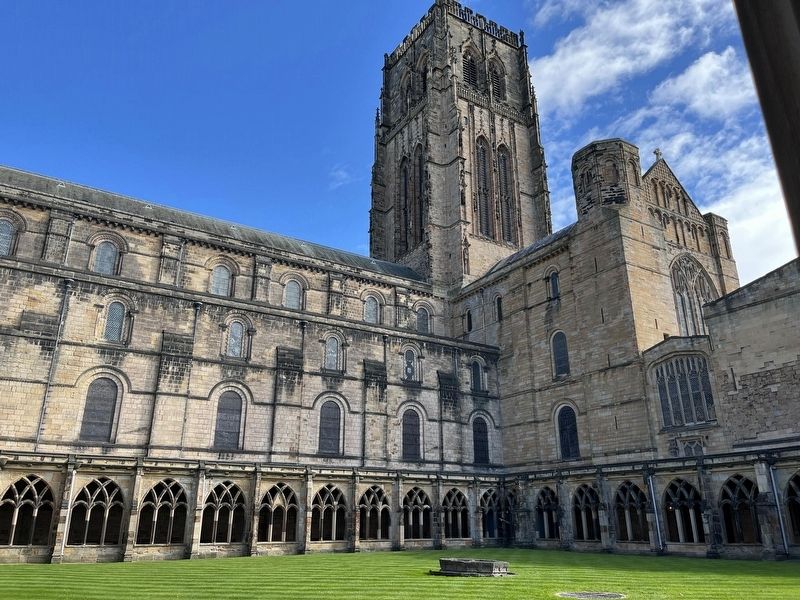
The Cloister
Photographed by Ray Gurganus, April 16, 2024
1. The Cloister Marker
The Cloister Garth
During the time of the monastery the Cloister Garth would have probably been kept as a lawn. The plain green, without the distraction of colourful flowers, was believed to be more soothing and an aid to meditation and study. Most cloister garths usually included a source of water, and you can still see a well near the centre.
The Laver Bowl
In the centre of the Garth is a large stone bowl. This is the Laver Bowl or 'Lavatorium'. Made of Egglestone marble, it was originally in the south west corner and is the basin of a large fountain. Installed in the 1430s, it had a central column with lots of brass spouts and taps, where the
this page online
The Meridian Line
In the north Cloister, opposite to where you are now stood, is a meridian line. It's made up of three parts: a covered cloister window with a small hole in, and division lines on the wall and floor. Look out for them as you walk around the Cloister.
People used it to accurately tell the time, with a beam of light falling on the marks when the sun passes the 'meridian' at midday. The light falls on the floor at summer solstice (21 June), when the sun is at its highest and on the wall at winter solstice (21 December), when the sun is lowest.
Topics. This historical marker is listed in this topic list: Religion & Religious Structures.
Location. 54° 46.404′ N, 1° 34.616′ W. Marker is in Durham, England, in County Durham. It can be reached from no nearby street. In the Cathedral's cloister walkways. Touch for map. Marker is in this post office area: Durham, England DH1 3EQ, United Kingdom. Touch for directions.

Regionally, this marker is in North East England. Globally, it is on the Atlantic Ocean, in
Photographed by Ray Gurganus, April 16, 2024
2. Durham Cathedral and Cloisters
Other nearby markers. At least 8 other markers are within walking distance of this marker: John Washington (a few steps from this marker); Repair and Restoration (within shouting distance of this marker); Durham Light Infantry Boer War Memorial (within shouting distance of this marker); Alfred Robert Tucker (within shouting distance of this marker); George William Kitchin (within shouting distance of this marker); Old Registry (about 120 meters away, measured in a direct line); Bishop Cosin’s Almshouses (about 150 meters away); Bishop Cosin’s Library (about 150 meters away). Touch for a list and map of all markers in Durham.
Credits. This page was last revised on June 19, 2026. It was originally submitted on August 9, 2024, by Ray Gurganus of Washington, District of Columbia. This page has been viewed 159 times since then and 20 times this year. Photos: 1, 2. submitted on August 9, 2024, by Ray Gurganus of Washington, District of Columbia. • Andrew Ruppenstein was the editor who published this page.
Editor’s want-list for this marker. photo of the marker within its surroundings • Can you help?
