Durham in County Durham, England, United Kingdom — Northwestern Europe (the British Isles)
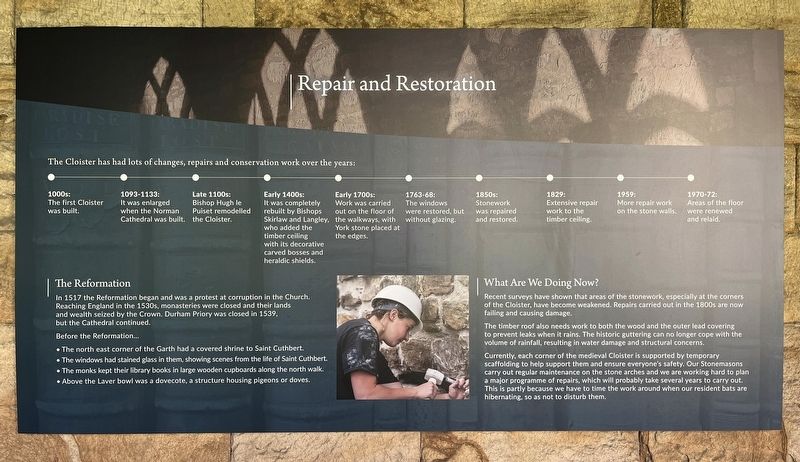
Repair and Restoration
Photographed by Ray Gurganus, April 16, 2024
1. Repair and Restoration Marker
• 1000s: The first Cloister was built.
• 1093-1133: It was enlarged when the Norman Cathedral was built.
• Late 1100s: Bishop Hugh le Puiset remodelled the Cloister.
• Early 1400s: It was completely rebuilt by Bishops Skirlaw and Langley, who added the timber ceiling with its decorative carved bosses and heraldic shields.
• Early 1700s: Work was carried out on the floor of the walkways, with York stone placed at the edges.
• 1763-68: The windows were restored, but without glazing.
• 1850s: Stonework was repaired and restored.
• 1829: Extensive repair work to the timber ceiling.
• 1959: More repair work on the stone walls.
• 1970-72: Areas of the floor were renewed and relaid.
The Reformation
In 1517 the Reformation began and was a protest at corruption in the Church. Reaching England in the 1530s, monasteries were closed and their lands and wealth seized by the Crown. Durham Priory was closed in 1539. but the Cathedral continued.
Before the Reformation...
• The north east corner of the Garth had a covered shrine to Saint
this page online
• The windows had stained glass in them, showing scenes from the life of Saint Cuthbert.
• The monks kept their library books in large wooden cupboards along the north walk.
• Above the Laver bowl was a dovecote, a structure housing pigeons or doves.
What Are We Doing Now?
Recent surveys have shown that areas of the stonework, especially at the comers of the Cloister, have become weakened. Repairs carried out in the 1800s are now failing and causing damage.
The timber roof also needs work to both the wood and the outer lead covering to prevent leaks when it rains. The historic guttering can no longer cope with the volume of rainfall, resulting in water damage and structural concerns.
Currently, each corner of the medieval Cloister is supported by temporary scaffolding to help support them and ensure everyone's safety. Our Stonemasons carry out regular maintenance on the stone arches and we are working hard to plan a major programme of repairs, which will probably take several years to carry out. This is partly because we have to time the work around when our resident bats are hibernating, so as not to
Photographed by Ray Gurganus, April 16, 2024
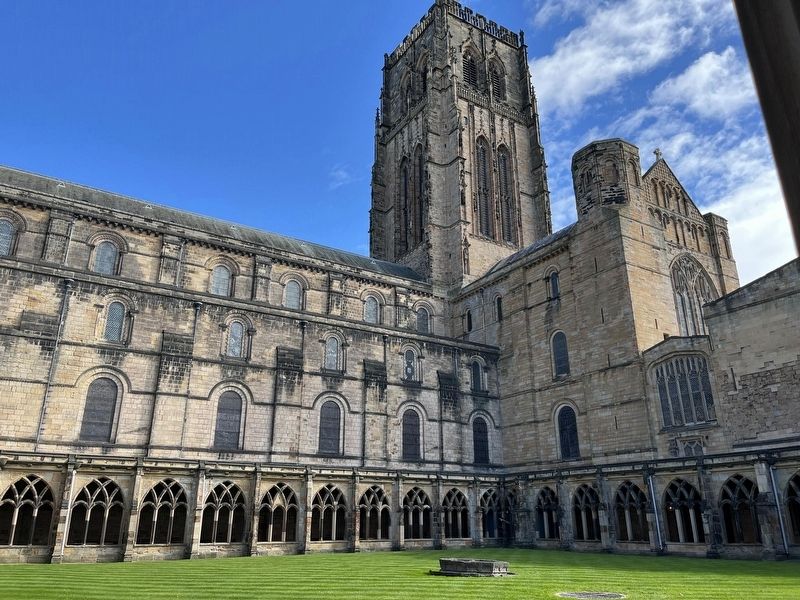
2. Durham Cathedral and Cloisters
Topics. This historical marker is listed in these topic lists: Architecture • Religion & Religious Structures.
Location. 54° 46.381′ N, 1° 34.61′ W. Marker is in Durham, England, in County Durham. It can be reached from no nearby street. In the Cathedral cloisters walkway. Touch for map. Marker is in this post office area: Durham, England DH1 3EQ, United Kingdom. Touch for directions.

Regionally, this marker is in North East England. Globally, it is on the Atlantic Ocean, in the North Atlantic Region, in Europe, in Atlantic Europe, on one of the British Isles, in the Western World, and in the Anglosphere. Historically, it finds itself in what was once the Roman Empire.
Other nearby markers. At least 8 other markers are within walking distance of this marker: The Cloister (within shouting distance of this marker); John Washington (within shouting distance of this marker); Durham Light Infantry Boer War Memorial (about 120 meters away, measured in a direct line); Alfred Robert Tucker (about 120 meters away); George William Kitchin (about 120 meters away); Old Registry (about 150 meters away); Bishop Cosin’s Almshouses (about 180 meters away); Bishop Cosin’s Library (about 180 meters away). Touch for a list and map of all markers in Durham.
Credits. This page was last revised on June 19, 2026. It was originally submitted on August 9, 2024, by Ray Gurganus of Washington, District of Columbia. This page has been viewed 91 times since then and 13 times this year. Photos: 1, 2. submitted on August 9, 2024, by Ray Gurganus of Washington, District of Columbia. • Andrew Ruppenstein was the editor who published this page.
Editor’s want-list for this marker. photo of the marker within its surroundings • Can you help?
