Reading in Berkshire, England, United Kingdom — Northwestern Europe (the British Isles)
At the Heart of the Abbey
Abbey Quarter
Photographed by Ray Gurganus, April 1, 2024
1. At the Heart of the Abbey Marker
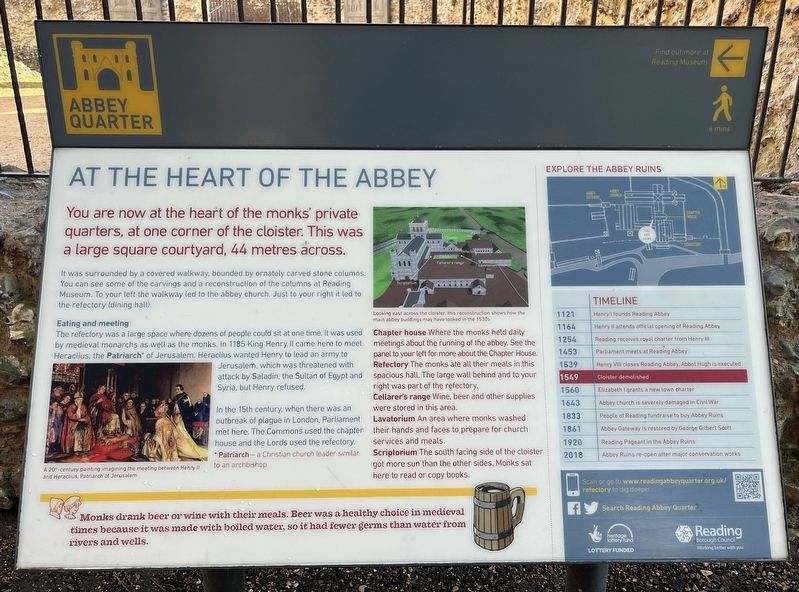
It was surrounded by a covered walkway, bounded by ornately carved stone columns You can see some of the carvings and a reconstruction of the columns at Reading Museum. To your left the walkway led to the abbey church. Just to your right it led to the refectory (dining hall).
Eating and meeting
The refectory was a large space where dozens of people could sit at one time. It was used by medieval monarchs as well as the monks. In 1185 King Henry II came here to meet Heraclius, the Patriarch* of Jerusalem. Heraclius wanted Henry to lead an army to Jerusalem, which was threatened with attack by Saladin, the Sultan of Egypt and Syria, but Henry refused.
In the 15th century, when there was an outbreak of plague in London, Parliament met here. The Commons used the chapter house and the Lords used the refectory.
* Patriarch: a Christian church leader similar to an archbishop.
Chapter house: Where the monks held daily meetings about the running of the abbey. See the panel to your
this page online
Refectory: The monks ate all their meals in this spacious hall. The large wall behind and to your right was part of the refectory.
Cellarer's range: Wine, beer and other supplies were stored in this area.
Lavatorium: An area where monks washed their hands and faces to prepare for church services and meals.
Scriptorium: The south facing side of the cloister got more sun than the other sides. Monks sat here to read or copy books.
Monks drank beer or wine with their meals. Beer was a healthy choice in medieval times because it was made with boiled water, so it had fewer germs than water from rivers and wells.
Erected by Reading Borough Council.
Topics. This historical marker is listed in this topic list: Religion & Religious Structures. A significant historical year for this entry is 1185.
Location. 51° 27.378′ N, 0° 57.915′ W. Marker is in Reading, England, in Berkshire. It can be reached from Abbot's Walk. Touch for map. Marker is at or near this postal address: 12 Abbot's Walk, Reading, England RG1 3HW, United Kingdom. Touch for directions.

Regionally, this marker is in the Greater

Photographed by Ray Gurganus, April 1, 2024
2. Reconstruction image of Reading Abbey
Looking north east towards the abbey church, this reconstruction shows the huge scale of Reading Abbey
Other nearby markers. At least 8 other markers are within walking distance of this marker: Chapter and Verse (here, next to this marker); In the Warm (a few steps from this marker); A Church on a Huge Scale (within shouting distance of this marker); Abbey Quarter (within shouting distance of this marker); Choir and Altar (within shouting distance of this marker); You've Found the Abbey Ruins (within shouting distance of this marker); Ground Level (within shouting distance of this marker); You've Found the Abbey Wharf (within shouting distance of this marker). Touch for a list and map of all markers in Reading.
Credits. This page was last revised on August 14, 2024. It was originally submitted on August 11, 2024, by Ray Gurganus of Washington, District of Columbia. This page has been viewed 133 times since then and 14 times this year. Photos: 1, 2. submitted on August 11, 2024, by Ray Gurganus of Washington, District of Columbia. • Andrew Ruppenstein was the editor who published this page.
