Boerum Hill in Brooklyn in Kings County, New York — The American Northeast (Mid-Atlantic)
Boerum Hill
⎯⎯⎯
Downtown Brooklyn
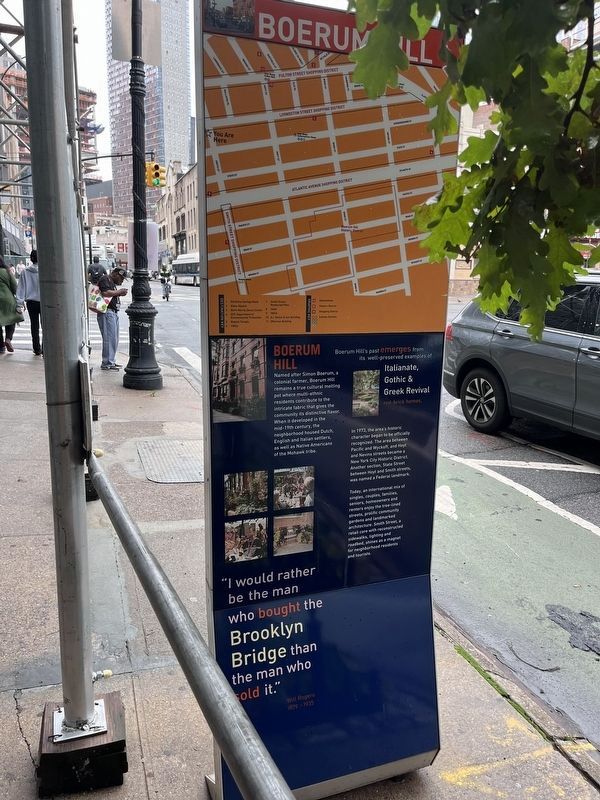
Boerum Hill
Boerum Hill's past emerges from its well-preserved examples of Italianate, Gothic, & Greek Revival red-brick homes.
Named after Simon Boerum, a colonial farmer, Boerum Hill remains a true cultural melting pot where multi-ethnic residents contribute to the intricate fabric that gives the community its distinctive flavor. When it developed in the mid-19th century, the neighborhood housed Dutch, English and Italian settlers, as well as Native Americans of the Mohawk tribe.
In 1973, the area's historic character began to be officially recognized. The area between Pacific and Wyckoff, and Hoyt and Nevins streets became a New York City Historic District. Another section, State Street between Hoyt and Smith streets, was named a Federal landmark.
Today, an international mix of singles, couples, families, seniors, homeowners and renters enjoy the tree-lined streets, prolific community gardens and landmarked architecture. Smith Street, a retail core with reconstructed sidewalks, lighting and roadbed, shines as a magnet for neighborhood residents and tourists.
"I would rather be the man who bought theBrooklyn Bridge than the man who sold it."
Click or scan to see
this page online
Will Rogers
1879 - 1935
Downtown Brooklyn
is a cluster of extraordinary neighborhoods
1. Fulton Landing
The Fulton Ferry Landing sets a residential neighborhood and commercial waterfront against world-class views of the Brooklyn Bridge, lower Manhattan, and New York Harbor.
Historic Fulton Ferry Pier, Brooklyn Bridge Anchorage, Empire State Park and Barge Music compete with the landing's restaurant row and surrounding historic structures.
2. DUMBO
"Down Under the Manhattan Bridge Overpass"
Local artists named the neighborhood in the 1980s, as they began flocking to this industrial relic.
Blends a gritty industrial past with urban chic: Belgian block streets, old train rails, former warehouses.
Bustling with the creative vibrancy of artists, theaters, restaurants, boutiques and two waterfront parks, Brooklyn's DUMBO amazes with breathtaking views of the Manhattan skyline.
4. Vinegar Hill
Remains a rare living example of an early 19th-century commercial and residential waterfront neighborhood.
Set on Belgian block streets, the storefonts and townhouses reveal

To attract Irish immigrants, the neighborhood was named after Ireland's 1798 failed Battle of Vinegar Hill.
Later the area became home to Brooklyn Navy Yard workers.
4. Brooklyn Heights
Colonized by the Dutch in the mid-1600s, Brooklyn Heights emerged as a "country retreat" for wealthy merchants and bankers 200 years later.
Crowds flock to the world-famous Promenade for its panoramic views of New York Harbor.
Replete with 19th century brownstones, Federal-style frame buildings and architecturally significant churches, Brooklyn Heights became the first New York City Historic District and a national landmark.
5. Brooklyn Civic Center
Brooklyn Hall, formerly Brooklyn City Hall and one of America's finest structures, dominates this center of government.
The imposing landmarked United States Post Office and Court House establish this as a center for City, State and Federal judicial system.
Statues of Henry Ward Beecher, Christopher Columbus, Robert Kennedy and the city's unique Brooklyn War Memorial glorify Cadman Plaza Park.
6. MetroTech
Stands out as Brooklyn's vibrant corporate, academic, retail and government center.
The Commons and adjacent cafes offer art exhibits, concerts and civic events.
Built around The Commons, a 3½ acre tree-filled park near the heart of Downtown Brooklyn, the 10-block MetroTech area is visited daily by over 75,000 people.
7. Cobble Hill
The Dutch granted settlers patents to farm this land in the 1640s.
From his outpost at Cobble Hill Fort, George Washington observed defeat of his troops in the Battle of Brooklyn.
Alfred T. White's modeled tenements and cottages, 1870s affordable housing for working men, contrast strongly to the brownstones of Cobble Hill.
Attracted by the 1950s preservation movements, multi-cultural residents moved into the Greek Revival and Italianate row houses.
8. Fulton Street
Welcoming 100,000 shoppers daily, the area is served by 14 subway and 11 bus lines with over 7,500 parking spaces. It continues to offer New Yorkers a variety of shopping experiences.
Established as New York City's first pedestrian mall, the Fulton Street Mall continues to be one of Brooklyn's busiest Shopping districts.
Fulton Street is strategically located in the center of Downtown Brooklyn.
9. Boerum Hill
It's 44 block of restaurants, chic boutiques and Atlantic Avenue antique shops.
Offering one of New York's most distinctive friendly, small-scale atmospheres.
The 19th century brownstone row houses and red-brick homes qualified Boerum Hill as a designated New York City Historic District and placed it on the National Register of Historic Places.
Close to Atlantic Avenue centers of transportation, shopping and entertainment, the neighborhood is enhanced by a vibrant international music and art scene.
10. Carroll Gardens
Colorful 33-foot gardens and trees are set against 19th century row houses in this neighborhood.
Settled by Irish Americans, replaced by Italian Americans, the area had been known as South Brooklyn.
In the 1960s, renamed for Charles Carroll, a Revolutionary War hero from Maryland who sent troops to fight in the Battle of Brooklyn.
11. Fort Greene
A juxtaposition of rich history and bustling modernity, this 18th century enclave now fosters an exciting 21st-century lifestyle.
With its diverse population and stability, Fort Green invites visitors to experience the local architecture, shops, restaurants, and trend-setting international entertainment.
12. Clinton Hill
Elegant Romanesque mansions built by kings of industry brush against simple pre-Civil War era frame houses.
Students from resident colleges add a cultural and intellectual mix to this New York City Historic District (designated 1981).
Apartment housing opened the neighborhood to more diversity.
Erected by Downtown Brooklyn Partnership. (Marker Number 9.)
Topics. This historical marker is listed in these topic lists: Architecture • Landmarks • Settlements & Settlers. A significant historical year for this entry is 1973.
Location. 40° 41.42′ N, 73° 59.281′ W. Marker is in Brooklyn, New York, in Kings County. It is in Boerum Hill. It is at the intersection of Smith Street and Livingston Street, on the left when traveling north on Smith Street. Touch for map. Marker is at or near this postal address: 144 Livingston St, Brooklyn NY 11201, United States of America. Touch for directions.

Regionally, this marker is in New York City and on Long Island. It is also in the American Northeast, in the Mid-Atlantic, and on the Eastern Seaboard. Globally, it is in the North Atlantic Region, North America, the Western Hemisphere, the Western World, and the Anglosphere. Historically, it finds itself in what was once New Netherland and also one of the original Thirteen Colonies.
Other nearby markers. At least 8 other markers are within walking distance of this marker: Did You Know? (within shouting distance of this marker); a different marker also named Did You Know? (about 400 feet away, measured in a direct line); Fulton Street / Downtown Brooklyn (about 500 feet away); a different marker also named Did You Know? (about 500 feet away); a different marker also named Did You Know? (about 500 feet away); a different marker also named Did You Know? (about 500 feet away); a different marker also named Did You Know? (about 500 feet away); Brooklyn Civic Center / Downtown Brooklyn (about 500 feet away). Touch for a list and map of all markers in Brooklyn.
Credits. This page was last revised on August 11, 2024. It was originally submitted on August 11, 2024, by Devry Becker Jones of Washington, District of Columbia. This page has been viewed 319 times since then and 48 times this year. Photos: 1, 2. submitted on August 11, 2024, by Devry Becker Jones of Washington, District of Columbia.
