Granbury in Hood County, Texas — The American South (West South Central)
Historical Granbury Light Plant

Photographed by James Hulse, July 29, 2024
1. Historical Granbury Light Plant Marker
In the early twentieth century, cities with electric lights,
this page online
The new plant housed the equipment in a fireproof natural stone building, with a corrugated iron roof supported by steel trusses. The plant was upgraded as demands grew. In 1949 the City began buying power from the Brazos Electric Cooperative

Photographed by James Hulse, July 29, 2024
2. The Historical Granbury Light Plant building and Marker (left side)
A detailed history that can be found at Http://www.granburydepot.org/z/biog/LightPlantHistory.htm, published on the web by the Hood County Genealogical Society.
The Granbury Flywheelers website is https://edgeta.com/branch/branch-43/
Captions
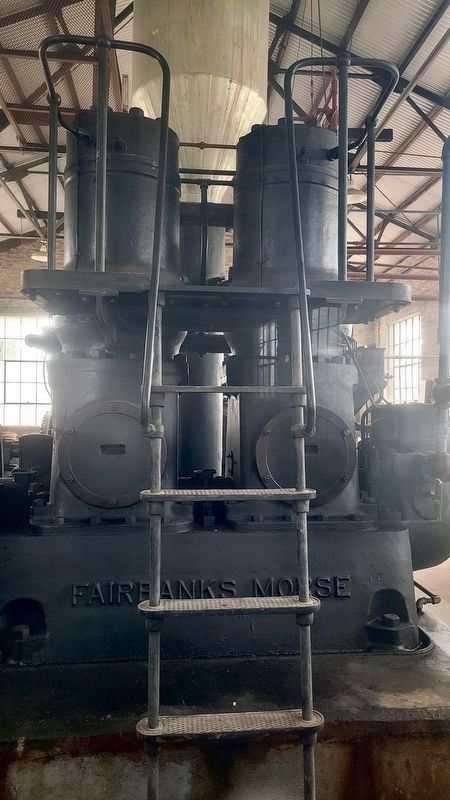
Unit Number 1 is a Fairbanks Morse Model 32E14 two-cylinder diesel engine that was installed in 1939, replacing the original 1923 engine. It produces 150 HP at 257 rpm and generates 100 KW of electricity at 2400 volts.
Unit Number 2 engine is original to the Light plant's construction in 1923. It is a Fairbanks Morse Type Y-V engine, known as a "hot plug” type engine. At the top of the cylinder is a kerosene blowtorch. Before the engine can be started, the blowtorch must heat the glow plug in front of it until it is red hot. The engine produces 50 HP at 257 rpm, generating 50 KW at 2400 volts.
Unit Number 3 is the largest engine in the plant, installed in 1930. It was brought by train and unloaded on a block of ice so it could be slid into place as the ice melted. It is a Fairbanks Morse three-cylinder Model Y that was converted into a model 32 in 1940. It produced 180 HP at 256 rpm, generating 180 KW of electricity at 2400 volts. The motor in the front of the picture is a water pump used for cooling the engines.
The switchgear controls power leaving the station. It is the control panel that monitors the generation output by connecting and disconnecting the generation using the knife blade switches. This is very early technology, and in newer generating stations, oil-filled circuit breakers were used to improve the safety of the operators.
Erected by Preserve
Photographed by James Hulse, July 29, 2024
3. Fairbanks Morse generating unit
Topics. This historical marker is listed in this topic list: Industry & Commerce. A significant historical year for this entry is 1923.
Location. 32° 26.862′ N, 97° 47.097′ W. Marker is in Granbury, Texas, in Hood County. It is at the intersection of East Ewell Street and North Brazos Street on East Ewell Street. The marker is located at the corner of the building. Touch for map. Marker is at or near this postal address: 401419 E Ewell St, Granbury TX 76048, United States of America. Touch for directions.

Regionally, this marker is in the Prairies & Lakes Region and in the Dallas-Fort Worth Metropolitan Area. Globally, it is in North America, a Gulf of Mexico state, the Western Hemisphere, the Western World, and the Anglosphere. Historically, it finds itself in what was once New Spain, the Republic of Texas, and one of the Confederate States of America.
Other nearby markers. At least 8 other markers are within walking distance of this marker: Granbury Light Plant (here, next to this marker); Granbury Railroad Depot (about 700 feet away, measured in a direct line); Granbury Cemetery (approx. 0.3 miles away); Hood County Jailhouse

Photographed by James Hulse, July 29, 2024
4. Side view of the Granbury Light Plant building
Also see . . . The Granbury Light Plant. Hood County Texas Genealogical Society
The electric utility industry had its birth in 1882 when Thomas A. Edison established the first central station in New York City.(1) By 1896, several cities and towns in Texas had operating electric light plants.(2) The town of Granbury, Texas, watched this development with great interest; however, the City Council was not prepared to enter into municipal ownership of this relatively new industry. Several attempts by the newspaper editor were made to entice private enterprise into putting forth the capital. One such attempt read, "No other town the size of Granbury with which we are acquainted is without electric lights, and most of them have water works. Granbury can have these things by a pull together."(Submitted on August 14, 2024, by James Hulse of Medina, Texas.)
Credits. This page was last revised on August 14, 2024. It was originally submitted on August 13, 2024, by James Hulse of Medina, Texas. This page has been viewed 322 times since then and 52 times this year. Photos: 1, 2, 3, 4. submitted on August 14, 2024, by James Hulse of Medina, Texas.
