Pasadena in Los Angeles County, California — The American West (Pacific Coastal)
Colonial Court
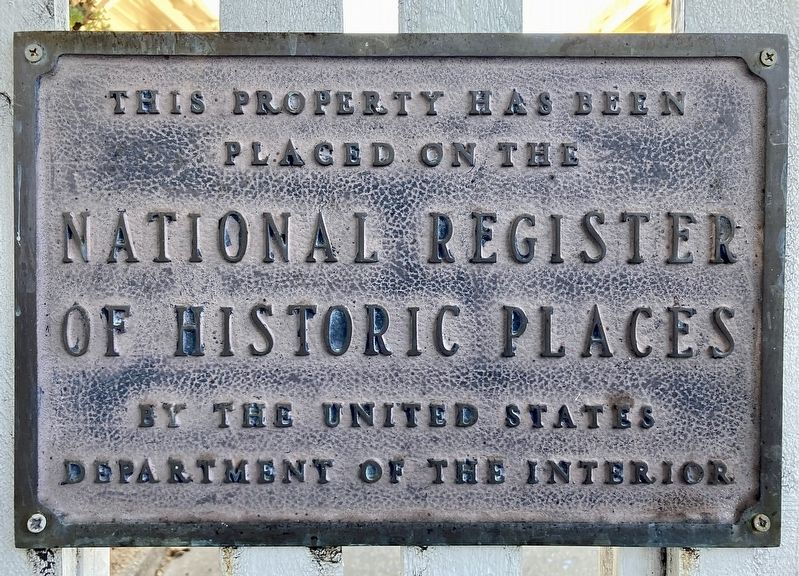
Photographed by Craig Baker, August 12, 2024
1. Colonial Court Marker
This property has been placed on the National Register of Historic Places by the United States Department of the Interior.
Erected 1983.
Topics and series. This historical marker is listed in this topic list: Architecture. In addition, it is included in the National Register of Historic Places (NRHP) series list. A significant historical year for this entry is 1916.
Location. 34° 9.063′ N, 118° 8.675′ W. Marker is in Pasadena, California, in Los Angeles County. It is at the intersection of Garfield Avenue and Corson Street, on the right when traveling south on Garfield Avenue. Touch for map. Marker is at or near this postal address: 301 Garfield Ave, Pasadena CA 91101, United States of America. Touch for directions.

Regionally, this marker is in Greater Los Angeles and in the Transverse Ranges. It is also on the American Pacific Coast. Globally, it is in North America, on the Ring of Fire, on the Pacific Rim, in the Western Hemisphere, in the Western World, and in the Anglosphere. Historically, it finds itself in what was once New Spain and also Mexico’s Alta California.
Other nearby markers. At least
this page online
Regarding Colonial Court. This bungalow court consists of six houses arranged around a narrow courtyard on 0.2 acres. The houses are designed in the Colonial Revival style and feature clapboard siding. Built in 1916, the homes were designed by architect Cyril Bennett.
The court was added to the National Register of Historic Places on July 11, 1983, NRHP reference No. 83001185.
-from Wikipedia
Bungalow courts by definition share a number of space and building relationships, such as building configuration, and focal point created by the central courtyard. These elements provided a format for bungalow court design without

Photographed by Craig Baker
2. Colonial Court Marker
First, the buildings of this high-density housing type were most often arranged in a "U"-shape, open end at the street, a result of the rectangular shape of land parcels.
Generally, courts were constructed between 1910 and 1930, although a few were built later.
Over 20 bungalow courts are nominated in this Pasadena neighborhood - Boundaries: east: Lake Avenue; north and west: Orange Grove Boulevard; south: California Boulevard.
-from NRHP Nomination.
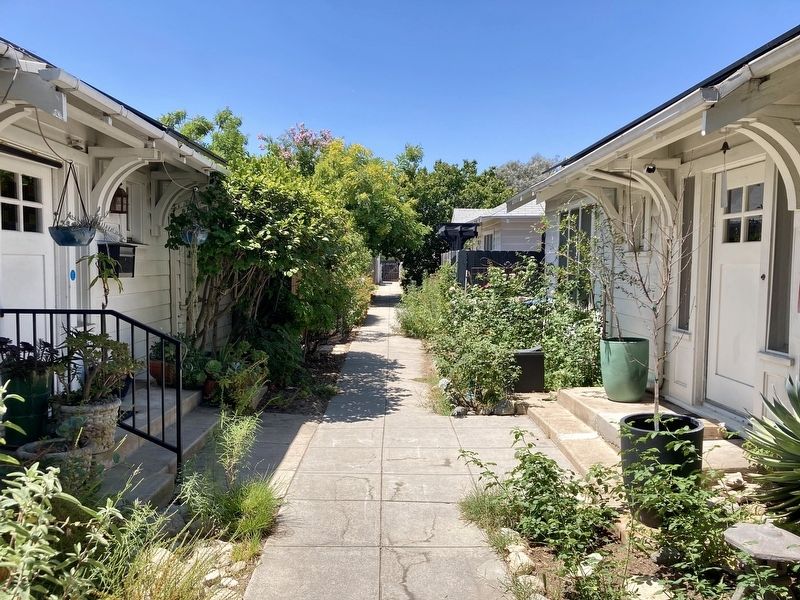
Photographed by Craig Baker, August 12, 2024
3. Colonial Court

Photographed by Craig Baker, August 12, 2024
4. Colonial Court
Credits. This page was last revised on August 14, 2024. It was originally submitted on August 13, 2024, by Craig Baker of Sylmar, California. This page has been viewed 180 times since then and 18 times this year. Photos: 1, 2, 3, 4. submitted on August 13, 2024, by Craig Baker of Sylmar, California.
