Midtown in Nashville in Davidson County, Tennessee — The American South (East South Central)
Vanderbilt University
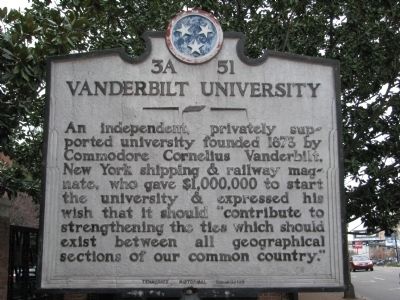
Photographed by Tom Gillard, December 11, 2009
1. Vanderbilt University Marker
Erected by Tennessee Historical Commission. (Marker Number 3A 51.)
Topics and series. This historical marker is listed in this topic list: Education. In addition, it is included in the Tennessee Historical Commission series list. A significant historical year for this entry is 1873.
Location. 36° 8.951′ N, 86° 48.2′ W. Marker is in Nashville, Tennessee, in Davidson County. It is in Midtown. It is on West End Avenue (U.S. 70 Spur), on the right. Touch for map. Marker is in this post office area: Nashville TN 37203, United States of America. Touch for directions.

Regionally, this marker is in Middle Tennessee. It is also in the American South and specifically in the Upper South. Globally, it is in North America, the Western Hemisphere, the Western World, and the Anglosphere. Historically,
this page online
Other nearby markers. At least 8 other markers are within walking distance of this marker: Cornelius Vanderbilt (within shouting distance of this marker); Governors' Mansion (about 300 feet away, measured in a direct line); The Rock Block (approx. 0.2 miles away); Vanderbilt University Gateposts (approx. 0.2 miles away); Nashville Academy of Medicine (approx. 0.2 miles away); Saint Thomas Hospital (approx. ¼ mile away); Wallace University School (approx. ¼ mile away); Vanderbilt Memorial Gymnasium (approx. 0.3 miles away). Touch for a list and map of all markers in Nashville.
Also see . . . Cornelius Vanderbilt. (Submitted on December 13, 2009, by Tom Gillard of Tullahoma, Tennessee.)
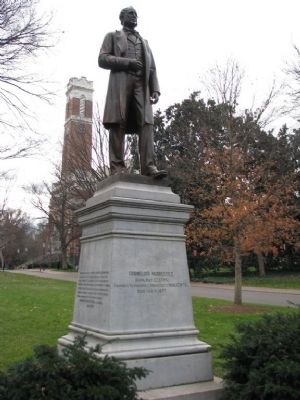
Photographed by Tom Gillard, December 11, 2009
2. Vanderbilt University
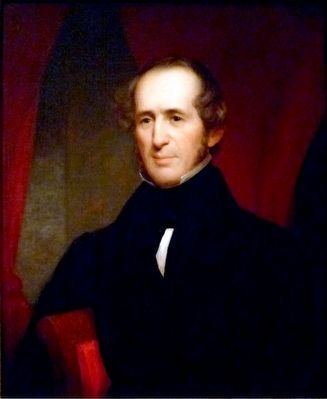
Photographed by Allen C. Browne, August 9, 2015
3. Cornelius Vanderbilt
This 1846 portrait of Cornelius Vanderbilt by Nathaniel Jocelyn hangs in the National Portrait Gallery in Washington,DC.
‘The Commodore,’ as he was dubbed for his domination of waterborne transportation, Cornelius Vanderbilt created one of the first great fortunes and business dynasties in American history. He began in the rough-and-tumble world of the New York port and by 1829 had parlayed several small shipping ventures into a stake in the lucrative Hudson River trade. He branched out to dominate the New England trade and seaborne travel to San Francisco. He next moved into railroads, eventually gaining control of the industry from New York to western Canada. Vanderbilt was a ruthless monopolist, driving out his competitors through rate wars, political muscle, and hostile takeovers. But in organizing America's fragmented transportation system, he facilitated national expansion and created the infrastructure on which an expanding economy could build.” — National Portrait Gallery
‘The Commodore,’ as he was dubbed for his domination of waterborne transportation, Cornelius Vanderbilt created one of the first great fortunes and business dynasties in American history. He began in the rough-and-tumble world of the New York port and by 1829 had parlayed several small shipping ventures into a stake in the lucrative Hudson River trade. He branched out to dominate the New England trade and seaborne travel to San Francisco. He next moved into railroads, eventually gaining control of the industry from New York to western Canada. Vanderbilt was a ruthless monopolist, driving out his competitors through rate wars, political muscle, and hostile takeovers. But in organizing America's fragmented transportation system, he facilitated national expansion and created the infrastructure on which an expanding economy could build.” — National Portrait Gallery
Credits. This page was last revised on February 7, 2023. It was originally submitted on December 13, 2009, by Tom Gillard of Tullahoma, Tennessee. This page has been viewed 1,382 times since then and 34 times this year. Photos: 1, 2. submitted on December 13, 2009, by Tom Gillard of Tullahoma, Tennessee. 3. submitted on September 26, 2015, by Allen C. Browne of Silver Spring, Maryland. • Craig Swain was the editor who published this page.
