Artesia in Eddy County, New Mexico — The American Mountains (Southwest)
Ranchers' Brands
Photographed by James Hulse, July 24, 2024
1. Ranchers' Brands Marker
Inscription.
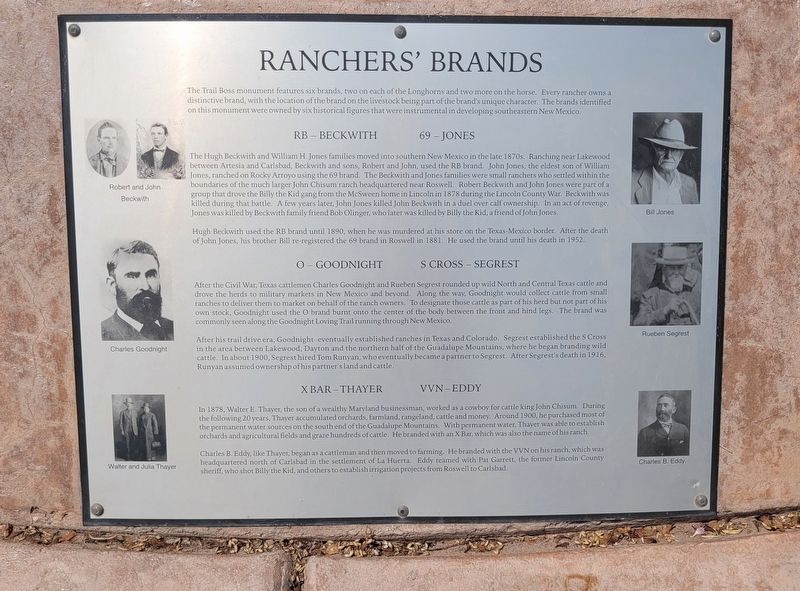
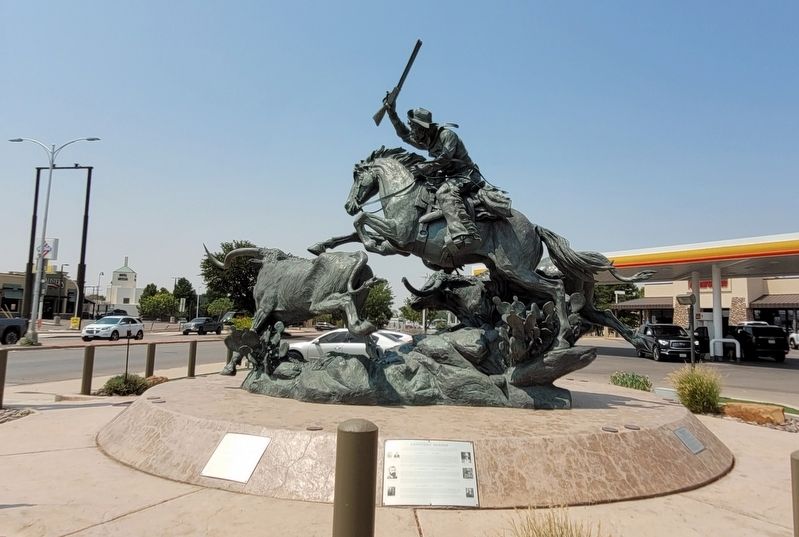
Ranchers' Brands. . The Trail Boss monument features six brands, two on each of the Longhorns and two more on the horse. Every rancher owns a distinctive brand, with the location of the brand on the livestock being part of the brand's unique character. The brands identified on this monument were owned by six historical figures that were instrumental in developing southeastern New Mexico.,
RB-Beckwith . 69-Jones. The Hugh Beckwith and William H. Jones families moved into southern New Mexico in the late 1870s. Ranching near Lakewood between Artesia and Carlsbad, Beckwith and sons, Robert and John, used the RB brand. John Jones, the eldest son of William Jones, ranched on Rocky Arroyo using the 69 brand. The Beckwith and Jones families were small ranchers who settled within the boundaries of the much larger John Chisum ranch headquartered near Roswell. Robert Beckwith and John Jones were part of a group that drove the Billy the Kid gang from the McSween home in Lincoln in 1878 during the Lincoln County War. Beckwith was killed during that battle. A few years later, John Jones killed John Beckwith in a duel over calf ownership. In an act of revenge, Jones was killed by Beckwith family friend Bob Olinger, who later was killed by Billy the Kid, a friend of John Jones., Hugh Beckwith used the RB brand until 1890, when he was murdered at his store on the Texas-Mexico border. After the death of John Jones, his brother Bill re-registered the 69 brand in Roswell in 1881. He used the brand until his death in 1952.,
O-Goodnight . S Cross-Segrest. After the Civil War, Texas cattlemen Charles Goodnight and Rueben Segrest rounded up wild North and Central Texas cattle and drove the herds to military markets in New Mexico and beyond. Along the way, Goodnight would collect cattle from small ranches to deliver them to market on behalf of the ranch owners. To designate those cattle as part of his herd but not part of his own stock, Goodnight used the O brand burnt onto the center of the body between the front and hind legs. The brand was commonly seen along the Goodnight Loving Trail running through New Mexico., After his trail drive era, Goodnight-eventually established ranches in Texas and Colorado. Segrest established the S Cross in the area between Lakewood, Dayton and the northern half of the Guadalupe Mountains, where he began branding wild cattle. In about 1900, Segrest hired Tom Runyan, who eventually became a partner to Segrest. After Segrest's death in 1916, Runyan assumed ownership of his partner's land and cattle.,
X Bar-Thayer . VVN-Eddy. In 1878, Walter E. Thayer, the son of a wealthy Maryland businessman, worked as a cowboy for cattle king John Chisum. During the following 20 years, Thayer accumulated orchards, farmland, rangeland, cattle and money. Around 1900, he purchased most of the permanent water sources on the south end of the Guadalupe Mountains. With permanent water, Thayer was able to establish orchards and agricultural fields and graze hundreds of cattle. He branded with an X Bar, which was also the name of his ranch., Charles B. Eddy, like Thayer, began as a cattleman and then moved to farming. He branded with the VVN on his ranch, which was headquartered north of Carlsbad in the settlement of La Huerta. Eddy teamed with Pat Garrett, the former Lincoln County sheriff, who shot Billy the Kid, and others to establish irrigation projects from Roswell to Carlsbad., Captions , Robert and John Beckwith , Charles Goodnight , Walter and Julia Thayer , Bill Jones , Rueben Segrest , Charles B. Eddy
The Trail Boss monument features six brands, two on each of the Longhorns and two more on the horse. Every rancher owns a distinctive brand, with the location of the brand on the livestock being part of the brand's unique character. The brands identified on this monument were owned by six historical figures that were instrumental in developing southeastern New Mexico.
RB-Beckwith 69-Jones
The Hugh Beckwith and William H. Jones families moved into southern New Mexico in the late 1870s. Ranching near Lakewood between Artesia and Carlsbad, Beckwith and sons, Robert and John, used the RB brand. John Jones, the eldest son of William Jones, ranched on Rocky Arroyo using the 69 brand. The Beckwith and Jones families were small ranchers who settled within the boundaries of the much larger John Chisum ranch headquartered near Roswell. Robert Beckwith and John Jones were part of a group that drove the Billy the Kid gang from the McSween home in Lincoln in 1878 during the Lincoln County War. Beckwith was killed during that battle. A few years later, John Jones killed John Beckwith in a duel over calf ownership. In an act of revenge, Jones was killed by Beckwith family friend Bob Olinger, who later was killed by Billy the Kid, a friend of John Jones.
Hugh Beckwith used the RB brand until 1890, when
Click or scan to see this page online
he was murdered at his store on the Texas-Mexico border. After the death of John Jones, his brother Bill re-registered the 69 brand in Roswell in 1881. He used the brand until his death in 1952.
O-Goodnight S Cross-Segrest
After the Civil War, Texas cattlemen Charles Goodnight and Rueben Segrest rounded up wild North and Central Texas cattle and drove the herds to military markets in New Mexico and beyond. Along the way, Goodnight would collect cattle from small ranches to deliver them to market on behalf of the ranch owners. To designate those cattle as part of his herd but not part of his own stock, Goodnight used the O brand burnt onto the center of the body between the front and hind legs. The brand was commonly seen along the Goodnight Loving Trail running through New Mexico.
After his trail drive era, Goodnight-eventually established ranches in Texas and Colorado. Segrest established the S Cross in the area between Lakewood, Dayton and the northern half of the Guadalupe Mountains, where he began branding wild cattle. In about 1900, Segrest hired Tom Runyan, who eventually became a partner to Segrest. After Segrest's death in 1916, Runyan assumed ownership of his partner's land and cattle.
X Bar-Thayer VVN-Eddy
In 1878, Walter E. Thayer, the son of a wealthy Maryland businessman, worked
Photographed by James Hulse, July 24, 2024
2. Ranchers' Brands Marker (center marker)
as a cowboy for cattle king John Chisum. During the following 20 years, Thayer accumulated orchards, farmland, rangeland, cattle and money. Around 1900, he purchased most of the permanent water sources on the south end of the Guadalupe Mountains. With permanent water, Thayer was able to establish orchards and agricultural fields and graze hundreds of cattle. He branded with an X Bar, which was also the name of his ranch.
Charles B. Eddy, like Thayer, began as a cattleman and then moved to farming. He branded with the VVN on his ranch, which was headquartered north of Carlsbad in the settlement of La Huerta. Eddy teamed with Pat Garrett, the former Lincoln County sheriff, who shot Billy the Kid, and others to establish irrigation projects from Roswell to Carlsbad.
Captions
Robert and John Beckwith
Charles Goodnight
Walter and Julia Thayer
Bill Jones
Rueben Segrest
Charles B. Eddy
Topics. This historical marker is listed in these topic lists: Animals • Industry & Commerce. A significant historical year for this entry is 1878.
Location. 32° 50.553′ N, 104° 23.839′ W. Marker is in Artesia, New Mexico, in Eddy County. It is at the intersection of North 1st Street (U.S. 285) and East Main Street (U.S. 82), on the right when traveling north on North 1st Street. The marker
Photographed by James Hulse, July 24, 2024
3. Closeup of the Trail Boss statue
is located along the base of the Trail Boss statue. Touch for map. Marker is at or near this postal address: 101 N 1st St, Artesia NM 88210, United States of America. Touch for directions.

Regionally, this marker is in New Mexico’s Pecos Valley. It is also in the American Southwest, on the Great Plains, on the Southern Plains, and specifically on the High Plains. Globally, it is in North America, the Western Hemisphere, the Western World, and the Anglosphere. Historically, it finds itself in what was once New Spain, the Comancherνa, and the Republic of Texas.
More about this marker. The Trail Boss statue by Vic Payne has seven plaques and markers along the base.
Credits. This page was last revised on August 19, 2024. It was originally submitted on August 19, 2024, by James Hulse of Medina, Texas. This page has been viewed 505 times since then and 72 times this year. Photos:1, 2, 3. submitted on August 19, 2024, by James Hulse of Medina, Texas.
