Lockport in Will County, Illinois — The American Midwest (Great Lakes)
Abraham Lincoln and Lockport
A Connection
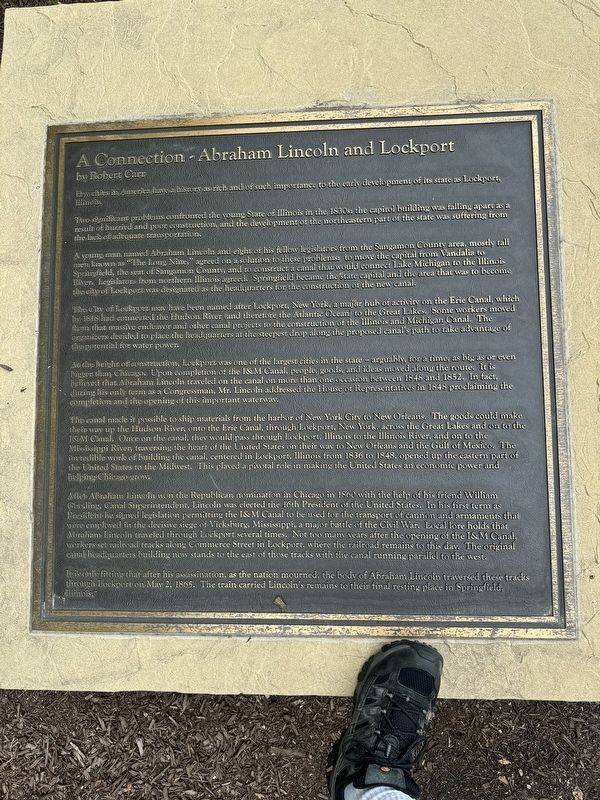
Photographed by Lou Donkle, June 8, 2024
1. Abraham Lincoln and Lockport Marker
Few cities in America lave a history as rich and of such importance to the early development of its state as Lockport, Illinois.
Two significant problems confronted the young State of Illinois in the 1830s: the capitol building was falling apart as a result of hurried and poor construction, and the development of the northeastern part of the state was suffering from the lack of adequate transportation.
A young man named Abraham Lincoln and eight of his fellow legislators from the Sangamon County area, mostly tall men known as "The Long Nine," agreed on a solution to these problems: to move the capital from Vandalia to Springfield, the seat of Sangamon County, and to construct a canal that would connect Lake Michigan to the Illinois River. Legislators from northern Illinois agreed. Springfield became the State capital and the area that was to become the city of Lockport was designated as the headquarters for the construction of the new canal.
The City of Lockport may have been named after Lockport, New York, a major hub of activity on the Erie Canal, which by 1818 had connected the Hudson River (and therefore
this page online
At the height of construction, Lockport was one of the largest cities in the state - arguably, for a time, as big as or even bigger than Chicago. Upon completion of the ISM Canal, people, goods, and ideas moved along the route. It is believed that Abraham Lincoln traveled on the canal on more than one occasion between 1848 and 1852. In fact, during his only term as a Congressman, Mr. Lincoln addressed the House of Representatives in 1848 proclaiming the completion and the opening of this important waterway.
The canal made it possible to ship materials from the harbor of New York City to New Orleans. The goods could make their way up the Hudson River, onto the Erie Canal, through Lockport, New York, across the Great Lakes and on to the ICEM Canal. Once on the canal, they would pass through Lockport, Illinois to the
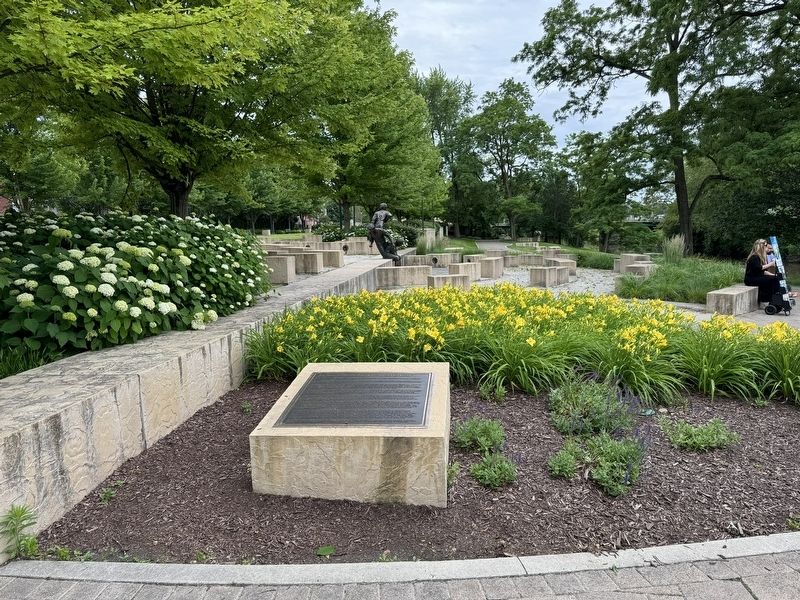
Photographed by Lou Donkle, June 8, 2024
2. Marker located within a flower bed
After Abraham Lincoln won the Republican nomination in Chicago in 1860 with the help of his friend William Gooding, Canal Superintendent, Lincoln was elected the 16th President of the United States. In his first term as President he signed legislation permitting the ISM Canal to be used for the transport of cannon and armaments that were employed in the decisive siege of Vicksburg, Mississippi, a major battle of the Civil War. Local lore holds that Abraham Lincoln traveled through Lockport several times. Not too many years after the opening of the ISM Canal, workers set railroad tracks along Commerce Street in Lockport, where the railroad remains to this day. The original canal headquarters building now stands to the east of those tracks with the canal running parallel to the west.
It is only fitting that after his assassination, as the nation mourned, the body of Abraham Lincoln traversed these tracks Illinois," through Lockport on May 2, 1865. The train carried Lincoln's remains to their final resting place in Springfield.
by Robert Carr
Topics. This historical marker is listed in these topic lists: Bridges & Viaducts • Government & Politics • Industry & Commerce • Settlements & Settlers. A significant historical date for this entry is May 2, 1865.
Location. 41° 35.442′ N, 88° 3.493′ W. Marker is in Lockport, Illinois, in Will County. It can be reached from West 8th Street just west of Commerce Street, on the left when traveling west. The marker is in Lincoln Landing Park. Touch for map. Marker is at or near this postal address: 801 Commerce St, Lockport IL 60441, United States of America. Touch for directions.

Regionally, this marker is in Greater Chicago. It is also in the American Midwest. Globally, it is in North America, on the Great Lakes, in the Western Hemisphere, in the Western World, and in the Anglosphere. Historically, it finds itself in what was once the territory of the Mississippian Culture and also the Northwest Territory.
Other nearby markers. At least 8 other markers are within walking distance of this marker: "Whittling Their Time Away" (here, next to this marker); William Schuler (a few steps from this marker); Abraham Lincoln (a few steps from this marker); George Gaylord (within shouting distance of this marker); Gaylord Donnelly Canal Trail Mile Marker 29.1 (within shouting distance of this marker); Illinois & Michigan Canal Office (about 300 feet away, measured in a direct line); Historic Lockport (approx. 0.2 miles away); The Norton Building (approx. 0.2 miles away). Touch for a list and map of all markers in Lockport.
Credits. This page was last revised on August 21, 2024. It was originally submitted on August 19, 2024, by Lou Donkle of Valparaiso, Indiana. This page has been viewed 447 times since then and 144 times this year. Photos: 1, 2. submitted on August 19, 2024, by Lou Donkle of Valparaiso, Indiana. • Devry Becker Jones was the editor who published this page.
