Lackland Air Force Base in Bexar County, Texas — The American South (West South Central)
Hero Sentry Dog: Nemo A534
United States Air Force Sentry Dog
| — | (1964-1972) | — |
Photographed by James Hulse, August 16, 2024
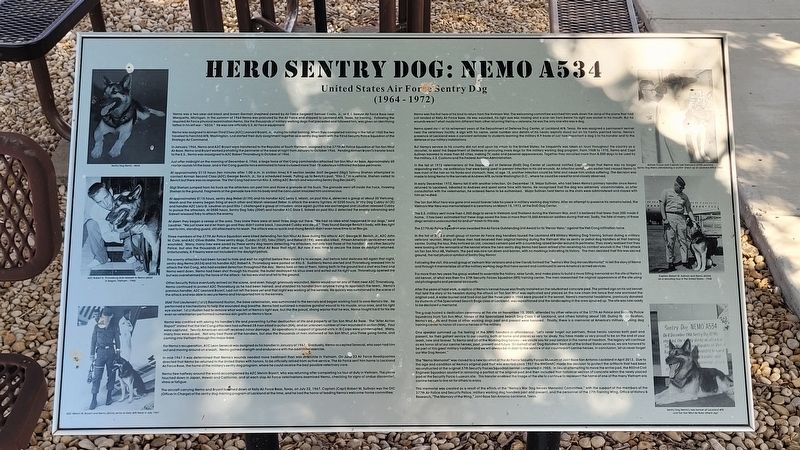
1. Hero Sentry Dog: Nemo A534 Marker
Nemo was assigned to Airman Third Class (A3C) Leonard Bryant, Jr., during his initial training. When they completed training in the fall of 1965 the two traveled to Fairchild AFB, Washington, and started their duty assignment together as a sentry dog team with the 92nd Security Police Squadron of the Strategic Air Command.
In January 1966, Nemo and A3C Bryant were transferred to the Republic of South Vietnam, assigned to the 377th Air Police Squadron at Tan Son Nhut Air Base. Nemo and Bryant worked patrolling the perimeter of the base at night from January to October 1966. Pending Airman Bryant's transfer back to the
this page online
Just after midnight on the morning of December 4, 1966, a large force of Viet Cong commandos attacked Tan Son Nhut Air Base. Approximately 60 mortar rounds hit the base, and a Viet Cong guerilla force estimated to have included more than 75 saboteurs infiltrated the base perimeter.
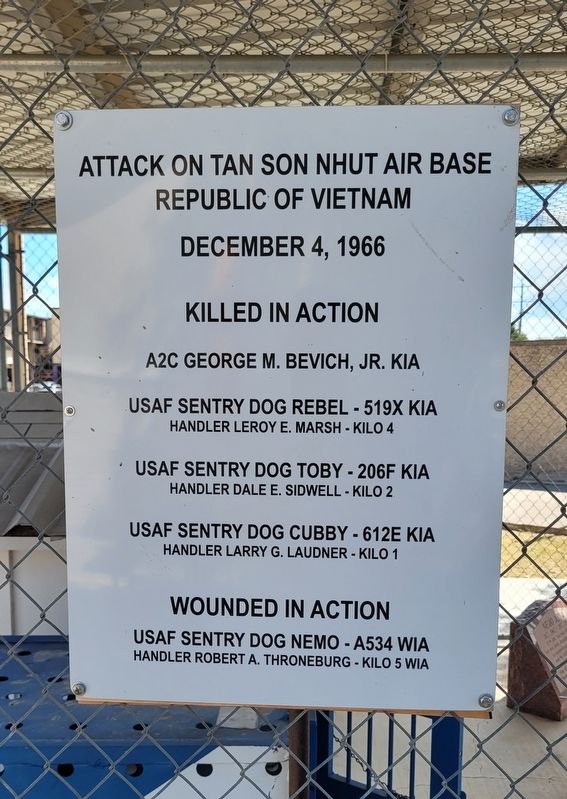
At approximately 0110 hours (ten minutes after 1:00 a.m. in civilian time) K-9 section leader Staff Sergeant (SSgt) Tommy Shehan attempted to contact Airman Second Class (A2C) George Bevich, Jr., for a scheduled break. Pulling up to Bevich's post, "Kilo-3," in a vehicle, Shehan called to Bevich but there was no response. The Viet Cong had overrun Kilo-3, killing A2C Bevich and wounding Sentry Dog Rex (664F).
SSgt Shehan jumped from his truck as the attackers ran past him and threw a grenade at the truck. The grenade went off inside the truck, throwing Shehan to the ground. Fragments of the grenade tore into his body and the concussion knocked him unconscious.
At approximately 0115 hours, sentry dog Rebel (519X) and his handler A2C Leroy E. Marsh, on post Kilo-4, detected a
Photographed by James Hulse, August 16, 2024
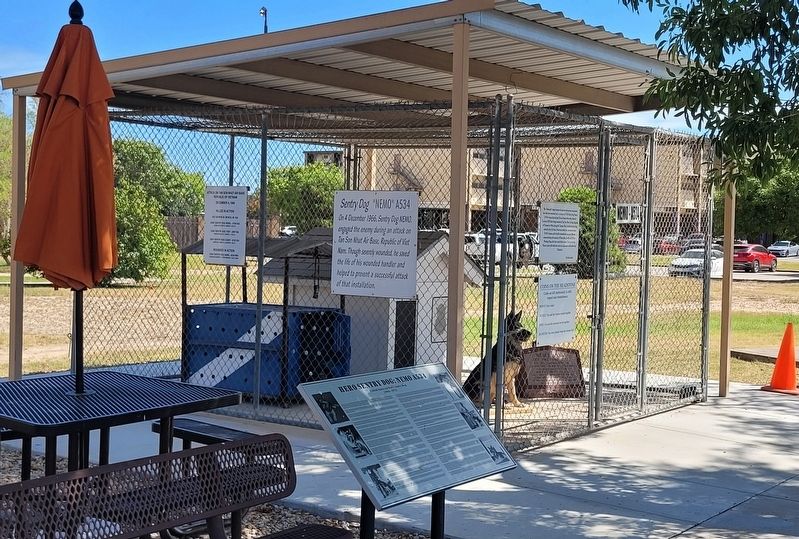
2. Hero Sentry Dog: Nemo A534 Memorial and Marker
At dawn they began a sweep of the area. They knew there were at least three dogs out there. "We had no idea what happened to our dogs," said Laudner. "We just knew we'd let them go and they didn't come back. I assumed Cubby was dead." They found George Bevich's body, with Rex right next to him, standing guard, still attached to his leash. The attack was so quick and strong Bevich didn't even have time to let Rex go.
Three members of the 377th Air Police Squadron were killed defending Tan Son Nhut Air Base during this attack: A2C George M. Bevich, Jr., A2C John M. Cole, and A2C Oliver Riddle. Three sentry dogs, Cubby (612E), Toby (206F), and
Photographed by James Hulse, August 16, 2024
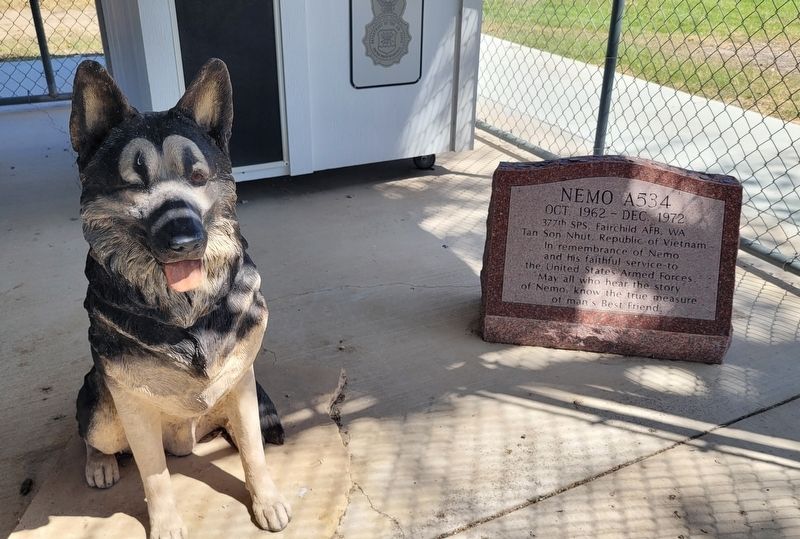
3. Closeup of the Hero Sentry Dog: Nemo A534 Memorial
The enemy attackers had been forced to hide and wait for nightfall before they could try to escape. Just before total darkness fell again that night, sentry dog Nemo (A534) and his handler A2C Robert A. Throneburg were posted on Kilo-5. Suddenly Nemo alerted and Throneburg released him to attack the Viet Cong, who had evaded detection throughout the day. Nemo took on two of them, taking both to the ground but a shot was fired and Nemo went down. Nemo had been shot through his muzzle; the bullet destroyed his sinus area and exited out his right eye. Throneburg opened fire but was overwhelmed by the force of the attack - he too was shot and fell to the ground.
Other Security Police eventually arrived on the scene, and even
Photographed by James Hulse, August 16, 2024
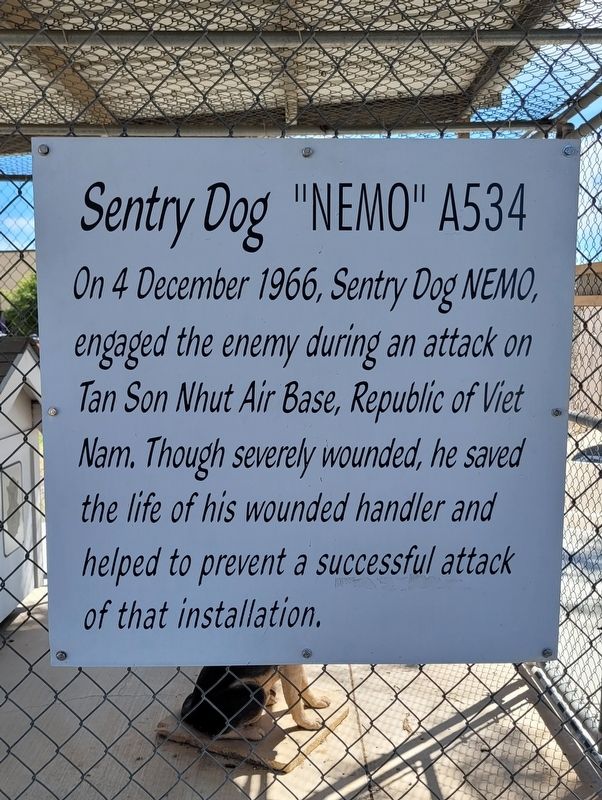
4. Hero Sentry Dog: Nemo A534 - Second Marker
USAF First Lieutenant (1st Lt) Raymond Huston, the base veterinarian, was summoned to the kennels and began working hard to save Nemo's life. He performed a tracheotomy to help the wounded dog breathe. Nemo had sustained a massive gunshot wound to his muzzle, sinus area, and his right eye socket. 1st Lt Huston had to remove what was left of Nemo's right eye, but like the proud, strong warrior that he was, Nemo fought hard for his life even as veterinarian performed numerous skin grafts on Nemo's face.
Nemo was credited with saving his handler's life and preventing further destruction of life and property at Tan Son Nhut Air Base. The "After Action Report" stated that the Viet Cong attackers had suffered
Photographed by James Hulse, August 16, 2024
5. List of others killed in the attack
For Nemo's recuperation, A1C Leon Senecal was assigned as his handler in January of 1967. Gradually, Nemo accepted Senecal, who soon had him out and moving around on a leash. Nemo gained strength and endurance with the additional exercise.
In mid-1967 it was determined that Nemo's wounds needed more treatment than was available in Vietnam. On June 23 Air Force Headquarters directed that Nemo be returned to the United States with honors, to be officially retired from active service. The Air Force sent him home to Lackland Air Force Base, the home of the military's sentry dog program, where he could receive the best possible veterinary care.
Nemo flew halfway around the world accompanied by A2C Melvin Bryant, who
Photographed by James Hulse, August 16, 2024
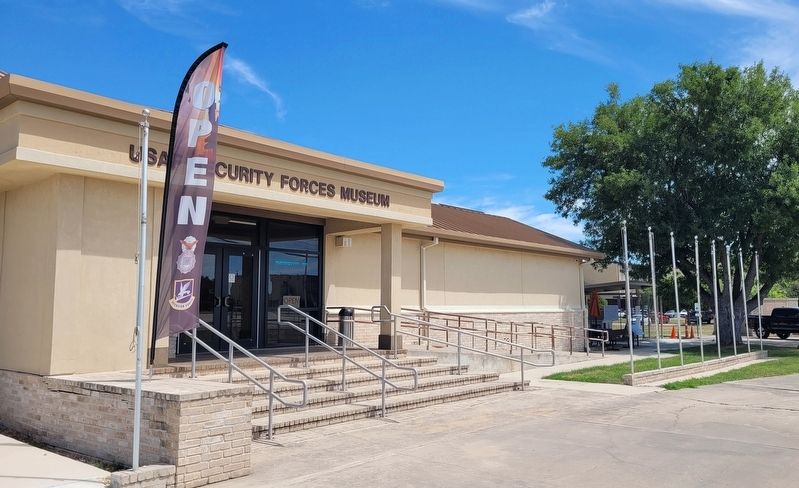
6. Hero Sentry Dog: Nemo A534 Memorial (Right side)
The Hero Sentry Dog: Nemo A534 Memorial and Marker are located next to the USAF Security Forces Museum
The aircraft carrying Nemo and Bryant toughed down at Kelly Air Force Base, Texas, on July 22, 1967. Captain (Capt) Robert M. Sullivan was the OIC (Officer In Charge) of the sentry dog-training program at Lackland at the time, and he had the honor of leading Nemo's welcome-home committee.
Nemo was the first hero of his kind to return from the Vietnam War. The welcoming committee watched him walk down the ramp of the plane that had just landed at Kelly Air Force Base. He was wounded, his right eye was missing and a scar ran from below his right eye socket to his mouth. But his wounds weren't what made him different from other returning Vietnam veterans; he was the only one who was a dog.
Nemo spent most of his retirement years at the Department of Defense Dog Center, at Lackland AFB, Texas. He was assigned a permanent kennel near the veterinary facility. A sign with his name, serial number and details of his heroic exploits stood out on his freshly painted home. Nemo's presence at Lackland were a constant reminder to students learning the military K-9 trade of just how important a dog is to his handler and to the defense of our military installations.
But Nemo's service to his country did not end upon his return to the United States; he frequently was taken on tours throughout the country as a recruiter, to assist the Department of Defense in procuring more dogs for the military working dog program. From 1968 to 1970, Nemo and Capt Sullivan traveled to more than 50 cities, making TV, radio and personal appearances. Together they recruited more than 8,000 dogs to be used by the military, U.S. Customs and the Federal Aviation Administration.
In the fall of 1972 veterinarians at the Department of Defense (DoD) Dog Center at Lackland notified Capt.Sullivan that Nemo was no longer responding well to the antibiotics that were being used to prevent infection in his old wounds. An infection some years earlier had caused Nemo to lose most of the hair on his flanks and stomach. Now, at age 10, another infection could be fatal and cause him undue suffering. The decision was made to bring Nemo to the kennels at Andrews AFB, outside Washington D.C., where he could be cared for and closely observed.
In early December 1972, Nemo fell ill with another infection. On December 18, Major Sullivan, who had been Nemo's primary handler since Nemo returned to Lackland, travelled to Andrews and spent some time with Nemo, He recognized that the dog was extremely uncomfortable, so after consultation with the veterinarian, he ordered Nemo to be euthanized. Major Sullivan held Nemo as the shots were administered and stayed with him as he died.
The Tan Son Nhut hero was gone and would forever take his place in military working dog history. After an attempt to preserve his remains failed, the Vietnam War Hero was memorialized in a ceremony on March 15, 1973, at the DoD Dog Center.
The U.S. military sent more than 4,000 dogs to serve in Vietnam and Thailand during the Vietnam War, and it is believed that fewer than 200 made it home. It has been estimated that these dogs saved the lives of more than 10,000 American soldiers during that war. Sadly, the fate of many of these dogs remains unaccounted for and unknown to this day.
The 377th Air Police Squadron was awarded the Air Force Outstanding Unit Award for its "Heroic Valor," against the Viet Cong infiltration force.
In the fall of 2003 a small group of former Air Force dog handlers toured the Lackland AFB Military Working Dog Training School during a military veterans' reunion. Many of these men had received their original training during the Vietnam War as sentry or patrol dog handlers at that training center. During the tour, they noticed an old, cracked cement pad with a crumbling raised border around its perimeter. They slowly realized that they were looking at the remnants of the kennel where the hero sentry dog Nemo had been retired after receiving his combat wounds in the 1966 attack on Tan Son Nhut AB, Vietnam. The pad was now run down and barren, with no markings indicating its history. The men decided that this was sacred ground, the last physical symbol of Sentry Dog Nemo!
Following the visit, this small group of Vietnam War veterans and a few friends formed the "Nemo's War Dog Heroes Memorial" to tell the story of Nemo and through it memorialize all of the military working dogs that have served and continued to serve America's armed services.
For more than two years the group worked to assemble the history, raise funds, and make plans to build a more fitting memorial on the site of Nemo's old kennel, at what was then the 37th Security Forces Squadron (SFS) training center. The men researched the original appearance of the site using old photographs and personal accounts.
After the years of hard work, a replica of Nemo's kennel house was finally installed on the refurbished concrete pad. The printed sign on his old kennel that told the story of his heroism during the attack on Tan Son Nhut was replicated and placed on the new chain link fence that now enclosed the original pad. A water bucket and food pan just like those used in 1966 were placed in the kennel. Nemo's memorial headstone, previously donated by students of the Specialized Search Dogs class at Lackland, was repositioned and the landscaping in the area spruced up. The site was now ready to be declared a memorial.
The group hosted a dedication ceremony at the site on November 15, 2005, attended by other veterans of the 377th Air Police and Security Police Squadrons from Tan Son Nhut, troops of the Specialized Search Dog Class II at Lackland, and others totaling about 100. During the dedication, Nemo's exploits and those of other working dogs past and present were honored. Finally, there is a memorial at America's military working dog training center to honor all canine heroes of the military.
One speaker summed up the feeling of the MWD handlers in attendance: "Let's never forget our partners, those heroic canines both past and present, for their gallant service to our country, both at home and places so very far away. You have made us very proud to be on the end of your leash, now and forever. To Nemo and all of the Working Dog heroes - we salute you for your service in the name of freedom. The legacy will continue as we honor all of our canine heroes, past, present and future. On behalf of all 'Dog Handlers' from all of the United States services, we are honored to be part of this great military tradition and we will always be in debt to the service of our counterpart canine heroes. In conclusion, let us never forget our War Dog Heroes."
The "Nemo Memorial" was moved to a new location at the Air Force Security Forces Museum at Joint Base San Antonio-Lackland in April 2013. Due to the age and condition of Nemo's original pad that was erected circa 1967 the NWDHMC made the decision to protect the artifacts that had been reconstructed at the original 37th Security Forces Squadron kennel completed in 2005. In lieu of attempting to move the entire pad, the 802nd Civil Engineer Squadron assisted in removing a portion of the original pad and then included that historical section of concrete within the newly placed pad at the Security Force museum site. This transfer enabled the linage of the site to continue to represent the home of one of the many Vietnam era canine heroes to live on for others to enjoy.
This memorial was created as a result of the efforts of the "Nemo's War Dog Heroes Memorial Committee," with the support of the members of the 377th Air Police and Security Police, military working dog handlers past and present, and the personnel of the 37th Training Wing, Office of History & Research, "The Memory of the Wing," Joint Base San Antonio-Lackland, Texas.
Captions
Sentry Dog Nemo - A534
A2C Robert A. Throneburg bids farewell to Nemo (A534)in Siagon, Vietnam - 1966
A2C Melvin W. Bryant and Nemo (A534) arrive at Kelly AFB Texas in July 1967
Airman Crover and Captain Lee Townsend (DVM) examine entry Dog Nemo (A534) during a routine check up at Lackland AFB in 1968.
Captain Robert M. Sullivan and Nemo (A534) on a recruiting tour in the United States - 1968
Sentry Dog Nemo's new kennel at Lackland AFB and Tan Son Nhut Air Base attack sign
Erected by Nemo's War Dog Heroes Memorial Committee.
Topics. This historical marker is listed in these topic lists: Animals • War, Vietnam. A significant historical month for this entry is January 1966.
Location. 29° 23.451′ N, 98° 37.941′ W. Marker is in Lackland Air Force Base, Texas, in Bexar County. It is at the intersection of Femoyer Street and Metzger Drive, on the right when traveling west on Femoyer Street. The marker is located next to the USAF Security Forces Museum. Touch for map. Marker is at or near this postal address: 1300 Femoyer St, Jbsa Lackland TX 78236, United States of America. Touch for directions.

Regionally, this marker is in South Texas and in the San Antonio Metropolitan Area. It is also in the American South. Globally, it is in North America, a Gulf of Mexico state, the Western Hemisphere, the Western World, and the Anglosphere. Historically, it finds itself in what was once New Spain, the Republic of Texas, and one of the Confederate States of America.
Other nearby markers. At least 8 other markers are within walking distance of this marker: Vought A-7D "Corsair II" (approx. 0.6 miles away); A-10A "Thunderbolt II" (approx. 0.6 miles away); F-16 "Fighting Falcon" (approx. 0.7 miles away); F-15 "Eagle" (approx. 0.7 miles away); P-38L "Lightning" (approx. 0.7 miles away); Chief Master Sgt. Lynn Steincamp (approx. 0.7 miles away); C-131A (T-29B) "Samaritan" (approx. 0.7 miles away); T-28 "Trojan" (approx. 0.7 miles away). Touch for a list and map of all markers in Lackland Air Force Base.
More about this marker. The marker, museum and air park are located on the Lackland Air Force Base, an active U.S. military installation which is a part of the Joint Base San Antonio (JBSA). The USAF Airman Heritage Museum, USAF Security Forces Museum and Air Park are open to the public, but appropriate identification is required for access. Visit the museum’s web site for current details on visiting the museum and air park.
Also see . . .
1. Airmen Heritage Training Complex. USAF Airman Heritage Museum (Submitted on August 22, 2024, by James Hulse of Medina, Texas.)
2. Museum. Security Forces Museum Foundation
This museum is the only USAF Career Field specific museum in the world and tells the Military Police, Air Police, Security Police and Security Forces historiography. The museum’s archival repository contains historical documents, photographs, films, videos, audio tapes, magazines, newspapers and military memorabilia. Through both static and dynamic displays it tells the history of the Security Forces career field and its evolution from 1947 to today.(Submitted on August 23, 2024, by James Hulse of Medina, Texas.)
Credits. This page was last revised on August 23, 2024. It was originally submitted on August 20, 2024, by James Hulse of Medina, Texas. This page has been viewed 1,175 times since then and 262 times this year. Photos: 1, 2, 3, 4, 5, 6. submitted on August 23, 2024, by James Hulse of Medina, Texas.
