Palmer in Matanuska-Susitna Borough, Alaska — Northwest (North America)
Engine #5
Photographed by William Fischer, Jr., August 12, 2024
1. Engine #5 Marker
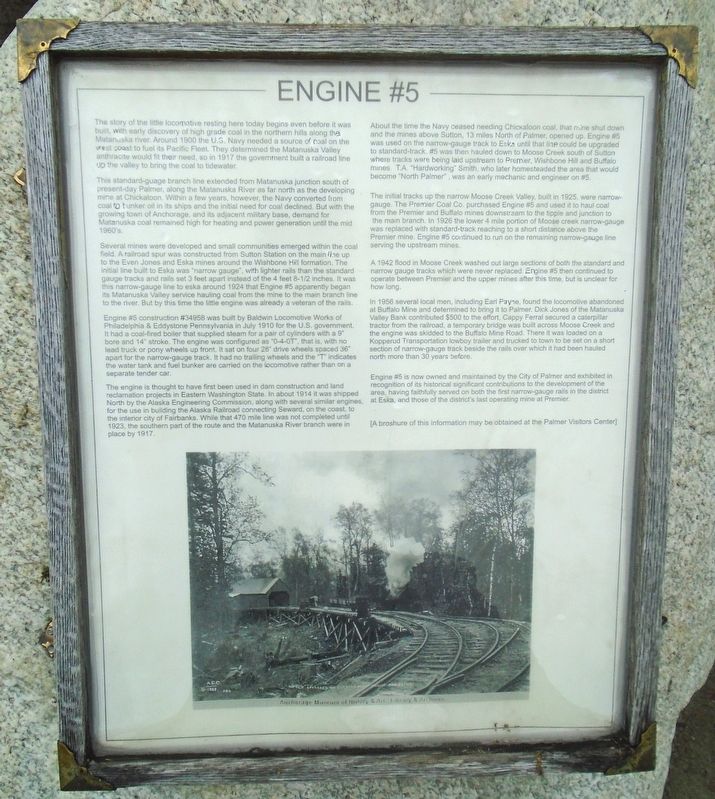
The story of the little locomotive resting here today begins even before it was built, with early discovery of high grade coal in the northern hills along the Matanuska river. Around 1900 the U.S. Navy needed a source of coal on the west coast to fuel its Pacific Fleet. They determined the Matanuska Valley anthracite would fit their need, so in 1917 the government built a railroad line up the valley to bring the coal to tidewater.
This standard-g[au]ge branch line extended from Matanuska junction south of present-day Palmer, along the Matanuska River as far north as the developing mine at Chickaloon. Within a few years, however, the Navy converted from coal to bunker oil in its ships and the initial need for coal declined. But with the growing town of Anchorage, and its adjacent military base, demand for Matanuska coal remained high for heating and power generation until the mid 1960's.
Several mines were developed and small communities emerged within the coal field. A railroad spur was constructed from Sutton Station on the main line up to the Even Jones and Eska mines around the Wishbone Hill formation.
this page online
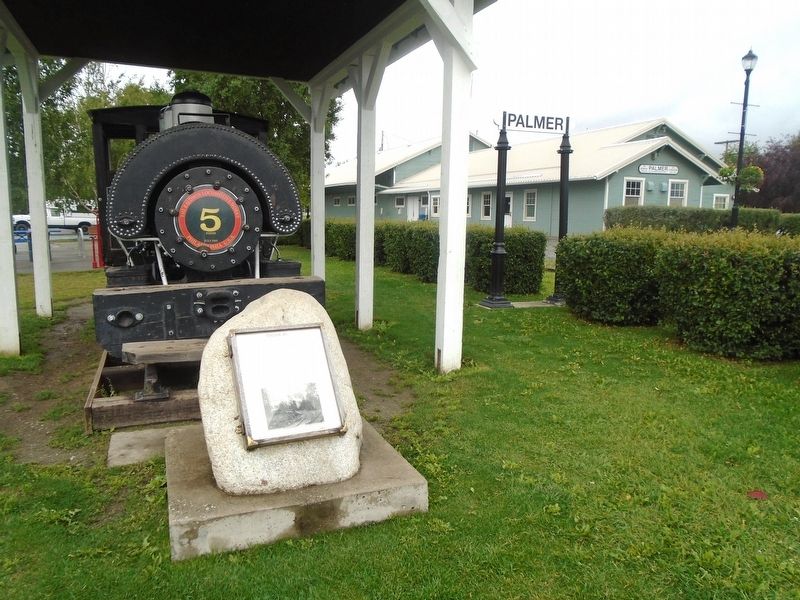
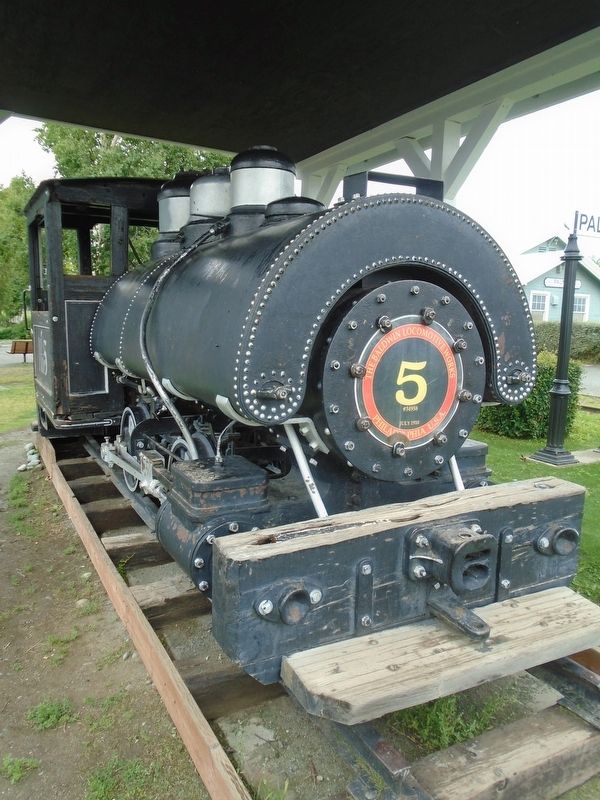
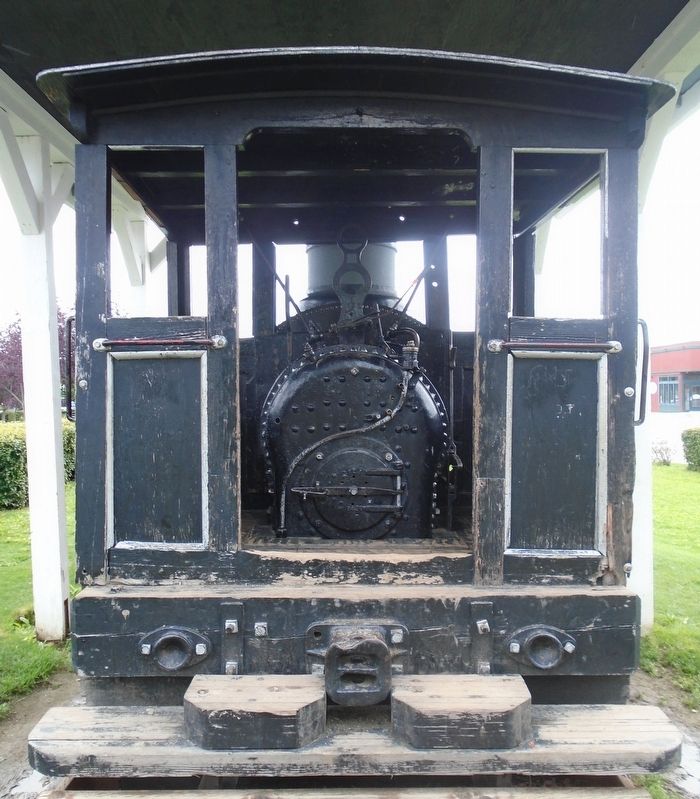
Engine #5 construction #34958 was built by Baldwin Locomotive Works of Philadelphia & Eddystone Pennsylvania in July 1910 for the U.S. government. It had a coal-fired boiler that supplied steam for a pair of cylinders with a 9" bore and 14" stroke. The engine was configured as "0-4-0T", that is, with no lead truck or pony wheels up front. It sat on four 28" drive wheels spaced 36" apart for the narrow-gauge track. It had no trailing wheels and the "T" indicates the water tank and fuel bunker are carried on the locomotive rather than on a separate tender car.
The engine is thought to have first been used in dam construction and land reclamation projects in Eastern Washington State. In about 1914 it was shipped North
Photographed by William Fischer, Jr., August 12, 2024
2. Engine #5 Marker
About the time the Navy ceased needing Chickaloon coal, that mine shut down and the mines above Sutton, 13 miles North of Palmer, opened up. Engine #5 was used on the narrow-gauge track to Eska until that line could be upgraded to standard-track. # 5 was then hauled down to Moose Creek south of Sutton where tracks were being laid upstream to Premier, Wishbone Hill and Buffalo mines. T.A. "Hardworking” Smith, who later homesteaded the area that would become "North Palmer", was an early mechanic and engineer on #5.
The initial tracks up the narrow Moose Creek Valley, built in 1925, were narrow-gauge. The Premier Coal Co. purchased Engine #5 and used it to haul coal from the Premier and Buffalo mines downstream to the tipple and junction to the main branch. In 1926 the lower 4 mile portion of Moose creek
Photographed by William Fischer, Jr., August 12, 2024
3. Engine #5
A 1942 flood in Moose Creek washed out large sections of both the standard and narrow gauge tracks which were never replaced. Engine #5 then continued to operate between Premier and the upper mines after this time, but is unclear for how long.
In 1956 several local men, including Earl Payne, found the locomotive abandoned at Buffalo Mine and determined to bring it to Palmer. Dick Jones of the Matanuska Valley Bank contributed $500 to the effort, Cappy Ferral secured a caterpillar tractor from the railroad, a temporary bridge was built across Moose Creek and the engine was skidded to the Buffalo Mine Road. There it was loaded on a Kopperud Transportation lowboy trailer and trucked to town to be set on a short section of narrow-gauge track beside the rails over which it had been hauled north more than 30 years before.
Engine #5 is now owned and maintained by the City of Palmer and exhibited in recognition of its historical significant

Photographed by William Fischer, Jr., August 12, 2024
4. Engine #5
[A brochure of this information may be obtained at the Palmer Visitors Center]
Erected by the City of Palmer.
Topics. This historical marker is listed in these topic lists: Industry & Commerce • Railroads & Streetcars. A significant historical month for this entry is July 1910.
Location. 61° 35.98′ N, 149° 6.849′ W. Marker is in Palmer, Alaska, in Matanuska-Susitna Borough. It is at the intersection of Alaska Street and Evergreen Avenue, on the right when traveling north on Alaska Street. Marker and locomotive are located in Colony Park, adjacent west of the former rail depot (now Community Center). Touch for map. Marker is at or near this postal address: 429 W Evergreen Ave, Palmer AK 99645, United States of America. Touch for directions.

Regionally, this marker is in the Alaska Railroad Corridor, in the Athabascan Region, in the Mat-Su Valley, and in Southcentral Alaska. It is also on the American Pacific Coast. Globally, it is
Photographed by William Fischer, Jr., August 12, 2024
5. Engine #5 Cab
Other nearby markers. At least 8 other markers are within walking distance of this marker: Colony Park (within shouting distance of this marker); Balto (about 400 feet away, measured in a direct line); Saroma-Cho, Japan and Palmer, Alaska (about 400 feet away); a little town with BIG PLANS (about 400 feet away); Land of Giants (about 500 feet away); a Great Place to Call Home (about 500 feet away); Matanuska Colony Project (about 500 feet away); a different marker also named Matanuska Colony Project (about 500 feet away). Touch for a list and map of all markers in Palmer.
Also see . . . Chronicle of Alaska Coal Mining History (Merritt, 1986). (Submitted on August 21, 2024, by William Fischer, Jr. of Reynoldsburg, Ohio.)
Credits. This page was last revised on August 21, 2024. It was originally submitted on August 21, 2024, by William Fischer, Jr. of Reynoldsburg, Ohio. This page has been viewed 314 times since then and 54 times this year. Photos: 1, 2, 3, 4, 5. submitted on August 21, 2024, by William Fischer, Jr. of Reynoldsburg, Ohio.
