D.N HaNegev Moshav Nevatim in Be'er Sheva, Southern District, Israel — West Asia (the Levant in the Middle East)
Maharaja Jam Sahib of Nawanagar
Sir Digvijaysinhji Ranjitsinhji Jadeja
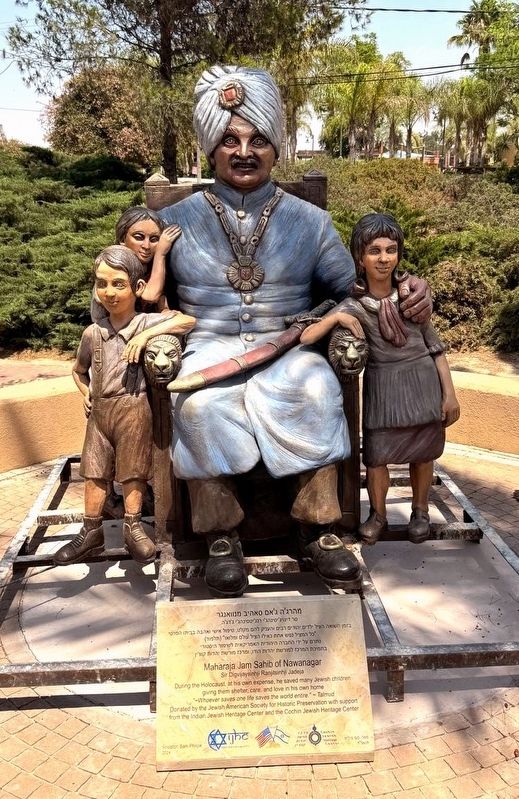
Photographed by Jerry Klinger
1. Jam Sahib Marker
(Hebrew text not transcribed)
During the Holocaust, at his own expense, he saved many Jewish children giving them shelter, care, and love in his own home
"-Whoever saves one life saves the world entire." ~ Talmud
Erected 2024 by Jewish American Society for Historic Preservation, Indian Jewish Heritage Center, Cochin Jewish Heritage Center.
Topics and series. This memorial is listed in these topic lists: Heroes • War, World II. In addition, it is included in the Jewish American Society for Historic Preservation., and the The Holocaust series lists.
Location. 31° 13.274′ N, 34° 53.195′ E. Memorial is in Nevatim, Southern District, in Be'er Sheva. It is in D.N HaNegev Moshav Nevatim. It can be reached from Meshek Nevatim Street. Marker is located opposite the entrance to the museum of the Indian Jewish Heritage Center in Nevatim, Israel. Touch for map. Memorial is in this post office area: Nevatim, Southern District 85540, Israel. Touch for directions.

Regionally, it is in Asia, specifically in West Asia, in the Middle East, in The Levant, on the Red Sea, in a coastal Mediterranean country, and in the Western World. Historically, it finds itself in what was once the Byzantine Empire, the Ottoman Empire, a British Mandate, and the Roman Empire.
Other nearby markers. At least 2 other markers are within 23 kilometers of this marker, measured as the crow flies: Palmach Negev Brigade Memorial (approx. 8 kilometers away); Lion's Trail - Dimona (approx. 21.8 kilometers away).
More about this memorial. The Indian Jewish Heritage and Cultural Center in Israel interprets and preserves the rich and unique 2000-year-old heritage of the Indian Jews. The Bene Israel, Cochini, Baghdadi, and Bnei Menashe communities each have their own unique
this page online
Regarding Maharaja Jam Sahib of Nawanagar. The marker/interpretive sculpture is the first in Israel to honor "Jam Sahib" for his humanitarian efforts to save Jewish children during the Holocaust.
During World War II many Polish refugees escaping Nazism sought safety in India. Hundreds of Polish children, Catholics, and Jews were sheltered by the Maharaja in his own home and at his own expense. The Maharaja's motivation, as a Hindu, was to save human life. The Jewish children, who were interspersed in the Polish groups to rescue them from the Holocaust and their deliberate murder by the Nazis and their sympathizers, were strictly warned to keep their Jewish heritages secret. They kept their heritage a secret, blending in as Poles.
After the War, some of the Jewish children settled in Israel and began to tell the story of their rescue by the Maharaja. Academic research and documentation are, after a long delay, underway.
The memorial was sculpted by Sam Philipe.
Also see . . .
1. How the ‘Indian Oskar Schindler’ took in 1,000 Polish children during WWII. Documentary ‘Little Poland in India’

circa 1944
2. Jam Sahib at a Christmas Pagent
Orphaned Polish children — Jews and Catholics alike — faced an uncertain future, but in the midst of the gloom a ray of hope appeared when a kindhearted Maharaja (member of Indian nobility) in a princely state in Gujarat agreed to accept the Polish children and look after them.(Submitted on August 22, 2024, by Jerry Klinger of Boynton Beach, Florida.)
2. An exceptional man in extraordinary times: Jam Saheb Digvijaysinhji of Nawanagar. (Submitted on August 22, 2024, by Jerry Klinger of Boynton Beach, Florida.)
3. Jam Sahib and the Jewish Children of the Holocaust.
They called Jam Sahib, the “Good” Maharaja. Jam Sahib is much easier for me than trying to pronounce his Indian name, Jam Sahib Digvijaysinhji Ranjitsinhji Jadeja.(Submitted on September 8, 2024, by Jerry Klinger of Boynton Beach, Florida.)
"He was Maharaja of Nawanagar from 1933 to 1966, North Western India. Jam Sahib personally saved over 1,000 Polish refugee children. He supported them. He sheltered them. He loved them. He opened his own house and funded them himself. He educated them in Polish language, culture, patriotism, and with the help of Polish Priests, Catholicism.
He asked the children, many of whom were orphans, to call him Bapu – Father. He became their father and their protector.
...What was never recognized was the fact that there were Jewish children among the Polish refugee children Jam Sahib saved. Historians have little to say on the subject. Without a doubt, many of the children who were old enough to understand were sternly warned to never, ever reveal you are Jewish as their parents kissed them a last goodbye. The Priests, to their credit, never singled out the Jews. Nor did the Priests come to Jam Sahib and ask for special help for the Jewish children. Jewish history and community in India is substantial. It is over two thousand years old."
4. Israel remembers the Good Maharaja who saved children in World War-II. The "Pioneer" is one of India's largest English-language newspapers. It was established in 1865.
A statue of Maharaja Digvijaysinhji Ranjitsinhji, the Jam Saheb of Nawanagar, was unveiled at Moshav Nevatim in southern Israel to honour his extraordinary humanitarian act of rescuing hundreds of Polish children — including Jewish orphans — during World War II. The Indian ruler, affectionately remembered as the Good Maharaja provided refuge to around 1,000 Polish children in 1942, saving them from the horrors of war and giving them a home in Balachadi village, near Jamnagar in Gujarat.(Submitted on November 13, 2025, by Jerry Klinger of Boynton Beach, Florida.)
5. Video of the Dedication of the Jam Sahib Monument with the Indian & Polish Ambassadors and Israelis. (Submitted on November 13, 2025, by Jerry Klinger of Boynton Beach, Florida.)
Credits. This page was last revised on July 20, 2026. It was originally submitted on August 22, 2024, by Jerry Klinger of Boynton Beach, Florida. This page has been viewed 1,911 times since then and 1,025 times this year. Photos: 1. submitted on August 22, 2024, by Jerry Klinger of Boynton Beach, Florida. 2. submitted on September 8, 2024, by Jerry Klinger of Boynton Beach, Florida. • Andrew Ruppenstein was the editor who published this page.
Editor’s want-list for this marker. Transcription of the Hebrew text • Can you help?
