Eska Coal Washery

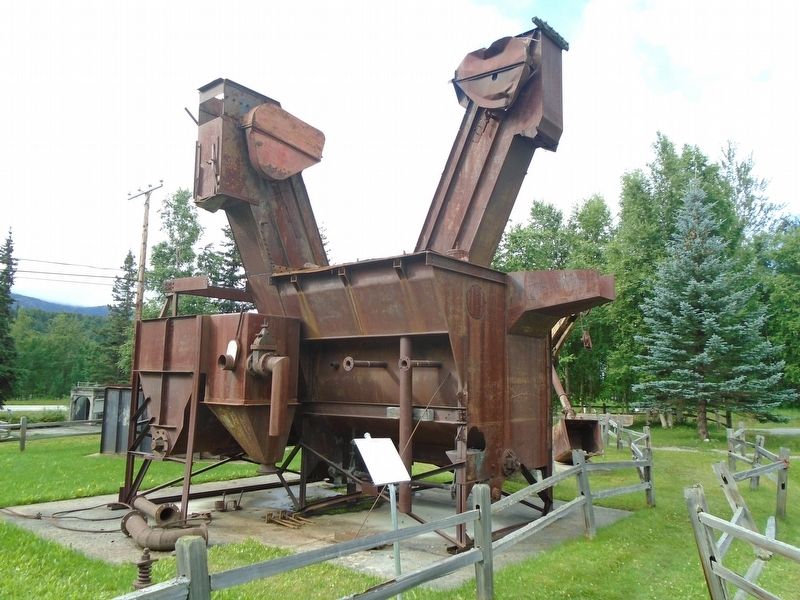
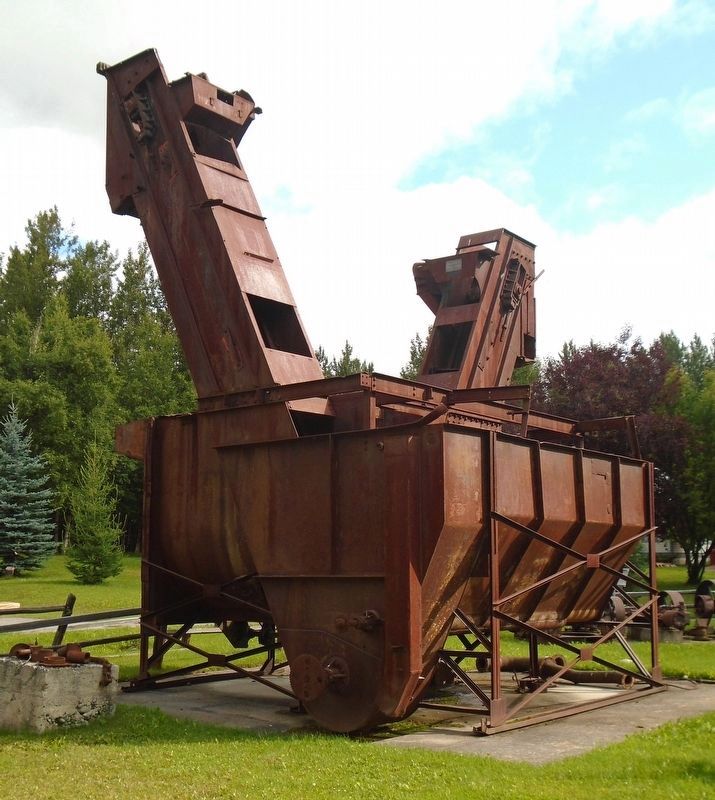
McNalley Pittsburg built this three plunger, jig-type coal washer for the Eska Coal Mine in 1941 and shipped it to the mine in pieces. At the site workers reassembled the washer, covered it with a wood framed, metal covered building about 75' X 100' and built catwalks around it for easy maintenance. Coal was crushed by another machine and conveyed by belt to this washer where three plungers agitated water much like today's family washing machine to wash 25 tons of coal an hour. Agitation forced the coal to float to the surface while the rock fell to the bottom. A small elevator carried the reject rock from the washer while a large elevator hauled the washed coal to a conveyor belt which carried it to the Eska Dryer displayed in this exhibit.
Erected by Alpine Historical Park.
Topics. This historical marker is listed in this topic list: Industry & Commerce. A significant historical year for this entry is 1941.
Location. 61° 42.609′ N, 148° 52.61′ W. Marker is in Sutton-Alpine, Alaska, in Matanuska-Susitna Borough. It is on Chickaloon Way north of Glenn Highway Milepost 61.6 (Alaska Highway 1), on the right
this page online

Regionally, this marker is in the Alaska Railroad Corridor, in the Athabascan Region, in the Mat-Su Valley, and in Southcentral Alaska. It is also on the American Pacific Coast. Globally, it is in North America, on the Pacific Rim, in the Western Hemisphere, in the Western World, and in the Anglosphere. Historically, it finds itself in what was once the Russian Empire.
Other nearby markers. At least 8 other markers are within walking distance of this marker: Dee Woods (here, next to this marker); Hoist and Steam Engines (a few steps from this marker); Welcome to Alpine Historical Park (a few steps from this marker); Buckeye Shovel (a few steps from this marker); Circulating Fan (a few steps from this marker); Gasoline Engine (a few steps from this marker); Large Hoist (a few steps from this marker); Eska Dryer (a few steps from this marker). Touch for a list and map of all markers in Sutton-Alpine.
Regarding Eska Coal Washery.
COAL WASHER DEVELOPMENT
Introduction
This problem interested Thomas McNally, so he investigated several new ideas for automatic cleaning of mine run coal. He purchased a plunger type coal washer and installed it in a coal plant in 1929. Experience with this unit impelled him to look further and to investigate washing equipment made in Europe and England.
This search finally lead to a patent arrangement with Bertram Norton, an English engineer. The Norton washer was a superior machine using air for the pulsing cycle and an automatic discharge control.
Previously mentioned was the fact that the coal tipple simply crushed and screened coal. Any cleaning done was manual, with men and boys throwing rock off the picking table.
The coal washer offered a vastly superior method, at lower cost, with heavier tonnages and controlled quality of good coal. By floating run of mine coal through a pulsating bath of water, the heavier dirt, stone and pyrites sank, while the lighter coal floated to the top. There
The first McNally Norton coal washer built in Pittsburg was put into service in Terre Haute, Ind. in 1932. It was a success. It proved to the coal industry that it could profit from this coal cleaning method.
With this unit McNally Pittsburg stepped up its pace. An experienced coal cleaning engineer, C.H.J. Patterson, joined the staff. Improvements in efficiency and size of the McNally Norton washer were constant, decade by decade. Machine capacity rose for 100 to 1300 tons per hour, with accurate control of clean coal recovery.
The first coal cleaning plants used but one McNally Norton washer. However, when coal operators entered extremely critical markets and needed better control, McNally engineers designed a system using two washers in tandem. This allowed exceptionally close control of ash (the general term for unburnable material). The tandem system also offered dividends in maximum production of clean coal.
Most plants were geared to capacities of several hundred tons. Some plants built processed 3,000 tons per hour.
From Pittsburg Boiler Works, in Pittsburg Scenes - Buildings & Businesses, Pittsburg, Kansas Memories online
Also see . . . McNally Pittsburg Collection, 1952-2013, Leonard H. Axe Library, Pittsburg State University KS. (Submitted on August 22, 2024, by William Fischer, Jr. of Reynoldsburg, Ohio.)
Credits. This page was last revised on August 24, 2024. It was originally submitted on August 22, 2024, by William Fischer, Jr. of Reynoldsburg, Ohio. This page has been viewed 172 times since then and 18 times this year. Photos: 1, 2. submitted on August 22, 2024, by William Fischer, Jr. of Reynoldsburg, Ohio. 3. submitted on August 24, 2024, by William Fischer, Jr. of Reynoldsburg, Ohio.
