
Rainy River in Rainy River District, Ontario — Central Canada (North America)
The Canadian Northern Railway

Photographed by Cosmos Mariner, June 17, 2024
1. The Canadian Northern Railway Marker
Incorporated in 1899 under the leading railway promoters Sir William Mackenzie and Sir Donald Mann, the Canadian Northern undertook construction of a line from Winnipeg to Port Arthur. Avoiding Lake of the Woods, the rail line left Manitoba at Sprague, crossed a small portion of Minnesota, and re-entered Canada at Rainy River. Construction of a rail bridge at Rainy River in 1902 coincided with completion of the railway to Lake Superior. By 1906, the Canadian Northern had acquired rail lines and traffic rights to the east coast, and in 1915 reached Vancouver, thus becoming a transcontinental line. It played a significant role in the development of northwestern Ontario and the Prairies. The line eventually formed part of the Canadian National Railway.
Erected by Archaeological and Historic Sites Board, Ministry of Colleges and Universities.
Topics and series. This historical marker is listed in these topic lists: Industry & Commerce • Railroads & Streetcars. In addition, it is included in the Canada, Ontario Heritage Trust series list. A significant historical date for this entry is January 13, 1899.
Location. 48° 43.355′ N, 94° 34.122′ W.
this page online

Regionally, this marker is in Northern Ontario and specifically in Northwest Ontario. It is also in Central Canada. Globally, it is in North America, the Great North Woods, the Western Hemisphere, the Western World, and the Anglosphere. Historically, it finds itself in what was once a British colony, the Viceroyalty of New France, the Haudenosaunee (Iroquois) Confederacy, and Rupert’s Land.
Other nearby markers. At least 8 other markers are within 3 kilometers of this marker, measured as the crow flies: 4008 Steam Locomotive (here, next to this marker); 1910-2010 (a few steps from this marker); 1960-2010 (a few steps from this marker); Yonge Street (a few steps from this marker); Royal Canadian Legion (within
Photographed by Cosmos Mariner, June 17, 2024
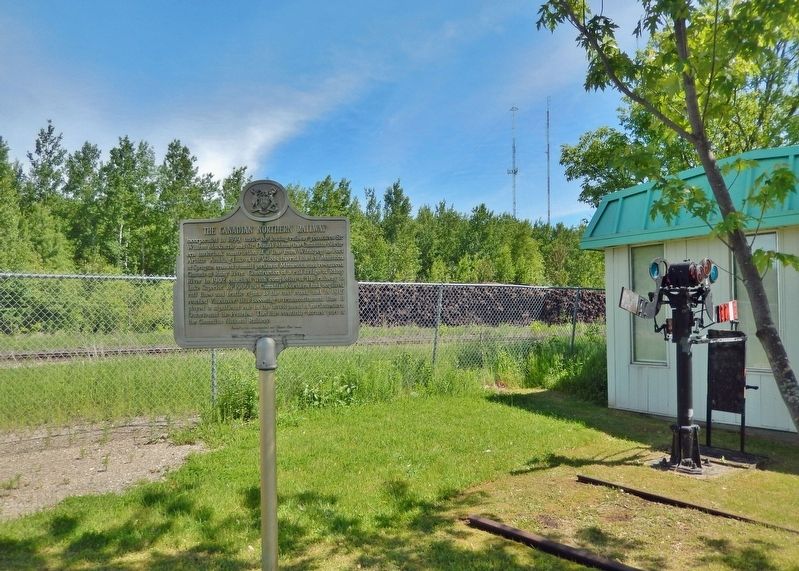
2. The Canadian Northern Railway Marker
Looking northeast; the Rainy River Tourist Information Center is in the right background.
Also see . . . Canadian Northern Railway (Wikipedia).
Excerpt: The Canadian Northern Railway (CNoR) was established on January 13, 1899, and all railway companies owned by Mackenzie and Mann (primarily in Manitoba) were consolidated into the new entity. The last spike of the CNoR transcontinental railway was driven January 23, 1915, at Basque, British Columbia, with Montreal-Vancouver freight and passenger services commencing six months later. CNoR was heavily indebted to banks and governments, and its profitable branchlines in the prairie provinces — "Canada's breadbasket" — would not generate enough revenue to cover construction costs in other areas. Unable to meet its debts, the company became desperate for financial aid. In 1917, the federal government effectively took control of the company.(Submitted on August 22, 2024, by Cosmos Mariner of Cape Canaveral, Florida.)Significant portions of the old CNoR system survive under CN (as the CNR has been known since 1960); for example:
• the Mount Royal Tunnel and suburban line to Deux-Montagnes, Quebec
• the line from Montreal (Pointe-aux-Trembles) northeast to Saguenay, Quebec
• the CN main line north and west from Toronto to Longlac, Ontario, about 900 km east of Winnipeg
• the CN main line from the Yellowhead Pass southwest to Vancouver.The majority of CN's former CNoR branchline network across Canada has either been abandoned or sold to shortline operators. An important U.S. subsidiary of CNoR, the Duluth, Winnipeg and Pacific Railway, forms part of a key CN connection between Chicago and Winnipeg.

Photographed by Cosmos Mariner, June 17, 2024
3. The Canadian Northern Railway Marker
Looking southwest; the CNR steam locomotive 4008 exhibit is in the background. Note: this north/back side of the marker has the same English inscription as the front side.
Credits. This page was last revised on August 22, 2024. It was originally submitted on August 22, 2024, by Cosmos Mariner of Cape Canaveral, Florida. This page has been viewed 381 times since then and 39 times this year. Photos: 1, 2, 3. submitted on August 22, 2024, by Cosmos Mariner of Cape Canaveral, Florida.
