Rainy River in Rainy River District, Ontario — Central Canada (North America)
4008 Steam Locomotive
Photographed by Cosmos Mariner, June 17, 2024
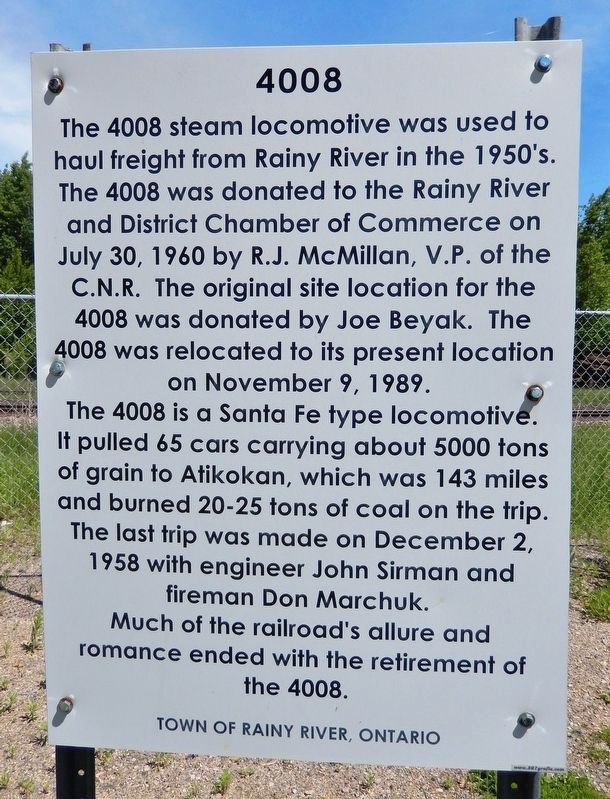
1. 4008 Steam Locomotive Marker
The 4008 steam locomotive was used to haul freight from Rainy River in the 1950's. The 4008 was donated to the Rainy River and District Chamber of Commerce on July 30, 1960 by R.J. McMillan, V.P. of the C.N.R. The original site location for the 4008 was donated by Joe Beyak. The 4008 was relocated to its present location on November 9, 1989.
The 4008 is a Santa Fe type locomotive. It pulled 65 cars carrying about 5000 tons of grain to Atikokan, which was 143 miles and burned 20-25 tons of coal on the trip. The last trip was made on December 2, 1958 with engineer John Sirman and fireman Don Marchuk.
Much of the railroad's allure and romance ended with the retirement of the 4008.
Erected by Town of Rainy River, Ontario.
Topics. This historical marker is listed in these topic lists: Charity & Public Work • Industry & Commerce • Railroads & Streetcars. A significant historical date for this entry is July 30, 1960.
Location. 48° 43.355′ N, 94° 34.124′ W. Marker is in Rainy River, Ontario, in Rainy River District. It is at the intersection of Atwood Avenue (Provincial Highway 11) and 4th Street, on the right when traveling
this page online

Regionally, this marker is in Northern Ontario and specifically in Northwest Ontario. It is also in Central Canada. Globally, it is in North America, the Great North Woods, the Western Hemisphere, the Western World, and the Anglosphere. Historically, it finds itself in what was once a British colony, the Viceroyalty of New France, the Haudenosaunee (Iroquois) Confederacy, and Rupert’s Land.
Other nearby markers. At least 8 other markers are within 3 kilometers of this marker, measured as the crow flies: The Canadian Northern Railway (here, next to this marker); 1910-2010 (a few steps from this marker); 1960-2010 (a few steps from this marker); Yonge Street (a few steps from this marker); Royal Canadian Legion (within shouting distance of this marker); Massacre Island (approx. 1.9 kilometers away in the U.S.); Great Fire of 1910 (approx. 2 kilometers
Photographed by Cosmos Mariner, June 17, 2024
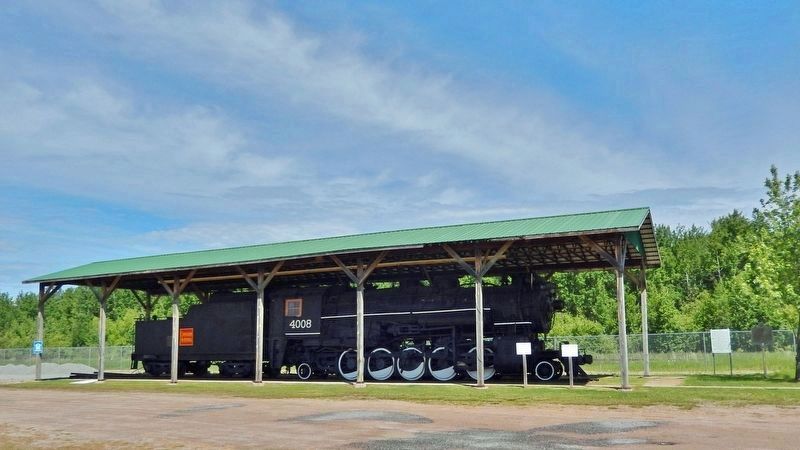
2. 4008 Steam Locomotive Exhibit & Marker
Looking north from Atwood Avenue; the marker is located on the east/right side of the 4008 Steam Locomotive exhibit. There is an adjacent Canadian Northern Railway marker on the far right.
Also see . . .
1. C.N.R. '4008' Santa Fe Steam Locomotive.
Excerpt: The focal point of the Heritage Square in Rainy River Ontario is the '4008', a 2-10-2 Sante Fe type steam locomotive built by Dunkirk in Montreal, 1916. This locomotive was used to haul 65 cars of freight between Rainy River and Atikokan during the 50's. This was the largest engine owned by the C.N.R. because the trip between Rainy River and Atikokan was hillier than the average prairie landscape and required more power. The final run was on Dec. 2, 1958, operated by engineer John Sirman and fireman Don Marchuk of Rainy River.(Submitted on August 22, 2024, by Cosmos Mariner of Cape Canaveral, Florida.)
2. 2-10-2 (Santa Fe) (Wikipedia).
Excerpt: Under the Whyte notation for the classification of steam locomotives, 2-10-2 represents the wheel arrangement of two leading wheels, ten powered and coupled driving wheels, and two trailing wheels. In the United States and elsewhere the 2-10-2 is known as the(Submitted on August 22, 2024, by Cosmos Mariner of Cape Canaveral, Florida.)Santa Fe type, after the Atchison, Topeka and Santa Fe Railway that first used the type in 1903.Photographed by Cosmos Mariner, June 17, 20243. 4008 Steam Locomotive & TenderNote the 2-10-2 “Santa Fe” locomotive wheel configuration.
The 2-10-2's inherent problem was the low speed restriction on the type, which was about 35 mph. The massive cylinders that were required on locomotives in the United States for high tractive effort had the result that no reasonably sized valves could admit and exhaust steam at a sufficient rate to permit fast running. The peak of the 2-10-2 design limitations was reached in the United States in 1926.
The 2-10-2s began to be scrapped in the mid-1950s, with the last models being used until 1961. There are two surviving CNR 2-10-2 locomotives. One is No. 4008, on display at the CNR Station in Rainy River, Ontario, and the other is No. 4100, on display at the Canadian Railway Museum in Delson, Quebec.

3. Steam locomotive profile: 2-10-2 Santa Fe.
Excerpt: The first 2-10-2s were built by Baldwin in 1903 for the Santa Fe, which actually needed the trailing truck to back its helper engines down the twisting alignment of Raton Pass. The 2-10-2 quickly gained(Submitted on August 22, 2024, by Cosmos Mariner of Cape Canaveral, Florida.)popularity. Large numbers were built beginning in 1915, and they were used extensively in heavy freight service. The 2-10-2 was called the Santa Fe type, named after the railroad that developed the engine. With 342 examples on the roster, Santa Fe owned more 2-10-2s than anyone else. At the time, it was common practice for railroads to assemble as many cars as possible into slow, heavy drag freights, which maximized the locomotive’s pulling power. The last 2-10-2s were built by Baldwin, delivered to the Reading in 1931. Overall, about 2,200 were built. The last 2-10-2 to operate pulled an excursion train on the Duluth, Missabe & Iron Range in 1962.Photographed by Cosmos Mariner, June 17, 20244. 4008 Steam Locomotive & Tender (north side)


Photographed by Cosmos Mariner, June 17, 2024
5. 4008 Steam Locomotive (detail)

Photographed by Cosmos Mariner, June 17, 2024
6. Heritage Square Appreciation Plaque
The Town of Rainy River
appreciates the following government agencies
clubs and individuals who made
Heritage Square
a reality
Ministry of Northern Development and Mines
Royal Canadian Legion Branch No. 54
Rainy River CN Track Crews
Save our Station Committee and
4008 Heritage Square Committee 1989 to 1995
VFW Club Baudette, Minnesota
Moose Lodge Branch No. 742 Baudette, Minnesota
Rainy River Lions Club
Contractor Murray Meyers
Mayor Gordon Armstrong and Council
Town of Rainy River
November 11, 1995
Photographed by Cosmos Mariner, June 17, 2024
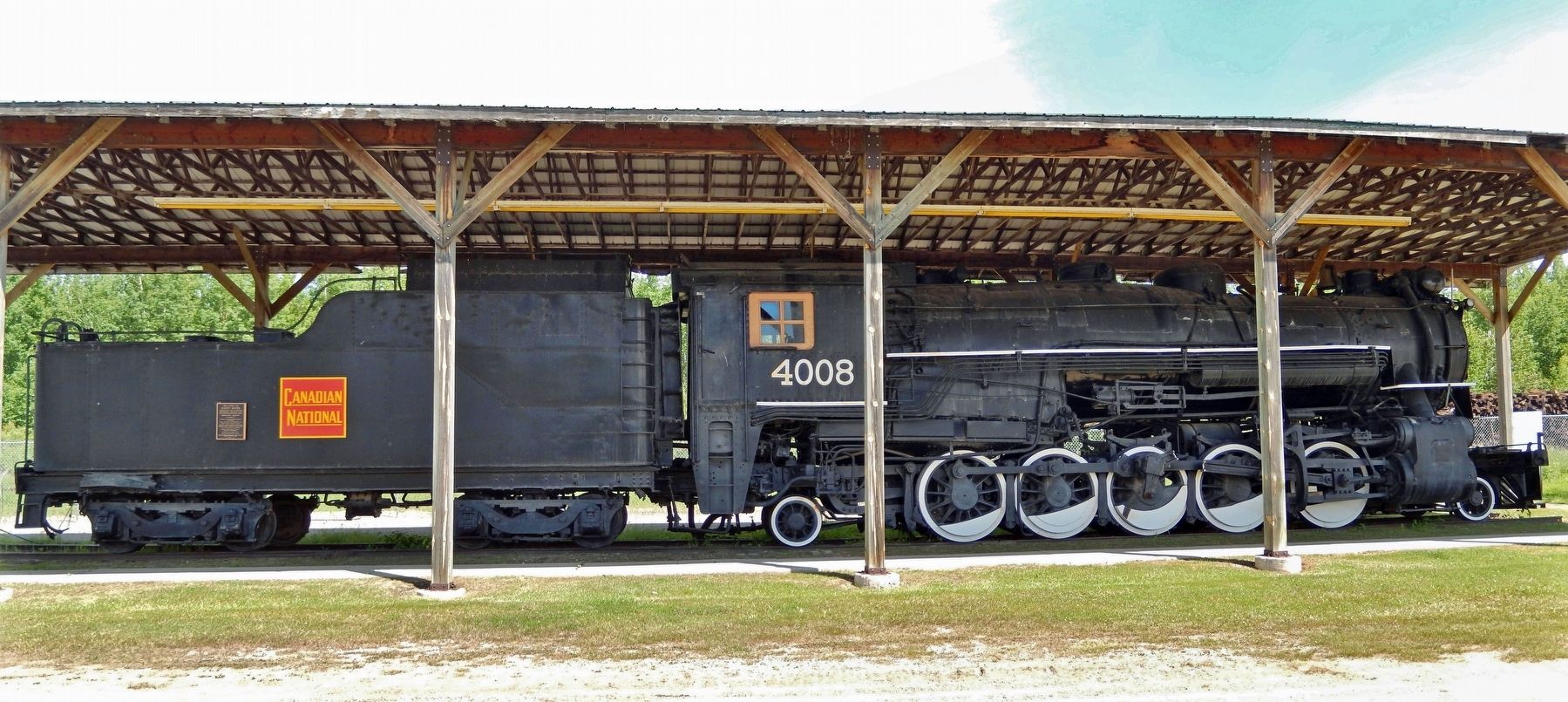
7. 4008 Steam Locomotive & Tender
The marker is visible in the far right background.
Credits. This page was last revised on August 23, 2024. It was originally submitted on August 22, 2024, by Cosmos Mariner of Cape Canaveral, Florida. This page has been viewed 852 times since then and 230 times this year. Photos: 1, 2, 3, 4, 5, 6, 7. submitted on August 22, 2024, by Cosmos Mariner of Cape Canaveral, Florida.
