Lackland Air Force Base in Bexar County, Texas — The American South (West South Central)
P-63G "King Cobra"
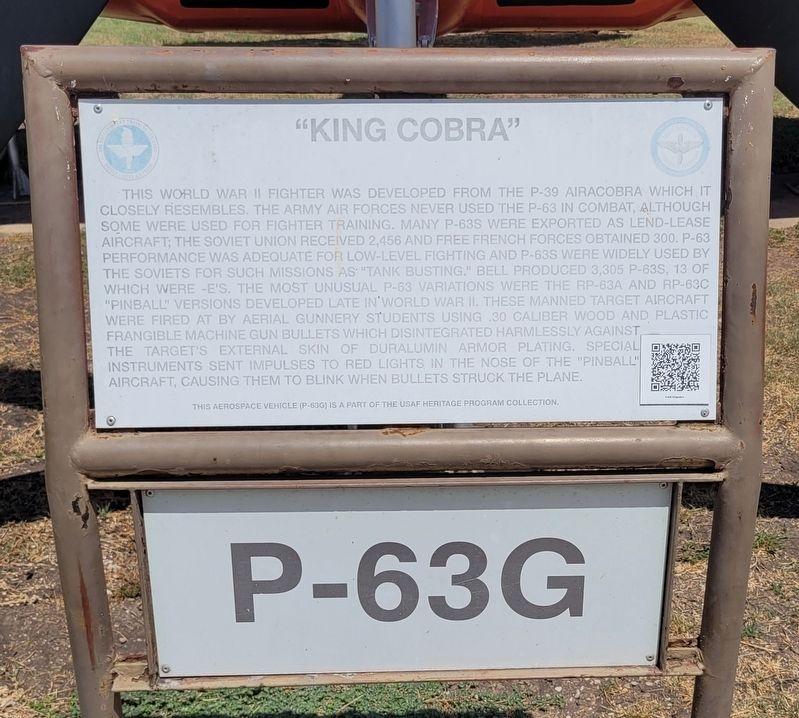
Photographed by James Hulse, August 16, 2024
1. P-63G "King Cobra" Marker
This aerospace vehicle (P-63G) is a part of the USAF Heritage Program Collection.
Erected by USAF Heritage Program Collection.
Topics. This historical marker
this page online
Location. 29° 23.577′ N, 98° 37.212′ W. Marker is in Lackland Air Force Base, Texas, in Bexar County. It is on Bong Avenue south of Luke Blvd. The marker is located at the USAF Airman Heritage Museum’s Air Park which is around the parade grounds. Touch for map. Marker is in this post office area: Jbsa Lackland TX 78236, United States of America. Touch for directions.

Regionally, this marker is in South Texas and in the San Antonio Metropolitan Area. It is also in the American South. Globally, it is in North America, a Gulf of Mexico state, the Western Hemisphere, the Western World, and the Anglosphere. Historically, it finds itself in what was once New Spain, the Republic of Texas, and one of the Confederate States of America.
Other nearby markers. At least 8 other markers are within walking distance of this marker: P-51H "Mustang" (within shouting distance of this marker); P-47N "Thunderbolt" (within shouting distance of this marker); Republic JF-105B "Thunderchief" (within shouting distance of this marker);
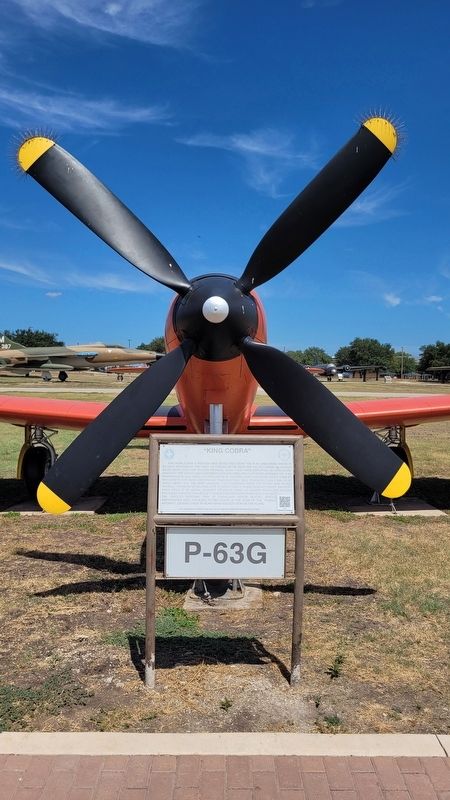
Photographed by James Hulse, August 16, 2024
2. P-63G "King Cobra" and Marker
More about this marker. The marker, museum and air park are located on the Lackland Air Force Base, an active U.S. military installation which is a part of the Joint Base San Antonio (JBSA). The USAF Airman Heritage Museum and Air Park are open to the public, but appropriate identification is required for access. Visit the museum’s web site for current details on visiting the museum and air park.
Also see . . .
1. Airmen Heritage Training Complex. USAF Airman Heritage Museum (Submitted on August 24, 2024, by James Hulse of Medina, Texas.)
2. Bell P-63 Kingcobra. Wikipedia
The Bell P-63 Kingcobra is an American fighter aircraft that was developed by Bell Aircraft during World War II. Based on the preceding Bell P-39 Airacobra, the P-63's design incorporated suggestions from P-39 pilots and was superior to its predecessor in virtually all respects. The P-63 was not accepted for combat use by the United States Army Air Forces. However, it was used during World War II by the Soviet Air Force, which had also been the most prolific user of the P-39.(Submitted on August 25, 2024, by James Hulse of Medina, Texas.)
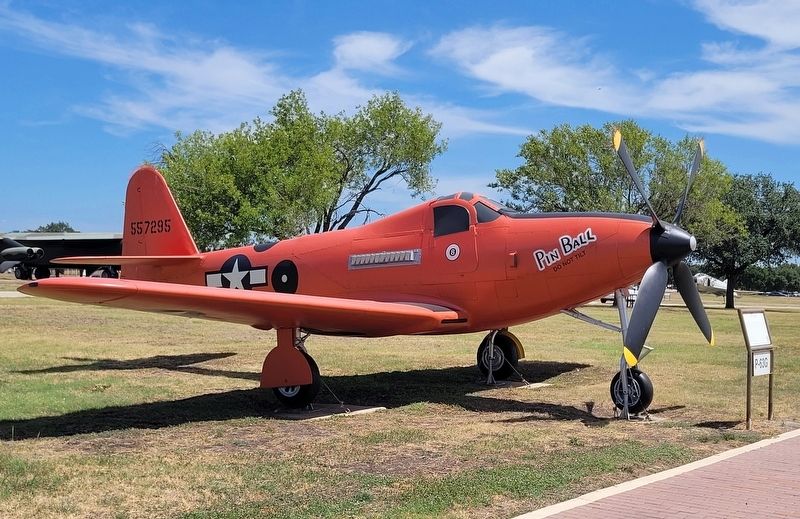
Photographed by James Hulse, August 16, 2024
3. P-63G "King Cobra" and Marker
Credits. This page was last revised on August 25, 2024. It was originally submitted on August 24, 2024, by James Hulse of Medina, Texas. This page has been viewed 148 times since then and 14 times this year. Photos: 1, 2, 3. submitted on August 25, 2024, by James Hulse of Medina, Texas.
