
Bolton in Peel Region, Ontario — Central Canada (North America)
Masonic Arms Hotel
Photographed by Cosmos Mariner, June 4, 2024
1. Masonic Arms Hotel Marker
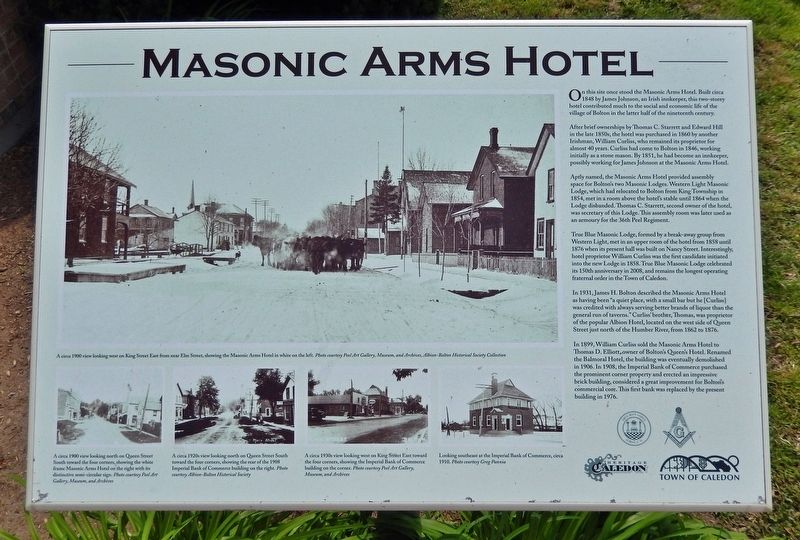
On this site once stood the Masonic Arms Hotel. Built circa 1848 by James Johnson, an Irish innkeeper, this two-storey hotel contributed much to the social and economic life of the village of Bolton in the latter half of the nineteenth century.
After brief ownerships by Thomas C. Starrett and Edward Hill in the late 1850s, the hotel was purchased in 1860 by another Irishman, William Curliss, who remained its proprietor for almost 40 years. Curliss had come to Bolton in 1846, working initially as a stone mason. By 1851, he had become an innkeeper, possibly working for James Johnson at the Masonic Arms Hotel.
Aptly named, the Masonic Arms Hotel provided assembly space for Bolton's two Masonic Lodges. Western Light Masonic Lodge, which had relocated to Bolton from King Township in 1854, met in a room above the hotel's stable until 1864 when the Lodge disbanded. Thomas C. Starrett, second owner of the hotel, was secretary of this Lodge. This assembly room was later used as an armoury for the 36th Peel Regiment.
True Blue Masonic Lodge, formed by a break-away group from Western Light, met in an upper room of the hotel from 1858
this page online
In 1931, James H. Bolton described the Masonic Arms Hotel as having been “a quiet place, with a small bar but he [Curliss] was credited with always serving better brands of liquor than the general run of taverns.” Curliss' brother, Thomas, was proprietor of the popular Albion Hotel, located on the west side of Queen Street just north of the Humber River, from 1862 to 1876.
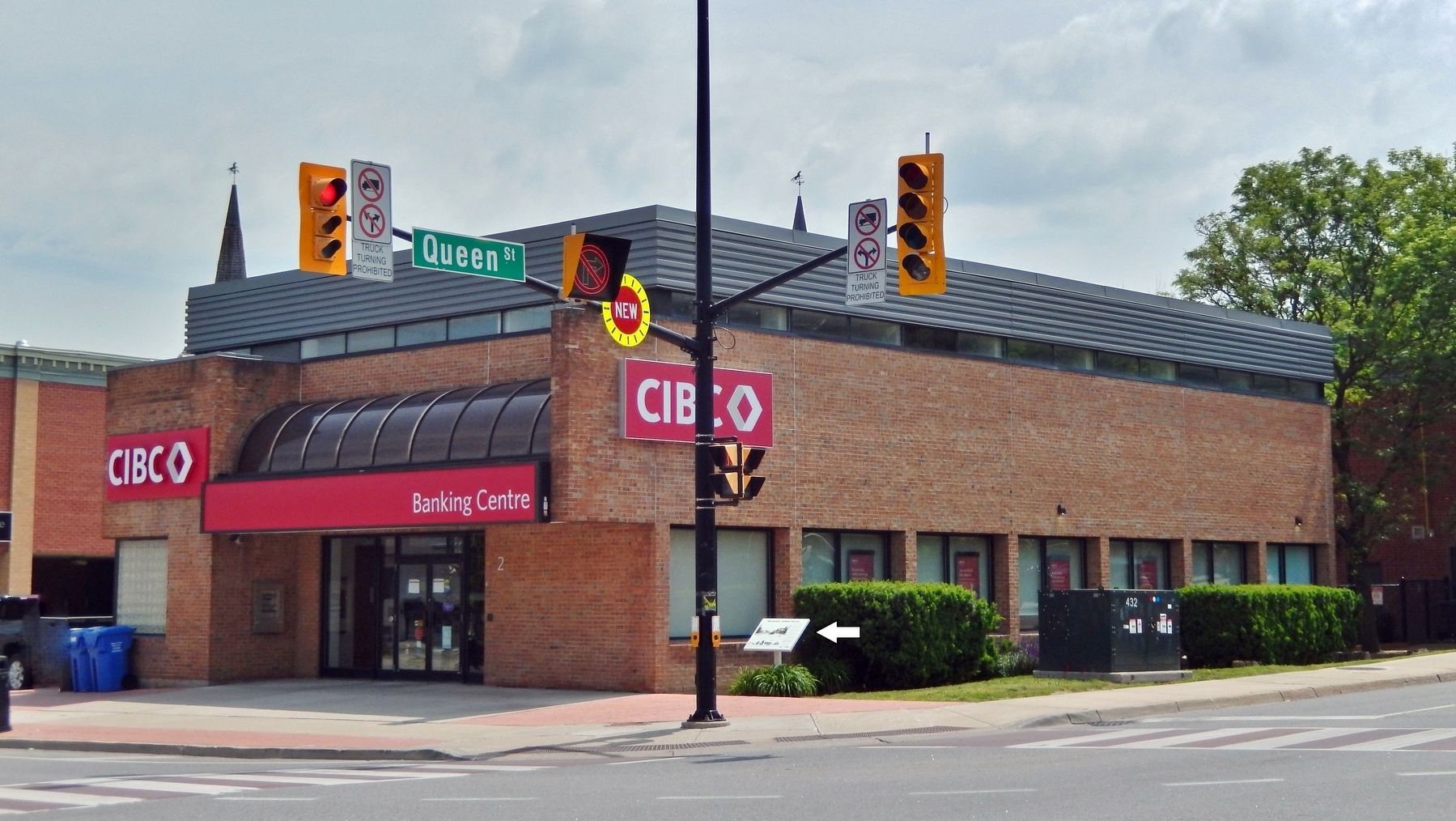
In 1899, William Curliss sold the Masonic Arms Hotel to Thomas D. Elliott, owner of Bolton's Queen's Hotel. Renamed the Balmoral Hotel, the building was eventually demolished in 1906. In 1908, the Imperial Bank of Commerce purchased the prominent corner property and erected an impressive brick building, considered a great improvement for Bolton's commercial core. This first bank was replaced by the present building in 1976.
Erected by Heritage Caledon.
Topics.
Courtesy Peel Art Gallery
2. Marker detail: King Street, circa 1900
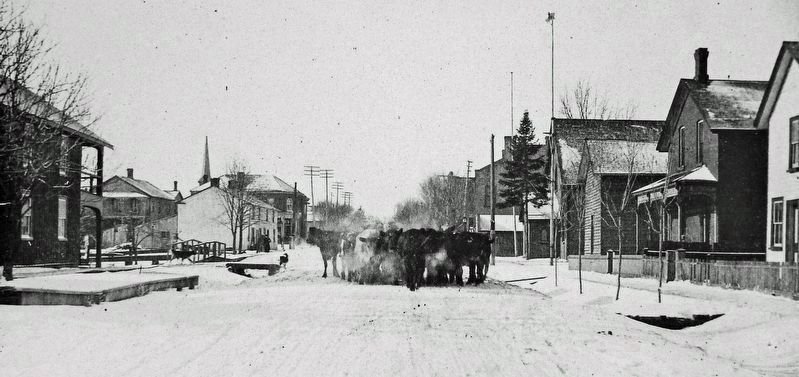
A circa 1900 view looking west on King Street East from near Elm Street, showing the Masonic Arms Hotel in white on the left. Photo courtesy Peel Art Gallery, Museum, and Archives, Albion-Bolton Historical Society Collection.
Location. 43° 52.777′ N, 79° 44.281′ W. Marker is in Bolton, Ontario, in Peel Region. It is at the intersection of Queen Street South (Provincial Highway 50) and King Street East (Regional Road 9), on the right when traveling north on Queen Street South. The marker is located beside the sidewalk near the southeast corner of the intersection. Touch for map. Marker is at or near this postal address: 2 King Street East, Bolton ON L7E 5T1, Canada. Touch for directions.

Regionally, this marker is in Greater Toronto, specifically on the Golden Horseshoe, and in the Toronto Metropolitan Area. It is also in Central Canada. Globally, it is in North America, the Western Hemisphere, the Western World, and the Anglosphere. Historically, it finds itself in what was once a British colony, the Viceroyalty of New France, the Haudenosaunee (Iroquois) Confederacy, and Rupert’s Land.
Other nearby markers. At least 8 other markers are within 18 kilometers
3. Marker detail: Queen Street
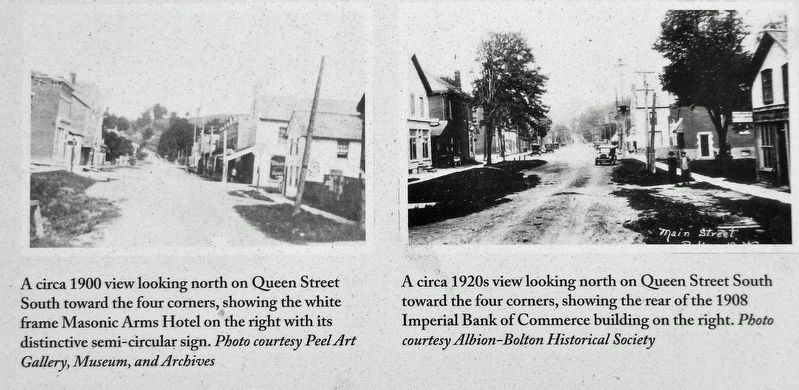
[left] A circa 1900 view looking north on Queen Street South toward the four corners, showing the white frame Masonic Arms Hotel on the right with its distinctive semi-circular sign. Photo courtesy Peel Art Gallery, Museum, and Archives.
[right] A circa 1920s view looking north on Queen Street South toward the four corners, showing the rear of the 1908 Imperial Bank of Commerce building on the right. Photo courtesy Albion-Bolton Historical Society.
Also see . . . The Rich History of Downtown Bolton.
Excerpt: The origins of this riverside community began in 1821 when George Bolton purchased 200 acres of land along the Humber River from surveyor James Chewett. George built a house, dammed the river and with the help of his older brother, Albion Township settler James Bolton, built a water-powered flour mill which was operating by 1824. George’s mill gradually attracted other development and by 1840, Bolton boasted 14 houses, 2 stores, blacksmiths, a shoemaker, a tailor and a hotel. In 1848, James Johnstone builds a tavern and Inn on the south-east corner of King and Queen Streets (present day location of(Submitted on August 26, 2024, by Cosmos Mariner of Cape Canaveral, Florida.)CIBC). By the late-1850s it is known as the Masonic Arms Hotel.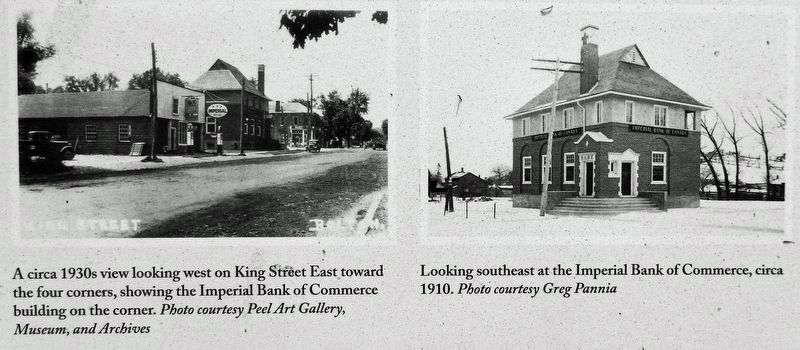 4. Marker detail: King Street[left] A circa 1930s view looking west on King Street East toward the four corners, showing the Imperial Bank of Commerce building on the corner. Photo courtesy Peel Art Gallery, Museum, and Archives.
[right] Looking southeast at the Imperial Bank of Commerce, circa 1910. Photo courtesy Greg Pannia.
Photographed by Cosmos Mariner, June 4, 2024
5. Masonic Arms Hotel Marker
Looking east across the King Street/Queen Street intersection. The marker is located beside the current CIBC bank building.
Credits. This page was last revised on August 26, 2024. It was originally submitted on August 25, 2024, by Cosmos Mariner of Cape Canaveral, Florida. This page has been viewed 223 times since then and 48 times this year. Photos: 1, 2, 3, 4, 5. submitted on August 26, 2024, by Cosmos Mariner of Cape Canaveral, Florida.
