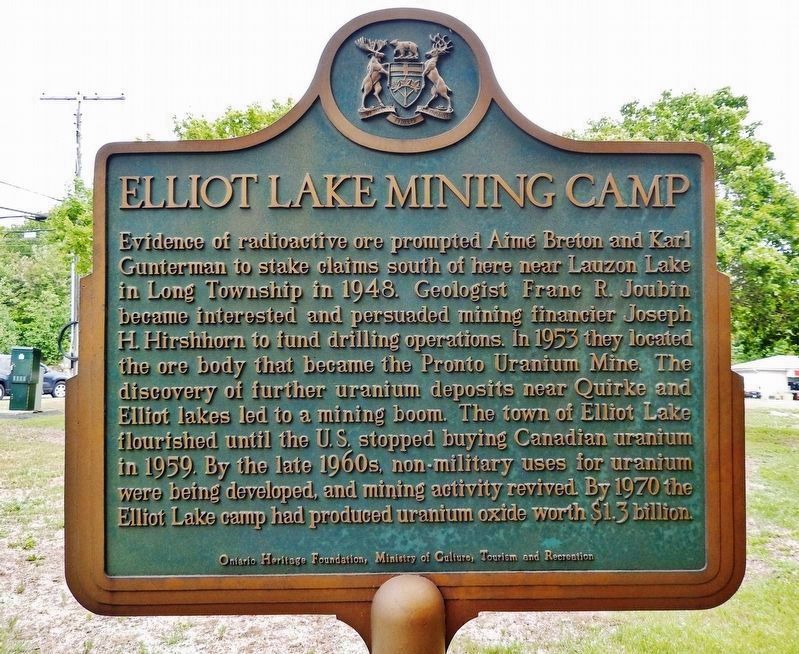
Elliot Lake Mining Camp
⎯⎯⎯
Le camp minier d'Elliot Lake

this page online
Erected 1972 by Ontario Heritage Foundation, Ministry of Culture, Tourism and Recreation/Fondation du patrimoine ontarien, Ministère de la Culture, du Tourisme et des Loisirs.
Topics and series. This historical marker is listed in these topic lists: Exploration • Industry & Commerce • Settlements & Settlers. In addition, it is included in the Canada, Ontario Heritage Trust series list. A significant historical year for this entry is 1948.
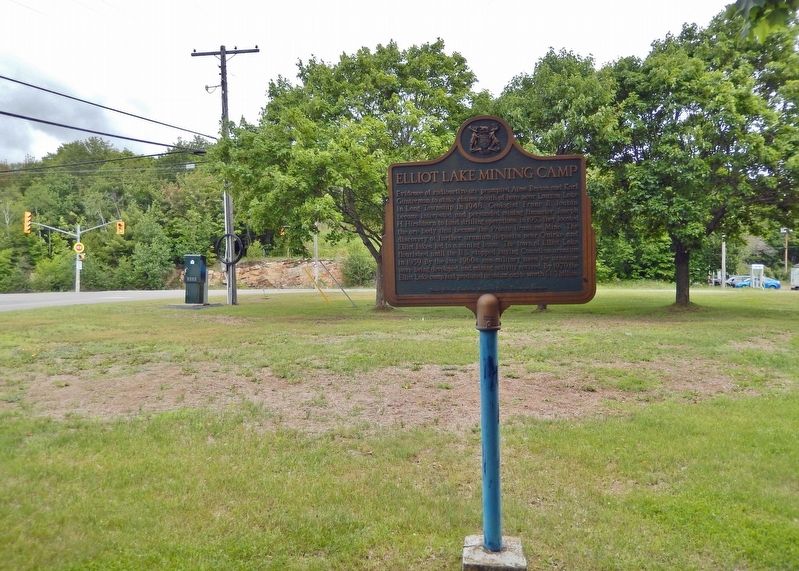
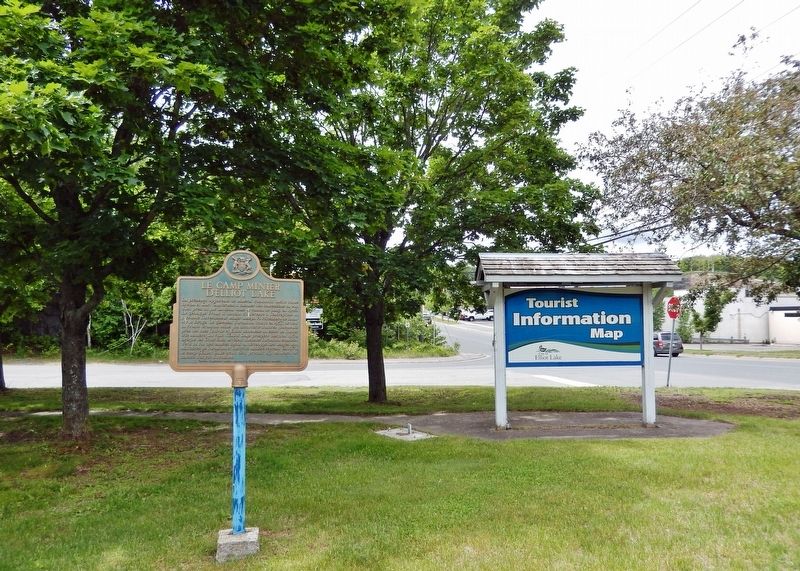
Location. 46° 22.928′ N, 82° 38.508′ W. Marker is in Elliot Lake, Ontario, in Algoma District. It is at the intersection of Provincial Highway 108 and Hillside Drive South, on the left when traveling north on Provincial Highway 108. The marker is located in the triangular park at the southwest corner of the intersection.


Regionally, this marker is in the Sault Ste. Marie and Algoma Area and in Northern Ontario. It is also in Central Canada. Globally, it is in North America, in the Great North Woods, on the Great Lakes, on Lake Superior’s North Shore, in the Western Hemisphere, in the Western World, and in the Anglosphere. Historically, it finds itself in what was once a British colony, the Viceroyalty of New France, the Haudenosaunee (Iroquois) Confederacy, and Rupert’s Land.
Also see . . .
1. Elliot Lake History (Wikipedia).
Excerpt: The city was established as a planned community for the mining industry in 1955 after the discovery of uranium in the area, and named after the small lake on its northern edge. By the late 1950s, its population had grown to about 25,000. The principal mining companies were Denison Mines and Rio Algom. The population has varied with several boom-and-bust cycles from the 1950s to the 1990s, from a high of over 26,000 to a low of about 6,600. By 1958 it was apparent that world production(Submitted on August 26, 2024, by Cosmos Mariner of Cape Canaveral, Florida.)of uranium was far outstripping demand and Canadian producers received unofficial notice that US options on Canadian uranium production between 1962 and 1966 would not be exercised.Photographed by Cosmos Mariner, June 9, 20243. Elliot Lake Mining Camp (marker west side)Looking east; Ontario Highway 108 crosses in the background.During the 1970s, federal plans for CANDU Reactors and Ontario Hydro's interest in atomic energy led the town, anticipating a population of 30,000, to expand again. However, by the early 1990s depleted reserves and low prices caused the last mines in the area to close.
2. Elliot Lake (University of Waterloo Earth Sciences Museum).
Excerpt: In 1957, the hills swarmed with contractors blasting roads, sinking shafts and raising mills. Never before in the history of Canada has so much money been spent so quickly in one place. Every single piece of equipment for the miners, mills, homes and businesses had to be carried by tractor and truck into Elliot Lake. At first the road was only a dusty ribbon of dirt, so narrow that every stalled vehicle had to be rolled over the edge to allow the traffic to pass. A traffic count showed that over a 24-hour period the flow averaged(Submitted on August 26, 2024, by Cosmos Mariner of Cape Canaveral, Florida.)50 trucks an hour, one every 72 seconds. In 1958, their first full year of production, the mines earned a staggering two hundred million dollars, boosting uranium into first place among Canadian metals.Photographed by Cosmos Mariner, June 9, 20244. Le camp minier d'Elliot Lake (marker east side)Looking west from Ontario Highway 108; Hillside Drive South is on the right.In November 1959 word came from Washington that no further build-up of uranium stockpiles was necessary. The effects were almost immediate. 1960 saw the closure of five uranium mines in the Elliot Lake area. The population dropped from a high of perhaps 28,000 to 6,000 in the early 1960’s, a bitter pill for many residents and small business operators.
On Friday, October 13, 1972 a historical plaque commemorating the opening up of the great uranium mining field in the Elliot Lake area was unveiled at the junction of Highway 108 and Hillside Drive South, Township of Elliot Lake.
3. Elliot Lake’s Glamourous Rise and Bitter Fall (MACLEAN’S Magazine – July 16, 1960).
Excerpt: (by McKenzie Porter) This is a candid portrait of the hundred-million-dollar boom town that was built on uranium — the mineral with sex appeal — and of the mesmerized thousands who learned the hard way that it was just another mining camp after all.(Submitted on August 26, 2024, by Cosmos Mariner of Cape Canaveral, Florida.)Why did the builders of Elliot Lake sink so much money in a mining camp? Because, as they readily admit today, they were mesmerized by the propaganda of the atomic age. Elliot Lake sits on the largest known deposit of uranium ore in the Western world and, as every schoolboy knows, uranium is the fuel for atomic energy, man’s most modern and widely publicized source of power. The ore body was discovered in 1953 by Franc Joubin, a Toronto prospector, and staked in dramatic secrecy by geologists working for Joseph Hirshhorn, a New York mining promoter. At that time the American stockpilers of cold war atomic weapons were devouring uranium as cats devour cream...
Credits. This page was last revised on August 26, 2024. It was originally submitted on August 25, 2024, by Cosmos Mariner of Cape Canaveral, Florida. This page has been viewed 488 times since then and 125 times this year. Photos: 1. submitted on August 25, 2024, by Cosmos Mariner of Cape Canaveral, Florida. 2, 3, 4. submitted on August 26, 2024, by Cosmos Mariner of Cape Canaveral, Florida.
