Downtown Sudbury in Greater Sudbury, Ontario — Central Canada (North America)
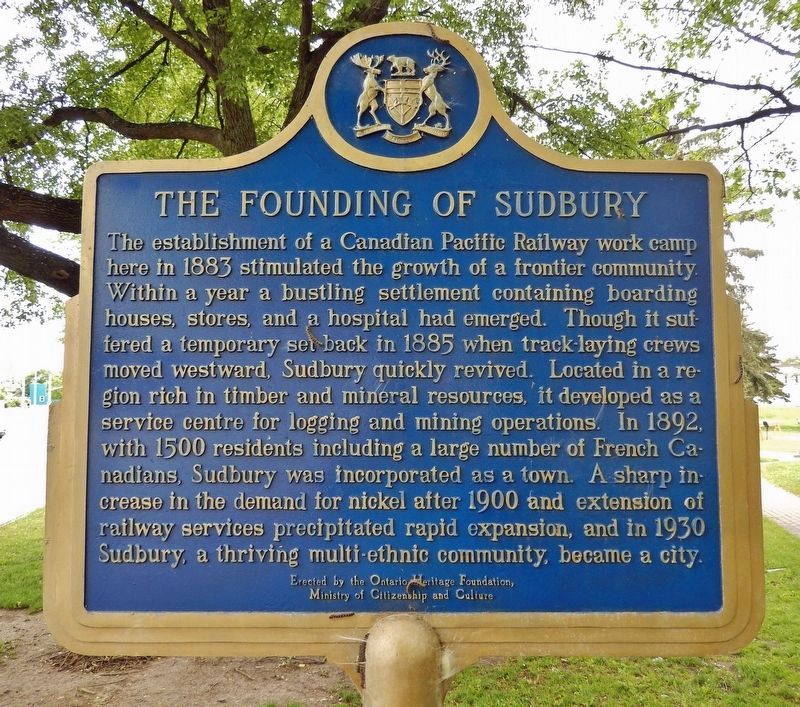
The Founding of Sudbury
⎯⎯⎯
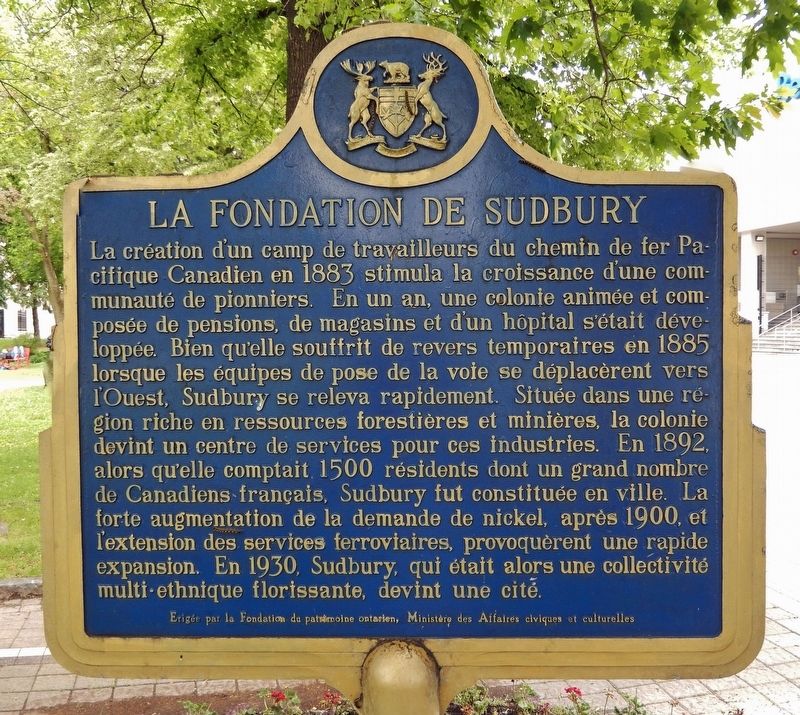
La fondation de Sudbury
Photographed by Cosmos Mariner, June 8, 2024
1. The Founding of Sudbury (marker north side)

this page online
Erected by Ontario Heritage Foundation, Ministry of Citizenship and Culture/Fondation du patrimoine ontarien, Ministère des Affaires civiques et culturelles.
Topics and series. This historical marker is listed in these topic lists: Industry & Commerce • Railroads & Streetcars • Settlements & Settlers. In addition, it is included in the Canada, Ontario Heritage Trust series list. A significant historical year for this entry is 1883.
Location. 46° 29.413′ N, 80° 59.521′ W. Marker is in Greater Sudbury, Ontario. It is in Downtown Sudbury. It is on Minto Street just north of Brady Street (Regional Road 49), on the left
Photographed by Cosmos Mariner, June 8, 2024
2. La fondation de Sudbury (marker south side)

Regionally, this marker is in Northeastern Ontario and specifically in Northern Ontario. It is also in Central Canada. Globally, it is in North America, the Great North Woods, the Western Hemisphere, the Western World, and the Anglosphere. Historically, it finds itself in what was once a British colony, the Viceroyalty of New France, the Haudenosaunee (Iroquois) Confederacy, and Rupert’s Land.
Other nearby markers. At least 8 other markers are within 3 kilometers of this marker, measured as the crow flies: The Irish Regiment of Canada (within shouting distance of this marker); Sainte-Anne-des-Pins (approx. half a kilometer away); W. J. Bell (approx. 1.2 kilometers away); The Sudbury Basin (approx. 1.2 kilometers away); Sacred Heart College / Collège du Sacré-Coeur (approx. 1.3 kilometers away); Austin Airways 1934-1987 (approx. 2.1 kilometers away); Laurentian University of Sudbury / Université Laurentienne de Sudbury
Photographed by Cosmos Mariner, June 8, 2024
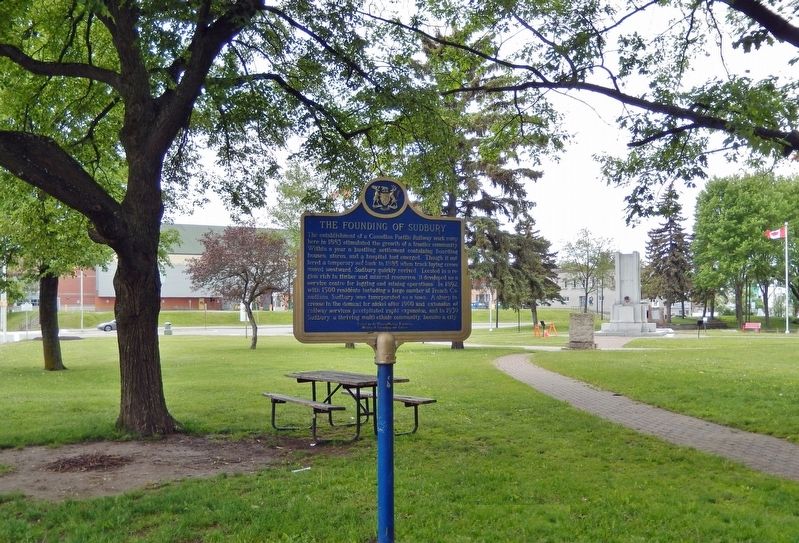
3. The Founding of Sudbury (marker north side)
Looking south; Brady Street crosses in the background.
Also see . . .
1. City of Greater Sudbury (Wikipedia).
Excerpt: During construction of the Canadian Pacific Railway in 1883, blasting and excavation revealed high concentrations of nickel-copper ore at Murray Mine on the edge of the Sudbury Basin. This discovery brought the first waves of European settlers, who arrived not only to work at the mines, but also to build a service station for railway workers. The construction of the railway allowed exploitation of these mineral resources and shipment of the commodities to markets and ports, as well as large-scale lumber extraction. Through the decades that followed, Sudbury's economy went through boom and bust cycles as world demand for nickel fluctuated. The city recovered from the Great Depression much more quickly than almost any other city in North America due to increased demand for nickel in the 1930s. Sudbury was the fastest-growing city and one of the wealthiest cities in Canada for most of the(Submitted on August 26, 2024, by Cosmos Mariner of Cape Canaveral, Florida.)decade.Photographed by Cosmos Mariner, June 8, 20244. La fondation de Sudbury (marker south side)Looking northeast; Minto Street is on the right.

2. History of Sudbury, Ontario (By Natalie Chabanova).
Excerpt: Sudbury evolved from a small mining town to a rapidly developing regional capital. The history of Sudbury began over nine thousand years ago, when the area was occupied by the Ojibwe people. The first European settlers came to the present-day Sudbury in the 1880s, when high concentration of nickel ore was discovered in the region. The discovery coincided with the construction of the Canadian Pacific Railway junction in Sudbury. It was James Worthington, the superintendent of railway construction, who gave Sudbury its name — after his wife’s birthplace in Sudbury, Suffolk. In the 1890s, lumbering industry was on the rise, which gave new impetus to the area’s economic development. In the 20th century, mining continued to be the major driving force of Sudbury’s economy. The main employers of the area were Inco (established in 1902) and Falconbridge (established in 1928) - top mining companies of the area.(Submitted on August 26, 2024, by Cosmos Mariner of Cape Canaveral, Florida.)
Credits. This page was last revised on August 26, 2024. It was originally submitted on August 25, 2024, by Cosmos Mariner of Cape Canaveral, Florida. This page has been viewed 1,069 times since then and 334 times this year. Photos: 1, 2, 3, 4. submitted on August 26, 2024, by Cosmos Mariner of Cape Canaveral, Florida.
