Lackland Air Force Base in Bexar County, Texas — The American South (West South Central)
P-47N "Thunderbolt"
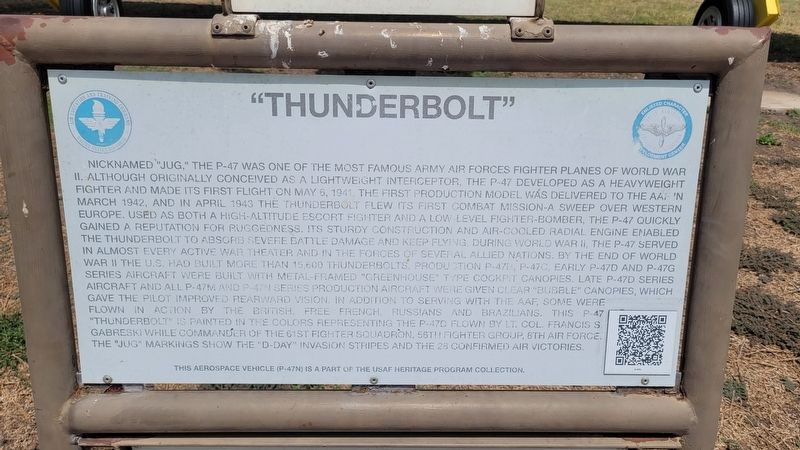
Photographed by James Hulse, August 16, 2024
1. P-47N "Thunderbolt" Marker
this page online
This aerospace vehicle (P-47N) is a part of the USAF Heritage Program Collection.
2nd Plaque Above
Dedicated to Colonel Francis S. Gabreski
Francis S. Gabreski flew many combat missions in the P-47 during WWII and recorded 33 1/2 aerial victories. He was shot down, captured and was a POW in Germany. In Korea he shot down 6 1/2 MiGs and became our 8th jet ace in 1952. Colonel Gabreski has more than 5,000 flying hours and held several command positions during his distinguished career.
Erected by USAF Heritage Program Collection.
Topics. This historical marker is listed in these topic lists: Air & Space • War, World II. A significant historical month for this entry is March 1942.
Location. 29° 23.589′ N, 98° 37.183′ W. Marker is

Photographed by James Hulse, August 16, 2024
2. P-47N "Thunderbolt" - 2nd plaque above

Regionally, this marker is in South Texas and in the San Antonio Metropolitan Area. It is also in the American South. Globally, it is in North America, a Gulf of Mexico state, the Western Hemisphere, the Western World, and the Anglosphere. Historically, it finds itself in what was once New Spain, the Republic of Texas, and one of the Confederate States of America.
Other nearby markers. At least 8 other markers are within walking distance of this marker: F-82E "Twin Mustang" (within shouting distance of this marker); P-63G "King Cobra" (within shouting distance of this marker); Republic JF-105B "Thunderchief" (within shouting distance of this marker); B-52 "Stratofortress" (within shouting distance of this marker); Master Sgt. Samuel O. Turner (within shouting distance of this marker); HH-43 Helicopter Memorial

Photographed by James Hulse, August 16, 2024
3. P-47N "Thunderbolt" and Marker
More about this marker. The marker, museum and air park are located on the Lackland Air Force Base, an active U.S. military installation which is a part of the Joint Base San Antonio (JBSA). The USAF Airman Heritage Museum and Air Park are open to the public, but appropriate identification is required for access. Visit the museum’s web site for current details on visiting the museum and air park.
Also see . . .
1. Airmen Heritage Training Complex. USAF Airman Heritage Museum (Submitted on August 28, 2024, by James Hulse of Medina, Texas.)
2. Republic P-47 Thunderbolt. Wikipedia
The Republic P-47 Thunderbolt is a World War II-era fighter aircraft produced by the American company Republic Aviation from 1941 through 1945. It was a successful high-altitude fighter, and it also served as the foremost American fighter-bomber in the ground-attack role. Its primary armament was eight .50-caliber machine(Submitted on August 28, 2024, by James Hulse of Medina, Texas.)guns, and it could carry 5-inch rockets or a bomb load of 2,500 lb (1,100 kg). When fully loaded, the P-47 weighed up to 8 tons, making it one of the heaviest fighters of the war.Photographed by James Hulse, August 16, 20244. P-47N "Thunderbolt" and Marker


Public Domain - US Air Force, circa 1945
5. P-47 "Thunderbolt" - Escuadrón 201 (201st Squadron)
A Fuerza Aérea Expedicionaria Mexicana (FAEM — "Mexican Expeditionary Air Force") Republic P-47D-30-RA Thunderbolt (USAAF s/n 44-33721) from Escuadrón 201 (201st Squadron) over the Philippines during the summer of 1945. The squadron was attached to the 58th Fighter Group of the United States Army Air Forces during the liberation of the main Philippine island of Luzon, flying 785 sorties in 96 combat missions.
Credits. This page was last revised on August 28, 2024. It was originally submitted on August 26, 2024, by James Hulse of Medina, Texas. This page has been viewed 359 times since then and 57 times this year. Photos: 1, 2, 3, 4, 5. submitted on August 28, 2024, by James Hulse of Medina, Texas.
