Robbinsdale in Hennepin County, Minnesota — The American Midwest (Upper Plains)
Victory Memorial Drive
Photographed by McGhiever, June 7, 2024
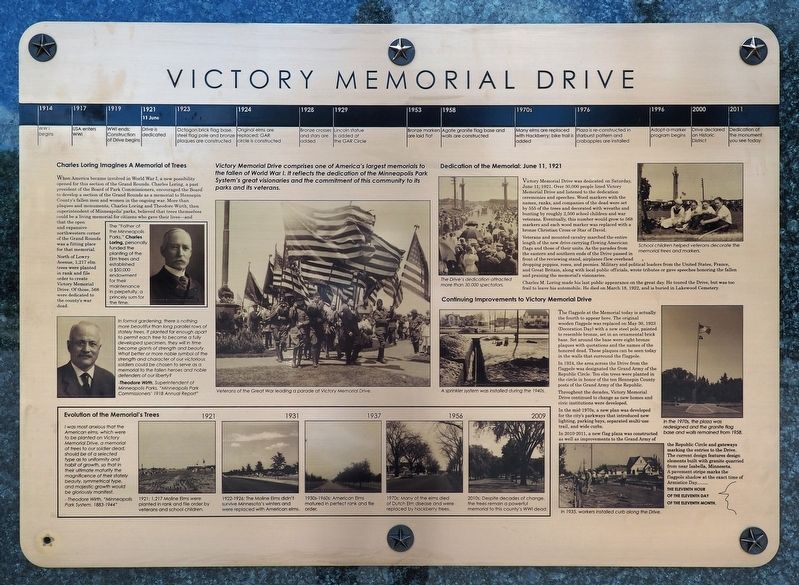
1. Victory Memorial Drive Marker
1914: WWI begins
1917: USA enters WWI
1919: WWI ends; Construction of Drive begins
1921, 11 June: Drive is dedicated
1923: Octogon [sic] brick flag base, steel flag pole and bronze plaques are constructed
1924: Original elms are replaced; GAR circle is constructed
1928: Bronze crosses and stars are added
1929: Lincoln statue is added at the GAR circle
1953: Bronze markers are laid flat
1958: Agate granite flag base and walls are constructed
1970s: Many elms are replaced with Hackberry; bike trail is added
1976: Plaza is re-constructed in starburst pattern and crabapples are installed
1996: Adopt-a-marker program begins
2000: Drive declared an Historic District
2011: Dedication of the monument you see today
Charles Loring Imagines A Memorial of Trees
When America became involved in World War I, a new possibility opened for this section of the Grand Rounds. Charles Loring, a past president of the Board of Park Commissioners, encouraged the Board to develop a section of the Grand Rounds as a memorial to Hennepin County's fallen men and women in the ongoing war. More than plaques and monuments, Charles Loring
this page online
North of Lowry Avenue, 1,217 elm trees were planted in rank and file order to create Victory Memorial Drive. Of those, 568 were dedicated to the county's war dead.
The "Father of the Minneapolis Parks," Charles Loring, personally funded the planting of the Elm trees and established a $50,000 endowment for their maintenance in perpetuity, a princely sum for the time.
In formal gardening, there is nothing more beautiful than long parallel rows of stately trees. If planted far enough apart to permit each tree to become a fully developed specimen, they will in time become giants of strength and beauty. What better or more noble symbol of the strength and character of our victorious soldiers could be chosen to serve as a memorial to the fallen heroes and noble defenders of our liberty?
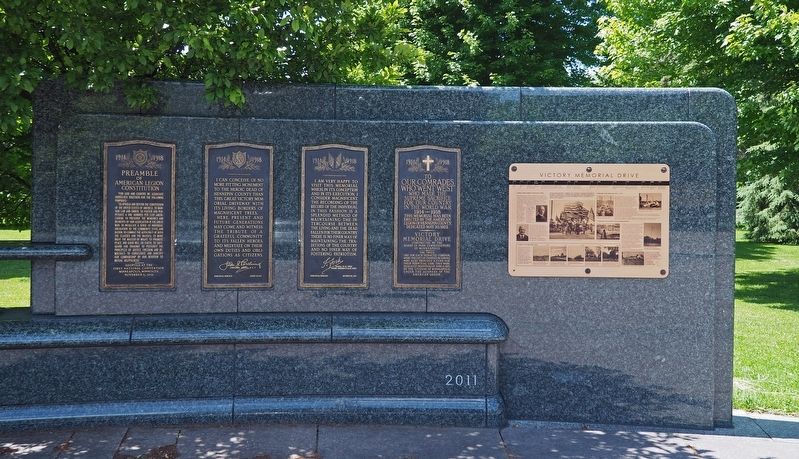
-Theodore Wirth, Superintendent of Minneapolis Parks, "Minneapolis Park Commissioners'1918 Annual Report"Photographed by McGhiever, June 7, 20242. Victory Memorial Drive Marker (right) at the southwest edge of the plaza
Victory Memorial Drive comprises one of America's largest memorials to the fallen of World War I. It reflects the dedication of the Minneapolis Park System's great visionaries and the commitment of this community to its parks and its veterans.
[Caption:] Veterans of the Great War leading a parade at Victory Memorial Drive.
Evolution of the Memorial's Trees
I was most anxious that the American elms, which were to be planted on Victory Memorial Drive, a memorial of trees to our soldier dead, should be of a selected type as to uniformity and habit of growth, so that in their ultimate maturity the magnificence of their stately beauty, symmetrical type, and majestic growth would be gloriously manifest. -Theodore Wirth, "Minneapolis Park System, 1883-1944"
1921: 1,217 Moline Elms were planted in rank and file order by veterans and school children.
1922-1926: The Moline Elms didn't survive Minnesota's winters and were replaced with American elms.
1930s-1960s: American Elms matured in perfect rank and file order.
1970s: Many of the elms died of Dutch Elm disease and were replaced by hackberry trees.
2010s: Despite decades of change, the trees remain a powerful memorial to this county's WWI dead.
Dedication of the Memorial: June 11, 1921
Victory Memorial Drive was dedicated on Saturday, June 11, 1921. Over 30,000 people lined Victory Memorial Drive and listened to the dedication ceremonies and speeches. Wood markers with the names, ranks, and companies of the dead were set by 555 of the trees and decorated with wreaths and bunting by roughly 2,500 school children and war veterans. Eventually, this number would grow to 568 markers and each wood marker was replaced with a bronze Christian Cross or Star of David.
Veterans and mounted cavalry marched the entire length of the new drive carrying flowing American flags and those of their units. As the parades from the eastern and southern ends of the Drive passed in front of the reviewing stand, airplanes flew overhead dropping poppies, roses, and peonies. Military and political leaders from the United States, France, and Great Britain, along with local public officials, wrote tributes or gave speeches honoring the fallen and praising the memorial's visionaries.
Charles M. Loring made his last public appearance on the great day. He toured the Drive, but was too frail to leave his automobile. He died on March 18, 1922, and is buried in Lakewood Cemetery.
[Caption:] The Drive's dedication attracted more than 30,000 spectators.
[Caption:] School children helped veterans decorate the memorial trees and markers.
Continuing Improvements to Victory Memorial Drive
The flagpole at the Memorial today is actually the fourth to appear here. The original wooden flagpole was replaced on May 30, 1923 (Decoration Day) with a new steel pole, painted to resemble bronze, set in an ornamental brick base. Set around the base were eight bronze plaques with quotations and the names of the honored dead. These plaques can be seen today in the walls that surround the flagpole.
In 1924, the area across the Drive from the flagpole was designated the Grand Army of the Republic Circle. Ten elm trees were planted in the circle in honor of the ten Hennepin County posts of the Grand Army of the Republic.
Throughout the decades, Victory Memorial Drive continued to change as new homes and civic institutions were developed.
In the mid-1970s, a new plan was developed for the city's parkways that introduced new lighting, parking bays, separated multi-use trail, and wide curbs.
In 2010-2011, a new flag plaza was constructed as well as improvements to the Grand Army of the Republic Circle and gateways marking the entries to the Drive. The current design features design elements built with granite quarried from near Isabella, Minnesota. A pavement stripe marks the flagpole shadow at the exact time of Armistice Day—
The eleventh hour
of the eleventh day
of the eleventh month.
[Caption:] In the 1970s, the plaza was redesigned and the granite flag base and walls remained from 1958.
[Caption:] In 1935, workers installed curb along the Drive.
Erected 2011.
Topics. This historical marker is listed in this topic list: War, World I. A significant historical date for this entry is June 11, 1921.
Location. 45° 2.222′ N, 93° 19.176′ W. Marker is in Robbinsdale, Minnesota, in Hennepin County. It can be reached from the intersection of Memorial Drive and Xerxes Avenue N., on the right when traveling west. The marker is on the southwest edge of the Victory Flagpole plaza. Touch for map. Marker is in this post office area: Minneapolis MN 55422, United States of America. Touch for directions.

Regionally, this marker is in the Twin Cities Metropolitan Area. It is also in the American Midwest, in the Corn Belt, and in the Great River Road Region. Globally, it is in North America, the Western Hemisphere, the Western World, and the Anglosphere. Historically, it finds itself in what was once Rupert’s Land, the territory of the Mississippian Culture, and the Louisiana Purchase.
Other nearby markers. At least 8 other markers are within 2 miles of this marker, measured as the crow flies: To Our Comrades Who "Went West" (here, next to this marker); a different marker also named Victory Memorial Drive (a few steps from this marker); The Great War (a few steps from this marker); "Lest We Forget" (a few steps from this marker); Grand Army of the Republic (about 400 feet away, measured in a direct line); Garden Dedicated to Frances Pollard (approx. 1.2 miles away); The "Lumberman" (approx. 1.4 miles away); Webber Pool (approx. 1.4 miles away). Touch for a list and map of all markers in Robbinsdale.
Credits. This page was last revised on August 26, 2024. It was originally submitted on August 26, 2024, by McGhiever of Minneapolis, Minnesota. This page has been viewed 330 times since then and 71 times this year. Photos: 1, 2. submitted on August 26, 2024, by McGhiever of Minneapolis, Minnesota.
