Collingwood in Simcoe County, Ontario — Central Canada (North America)
The Northern Railway Company of Canada
Photographed by Cosmos Mariner, June 4, 2024
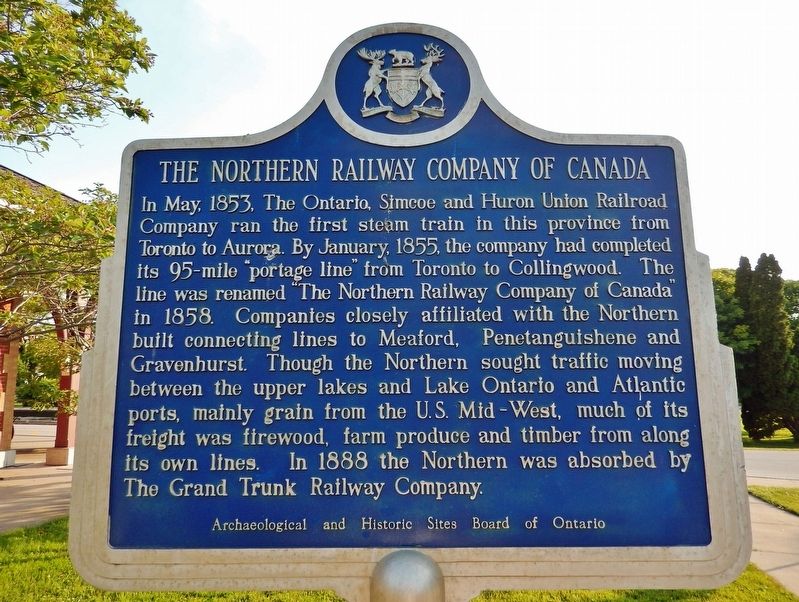
1. The Northern Railway Company of Canada Marker
In May, 1853, the Ontario, Simcoe and Huron Union Railroad Company ran the first steam train in this province from Toronto to Aurora. By January 1855, the company had completed its 95-mile “portage line” from Toronto to Collingwood. The line was renamed “The Northern Railway Company of Canada” in 1858. Companies closely affiliated with the Northern built connecting lines to Meaford, Penetanguishene and Gravenhurst. Though the Northern sought traffic moving between the upper lakes and Lake Ontario and Atlantic ports, mainly grain from the U.S. Mid-West, much of its freight was firewood, farm produce and timber from along its own lines. In 1888 the Northern was absorbed by the Grand Trunk Railway Company.
Erected by Archaeological and Historic Sites Board of Ontario.
Topics and series. This historical marker is listed in these topic lists: Industry & Commerce • Railroads & Streetcars. In addition, it is included in the Canada, Ontario Heritage Trust series list. A significant historical month for this entry is May 1853.
Location. 44° 30.18′ N, 80° 12.862′ W. Marker is in Collingwood, Ontario, in Simcoe County. It can be
this page online

Regionally, this marker is in Central Ontario Cottage Country and specifically in Georgian Bay Country. It is also in Central Canada. Globally, it is in North America, on the Great Lakes, in the Western Hemisphere, in the Western World, and in the Anglosphere. Historically, it finds itself in what was once a British colony, the Viceroyalty of New France, the Haudenosaunee (Iroquois) Confederacy, and Rupert’s Land.
Other nearby markers. At least 8 other markers are within walking distance of this marker: The Associated Country Women of the World / L'union mondiale des femmes rurales (here, next to this marker); Collingwood - An Overview / Collingwood Elevators (within shouting distance of this marker); Collingwood World War I Cenotaph (within
Photographed by Cosmos Mariner, June 4, 2024
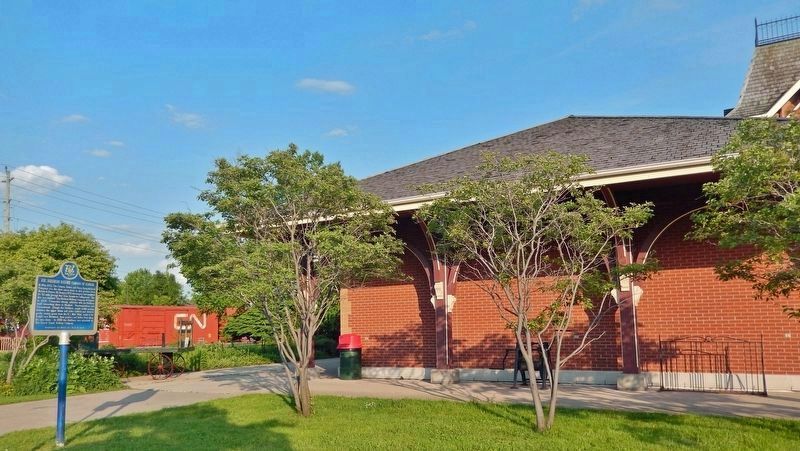
2. The Northern Railway Company of Canada Marker
Looking from the northwest; the Collingwood Museum (former Collingwood Train Station) is in the background.
Also see . . . Northern Railway of Canada (Wikipedia).
Excerpt: The Northern Railway of Canada was the first steam railway to enter service in what was then known as Upper Canada. It was eventually acquired by the Grand Trunk Railway, and is therefore a predecessor to the modern Canadian National Railway (CNR). First known as the Toronto, Simcoe and Huron Railway, and then the Ontario, Simcoe and Huron Railway, the aim was to provide a portage route from the upper Great Lakes at Collingwood to Toronto.(Submitted on August 28, 2024, by Cosmos Mariner of Cape Canaveral, Florida.)In February 1853, the railway commissioned the construction of the first locomotive built in any British colony. Early construction required the line to pass over the Oak Ridges Moraine, and it was not until
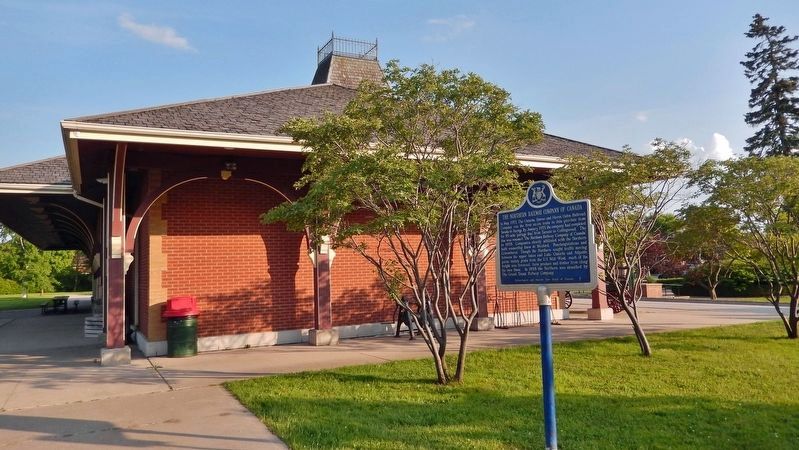
16 May 1853 that the first train reached Machell's Corners, today's Aurora, Ontario. Work north of there was much more rapid; the line reached Allandale in Barrie later in 1853, and Collingwood in 1855. Early traffic was dominated by agricultural products, earning it the nickname “Oats, Straw, and Hay.”Photographed by Cosmos Mariner, June 4, 20243. The Northern Railway Company of Canada MarkerLooking from the north; the Collingwood Museum (former Collingwood Train Station) is in the background.A combination of factors, including the Great Depression and the opening of a wider Welland Canal led to decreased use of the ports, and traffic fell. The closure of Collingwood Shipbuilding in 1986 led to the abandonment of the sections in Collingwood and to the west. Several sections of the line have been turned over to rail trail use. The section of the mainline from the western side of Collingwood to Meaford is now the high-quality 34 km Georgian Trail.
Photographed by Cosmos Mariner, June 4, 2024
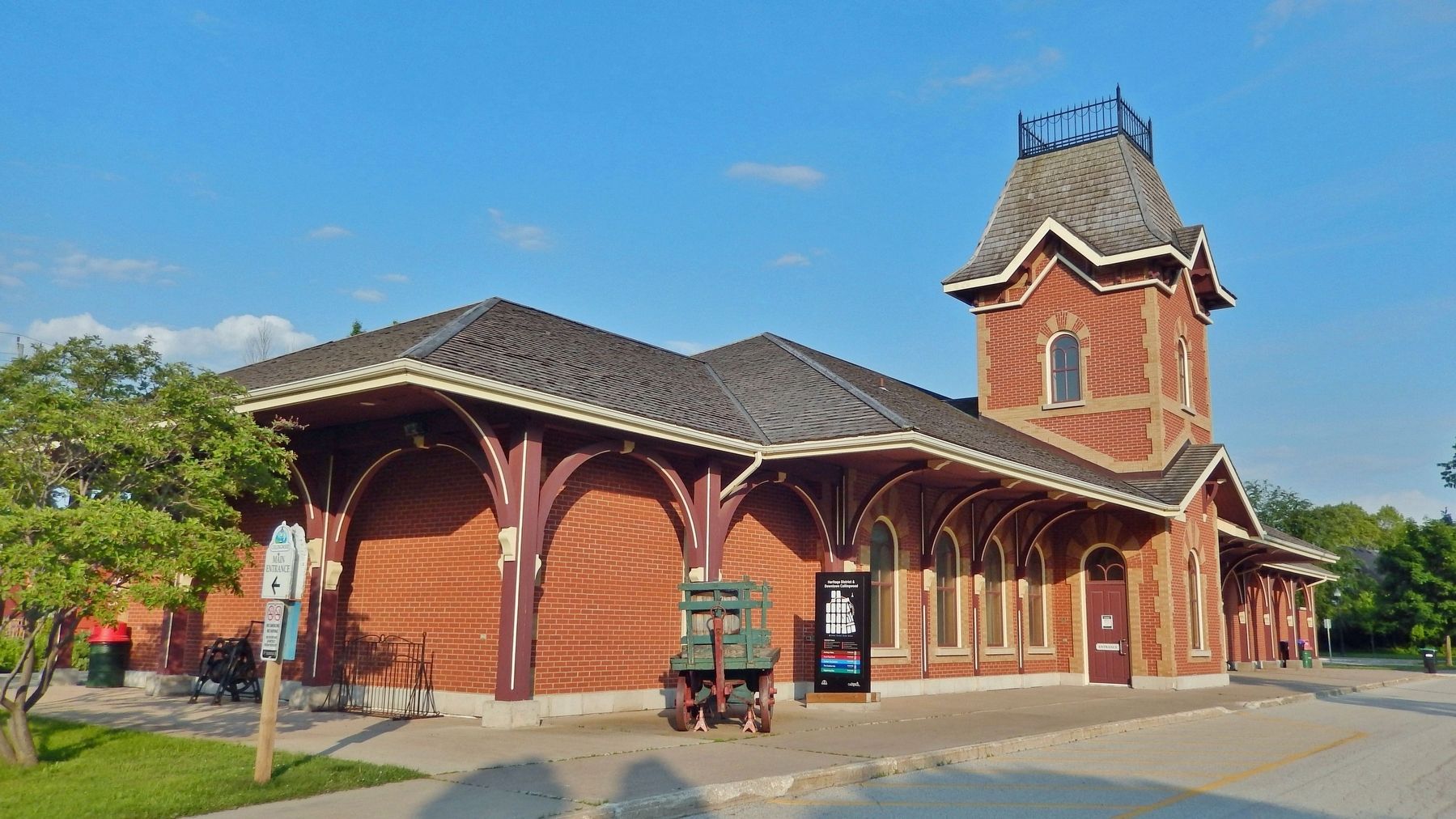
4. Collingwood Train Station (northwest elevation)
Today houses the Collingwood Museum.
Credits. This page was last revised on August 28, 2024. It was originally submitted on August 27, 2024, by Cosmos Mariner of Cape Canaveral, Florida. This page has been viewed 183 times since then and 18 times this year. Photos: 1, 2, 3. submitted on August 27, 2024, by Cosmos Mariner of Cape Canaveral, Florida. 4. submitted on August 28, 2024, by Cosmos Mariner of Cape Canaveral, Florida.
