J.E.H. MacDonald 1873-1932
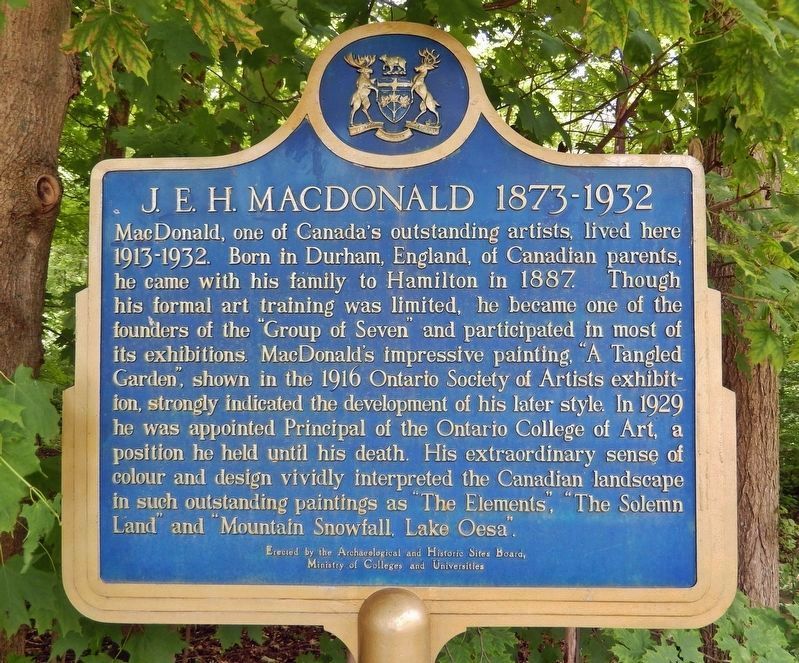
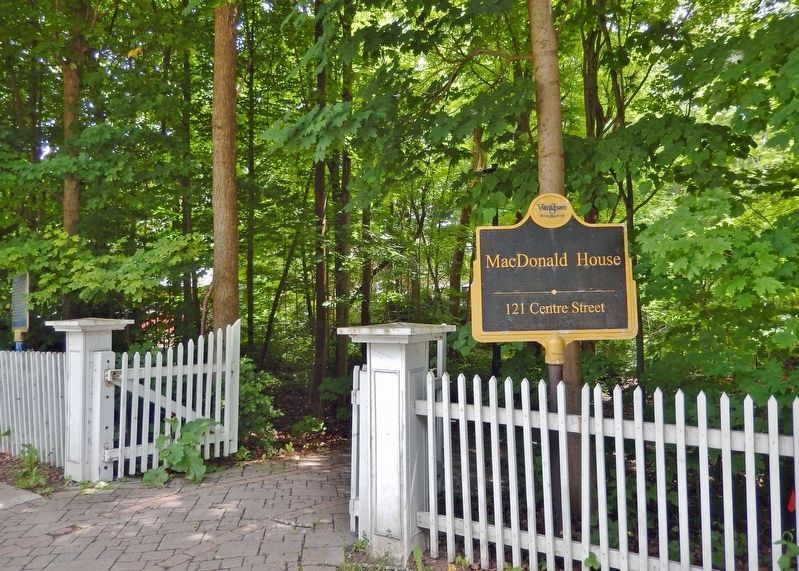
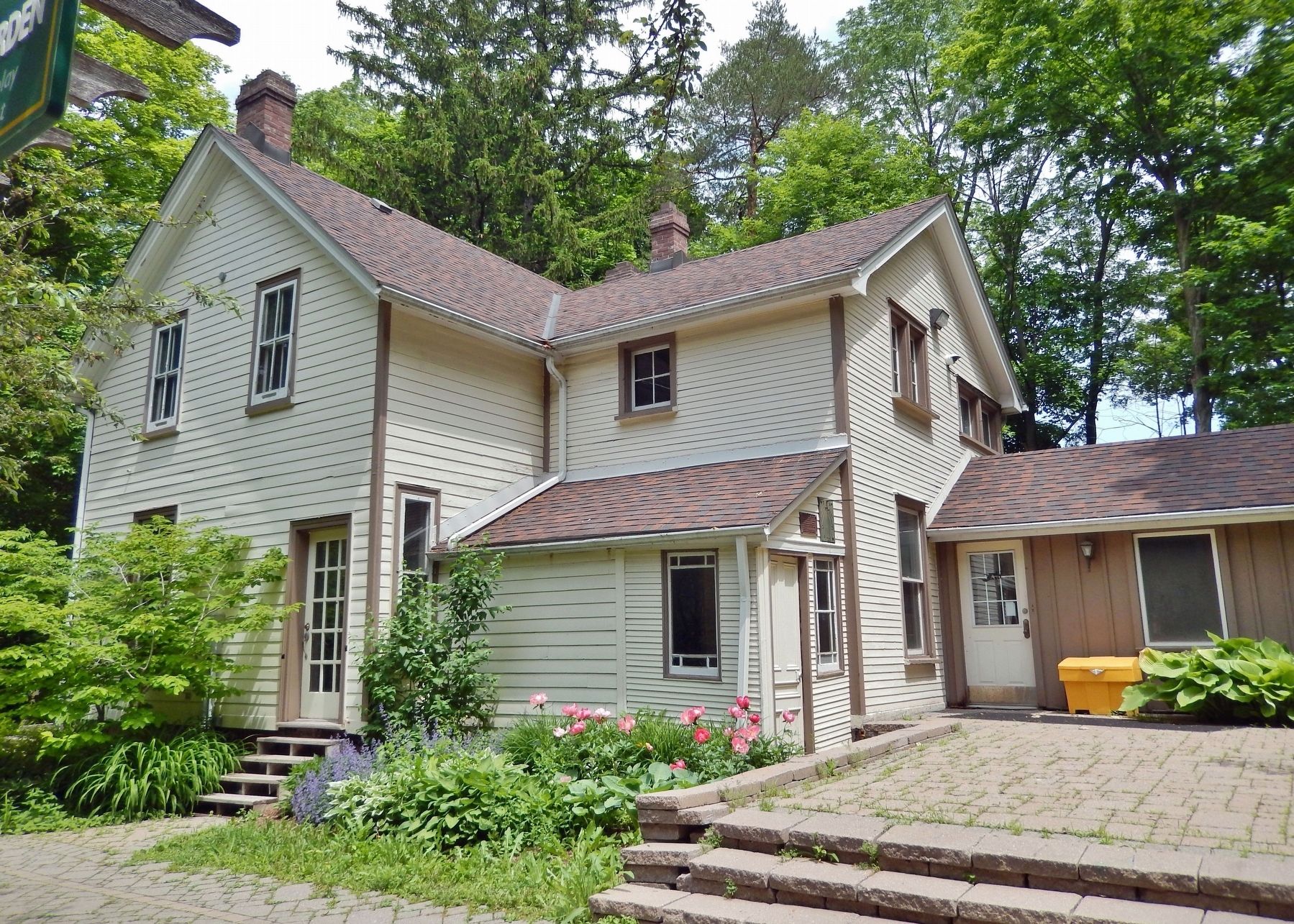
MacDonald, one of Canada's outstanding artists, lived here 1913-1932. Born in Durham, England, of Canadian parents, he came with his family to Hamilton in 1887. Though his formal art training was limited, he became one of the founders of the “Group of Seven” and participated in most of its exhibitions. MacDonald's impressive painting, “A Tangled Garden”, shown in the 1916 Ontario Society of Artists exhibition, strongly indicated the development of his later style. In 1929 he was appointed Principal of the Ontario College of Art, a position he held until his death. His extraordinary sense of colour and design vividly interpreted the Canadian landscape in such outstanding paintings as “The Elements”, “The Solemn Land” and “Mountain Snowfall, Lake Oesa”.
Erected by Archaeological and Historic Sites Board, Ministry of Colleges and Universities.
Topics and series. This historical marker is listed in these topic lists: Arts, Letters, Music • Education. In addition, it is included in the Canada, Ontario Heritage Trust series list. A significant historical year for this entry is 1913.
Location. 43° 48.924′ N, 79° 25.694′ W.
this page online

Regionally, this marker is in Greater Toronto, specifically on the Golden Horseshoe, in the York, Durham and Headwaters Area, and in the Toronto Metropolitan Area. It is also in Central Canada. Globally, it is in North America, the Western Hemisphere, the Western World, and the Anglosphere. Historically, it finds itself in what was once a British colony, the Viceroyalty of New France, the Haudenosaunee (Iroquois) Confederacy, and Rupert’s Land.
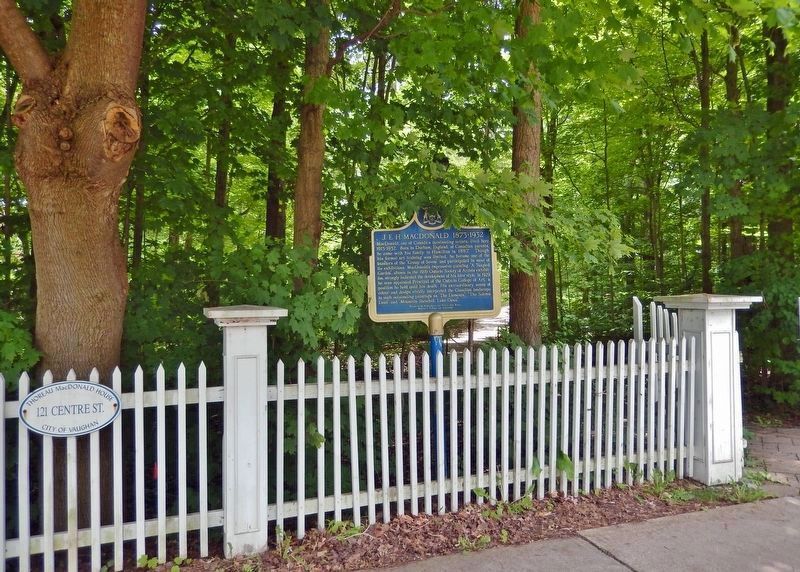
Other nearby markers. At least 8 other markers are within 8 kilometers of this marker, measured as the crow flies: Unearthing Thoreau's Thornhill (within shouting distance of this marker); Holy Trinity Church (about 150 meters away, measured in a direct line); Yonge Street Hill
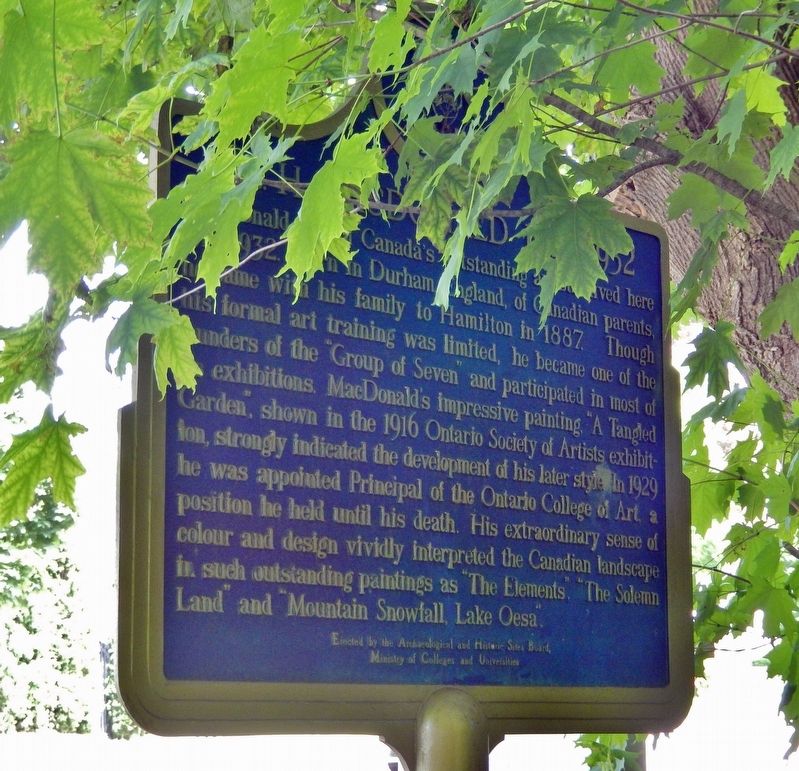
More about this marker. Both sides of this marker have the same English inscription.
Also see . . .
1. James Edward Hervey MacDonald (Wikipedia).
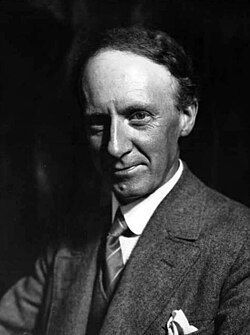
Excerpt: English-Canadian artist, best known as a member of the Group of Seven who asserted a distinct national identity combined with a common heritage stemming from early modernism in Europe in the early twentieth century. He was the father of the illustrator, graphic artist and designer Thoreau MacDonald.(Submitted on August 29, 2024, by Cosmos Mariner of Cape Canaveral, Florida.)In 1920, MacDonald co-founded the Group of Seven, which dedicated itself to promoting a distinct Canadian art developed through direct contact with the Canadian landscape. The other founding members were Frederick Varley, A. Y. Jackson, Lawren Harris, Frank Johnston, Arthur Lismer, and Franklin Carmichael. Together they initiated what they asserted was the first major Canadian national art movement, producing paintings directly inspired by the Canadian landscape. In 1921, MacDonald was appointed instructor in decorative art and commercial design at the Ontario College of Art and his teaching commitments somewhat curtailed his painting activities. However, every summer from 1924 until 1930, MacDonald travelled to the Canadian Rockies to paint the mountain landscapes that dominated his later work.
Today, MacDonald is viewed with general admiration for his art, with one writer commenting, "no Canadian landscape painter possessed a richer command of colour and pigment than J. E. H. MacDonald
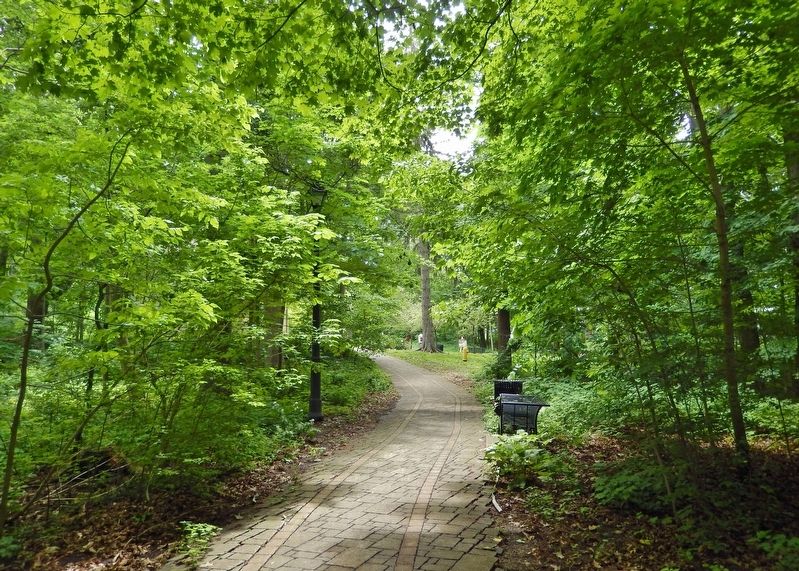
... His brushwork is at once disciplined and vigorous. His best on-the-spot sketches possess an intensity and freshness of execution not dissimilar from Van Gogh." His former home and 4-acre garden in Vaughan, Ontario have been restored. Owned by the City of Vaughan, they are open to the public.Photographed by Cosmos Mariner, June 3, 20243. J.E.H. MacDonald 1873-1932 Marker (south side)The south side of the marker is obscured by trees.
2. J. E. H. MacDonald Artworks Gallery (wikiart.org). (Submitted on August 29, 2024, by Cosmos Mariner of Cape Canaveral, Florida.)
Credits. This page was last revised on July 5, 2026. It was originally submitted on August 28, 2024, by Cosmos Mariner of Cape Canaveral, Florida. This page has been viewed 251 times since then and 44 times this year. Photos: 1. submitted on August 29, 2024, by Cosmos Mariner of Cape Canaveral, Florida. 2. submitted on July 5, 2026, by Larry Gertner of New York, New York. 3, 4, 5, 6, 7. submitted on August 29, 2024, by Cosmos Mariner of Cape Canaveral, Florida.
