Holy Trinity Church
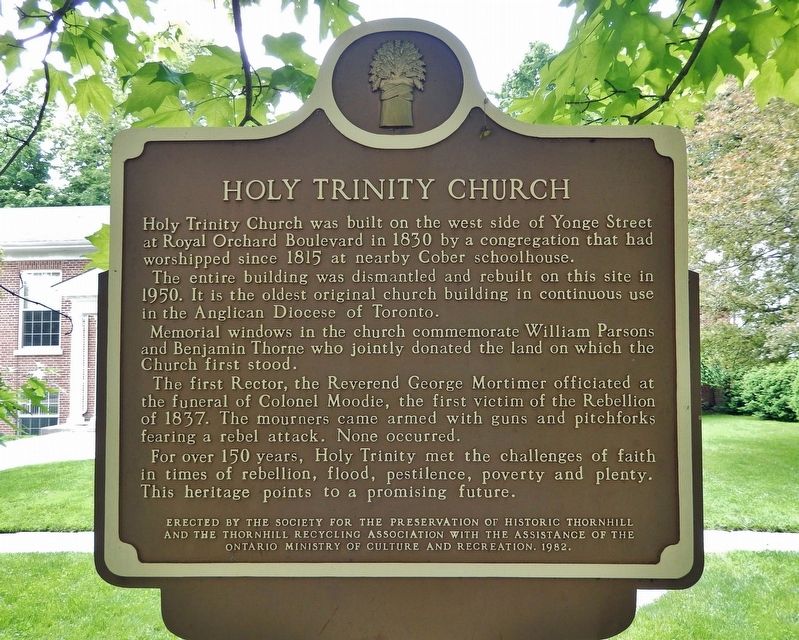
Holy Trinity Church was built on the west side of Yonge Street at Royal Orchard Boulevard in 1830 by a congregation that had worshipped since 1815 at nearby Cober schoolhouse.
The entire building was dismantled and rebuilt on this site in 1950. It is the oldest original church building in continuous use in the Anglican Diocese of Toronto.
Memorial windows in the church commemorate William Parsons and Benjamin Thorne who jointly donated the land on which the Church first stood.
The first Rector, the Reverend George Mortimer officiated at the funeral of Colonel Moodie, the first victim of the Rebellion of 1837. The mourners came armed with guns and pitchforks fearing a rebel attack. None occurred.
For over 150 years, Holy Trinity met the challenges of faith in times of rebellion, flood, pestilence, poverty and plenty. This heritage points to a promising future.
Erected 1982 by Society for the Preservation of Historic Thornhill and the Thornhill Recycling Association with the assistance of the Ontario Ministry of Culture and Recreation.
Topics. This historical marker is listed in these topic lists: Architecture
this page online
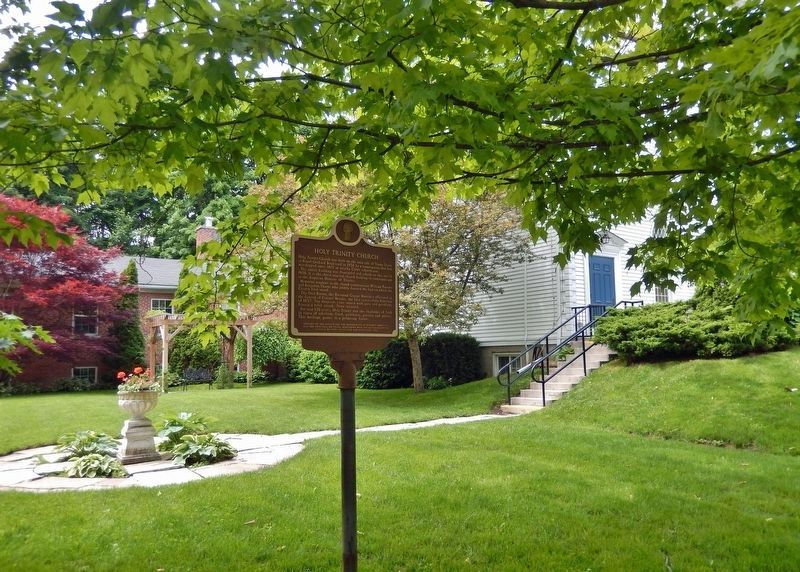
Location. 43° 48.855′ N, 79° 25.639′ W. Marker is in Vaughan, Ontario, in York Region. It is in Thornhill. It is on Brooke Street just south of Old Jane Street, on the right when traveling south. The marker is located in the grassy courtyard on the south side of the church. Touch for map. Marker is at or near this postal address: 140 Brooke Street, Vaughan ON L4J 1Y9, Canada. Touch for directions.

Regionally, this marker is in Greater Toronto, specifically on the Golden Horseshoe, in the York, Durham and Headwaters Area, and in the Toronto Metropolitan Area. It is also in Central Canada. Globally, it is in North America, the Western Hemisphere, the Western World, and the Anglosphere. Historically, it finds itself in what was once a British colony, the Viceroyalty of New France, the Haudenosaunee (Iroquois) Confederacy, and Rupert’s Land.
Other nearby markers. At least 8 other markers are within 8 kilometers of this marker, measured as the crow flies: Unearthing Thoreau's Thornhill
Also see . . .
1. History of Holy Trinity Anglican Church (Holy Trinity website).
Excerpt: In 1828 Thornhill was one of several places selected by Archdeacon Strachan and Bishop Stewart to receive the ministrations of professors of theology and divinity students who were sent here to conduct regular services. Erection of a church building soon became necessary. The two laymen chiefly responsible for the undertaking were William Parsons and his brother-in-law Benjamin Thorne, both who had come to this area from England, and who had both been successful in business. They donated the property for the church and the burial ground.(Submitted on August 29, 2024, by Cosmos Mariner of Cape Canaveral, Florida.)By
the 1830’s Thornhill had become a thriving pioneer community. Among the many businesses were four grist mills, three saw mills, four tanneries, a brickyard, two distilleries, seven taverns and several stores. It was during this bustle of activity that the church was constructed. Trinity Church, as it was formerly known, is the oldest original church building still in use in the Diocese.Photographed by Cosmos Mariner, June 3, 20243. Ontario Heritage Act PlaqueTown of Vaughan
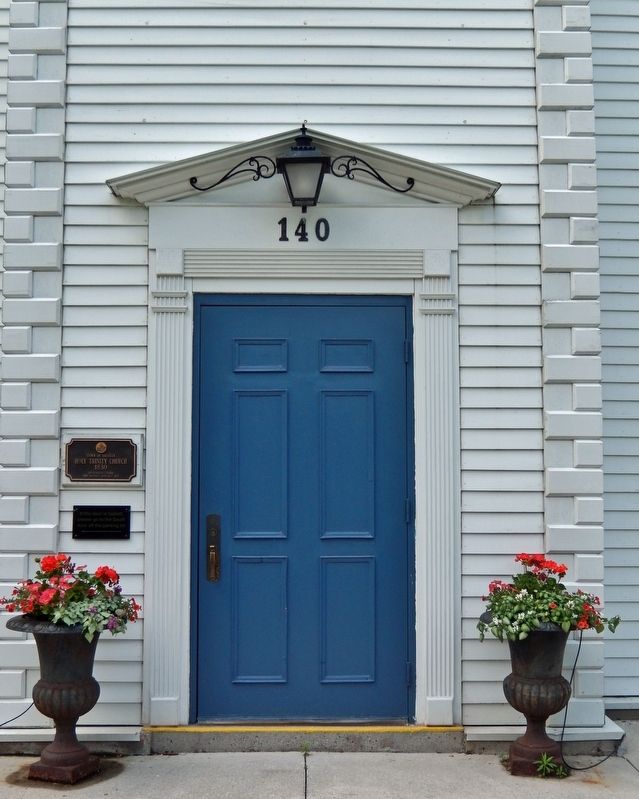
Holy Trinity Church
1830
Designated Under
The Ontario Heritage ActThe 15 years after the building of the church were years of prosperity and expansion in Upper Canada. Within a decade, the congregation had grown to such an extent that some change became necessary to accommodate the large numbers attending services. In 1840, with the addition of an aisle to each side of the church, the width was increased to forty-eight feet, and the seating capacity was almost doubled.
At the Vestry meeting in 1947 a startling suggestion was made to the congregation to purchase a quieter and more suitable site in Thornhill. Such a property was available on Brooke Street thanks to the kindness of Dr. Lorne Pierce and the co-operation of Mr. Thoreau MacDonald. The vestry agreed, and a site with three hundred feet of frontage was purchased
from Dr. Pierce, with the assistance of the Church Extension Committee of the Diocese. The decision was made to move the church building to the new site, to renovate it, and to enlarge it. In its new location on Brooke Street, Holy Trinity Church as it was renamed, has continued to thrive, and has been a welcoming place of worship and service to many during the past years.Photographed by Cosmos Mariner, June 3, 20244. Holy Trinity Church Front EntranceThe Ontario Heritage Act Plaque is mounted on the left side of the front entrance.

2. Holy Trinity Anglican Church (Vaughan City Archives).
Excerpt: John Strachan, who later became the first bishop of Toronto, officially opened the church in 1829 and held the first service on Feb. 29, 1830. According to City records, it is believed the first wedding at the church took place in May 1830, between Mary Sophia Gapper and Captain Edmund O’Brien. The church’s first rector was Reverend George Mortimer, and the first warden was William Parsons. Originally, there was no space in the church to hold Sunday school or other meetings. This led to the creation of a parish hall in 1928 on the same land. Then, in 1950, the church was remodeled and built on a new site, approximately(Submitted on August 29, 2024, by Cosmos Mariner of Cape Canaveral, Florida.)one km south of the original location, on the corner of present-day Old Jane Street and Brooke Street.Photographed by Cosmos Mariner, June 3, 20245. Holy Trinity Anglican Church Marker(over the door on the right side of the front façade) Thornhill’s oldest church building erected 1830 on the west side of Yonge St. dismantled and re-erected on the present site in 1950.


Credits. This page was last revised on August 29, 2024. It was originally submitted on August 28, 2024, by Cosmos Mariner of Cape Canaveral, Florida. This page has been viewed 201 times since then and 48 times this year. Photos: 1, 2, 3, 4, 5, 6. submitted on August 29, 2024, by Cosmos Mariner of Cape Canaveral, Florida.
