Port Glasgow in Elgin County, Ontario — Central Canada (North America)
Burning of the Mills, 1814
Photographed by Tim Boyd, August 23, 2024
1. Burning of the Mills, 1814 Marker
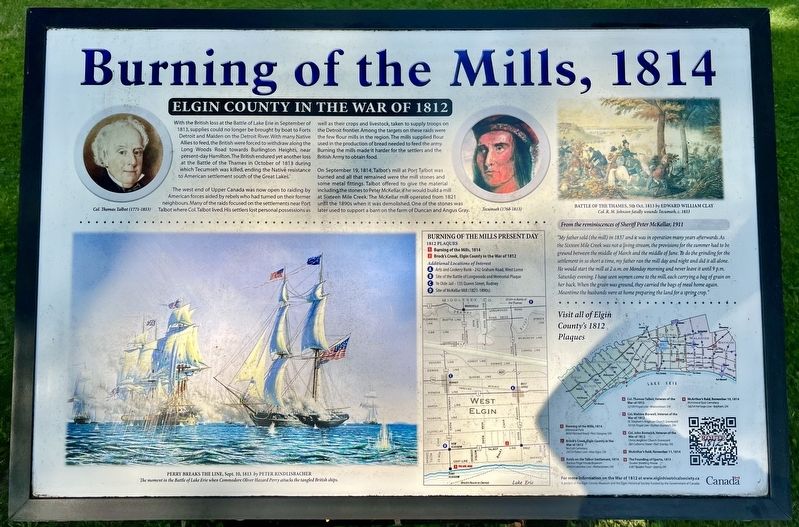
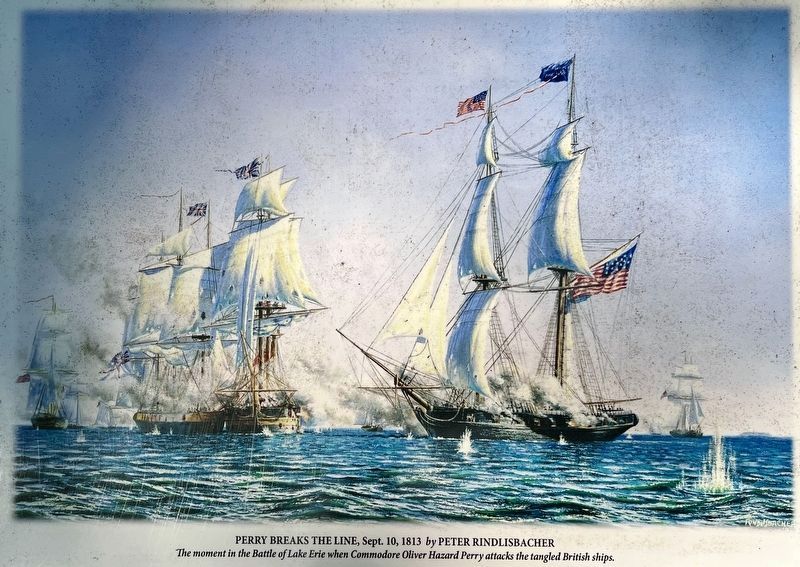
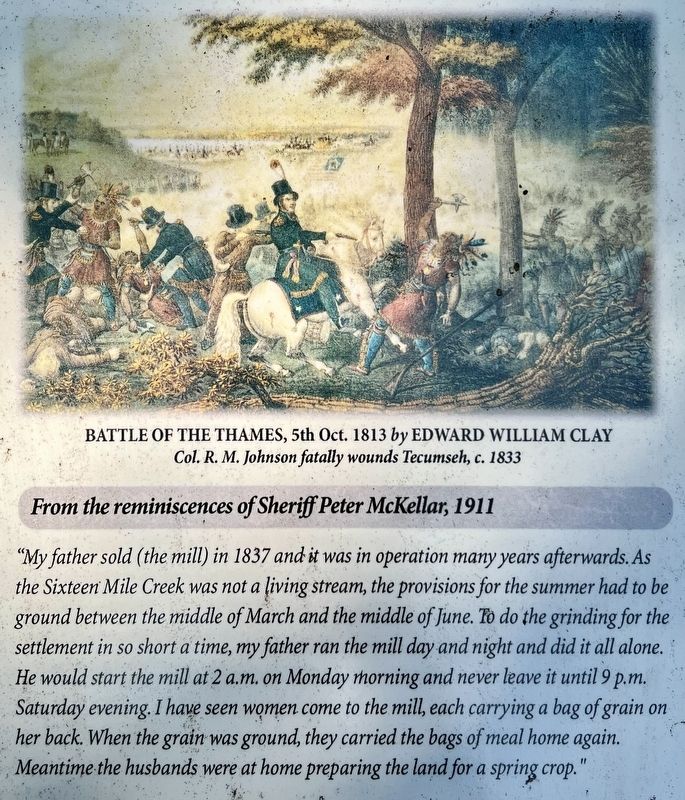
With the British loss at the Battle of Lake Erie in September of 1813, supplies could no longer be brought by boat to Forts Detroit and Malden on the Detroit River. With many Native Allies to feed, the British were forced to withdraw along the Long Woods Road towards Burlington Heights, near present-day Hamilton. The British endured yet another loss at the Battle of the Thames in October of 1813 during which Tecumseh was killed, ending the Native resistance to American settlement south of the Great Lakes.
The west end of Upper Canada was now open to raiding by American forces aided by rebels who had turned on their former neighbours. Many of the raids focused on the settlements near Port Talbot where Col. Talbot lived. His settlers lost personal possessions as well as their crops and livestock, taken to supply troops on the Detroit frontier. Among the targets on these raids were the few flour mills in the region. The mills supplied flour used in the production of bread needed to feed the army. Burning the mills made it harder for the settlers and the British Army to obtain food.
On September 19, 1814, Talbot's mill
this page online
Erected by Elgin County Museum.
Topics. This historical marker is listed in this topic list: War of 1812. A significant historical date for this entry is September 19, 1814.
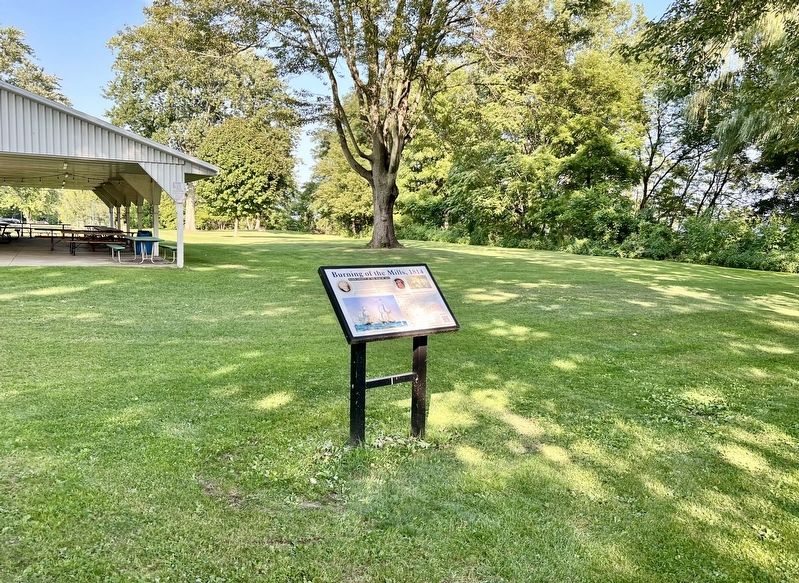
Location. 42° 30.589′ N, 81° 36.62′ W. Marker is in Port Glasgow, Ontario, in Elgin County. It is on Furnival Road 0.4 kilometers south of Gray Road, on the left when traveling south. The marker is in Memorial Park. Touch for map. Marker is at or near this postal address: 8609 Furnival Road, Port Glasgow ON N0L 2C0, Canada. Touch for directions.

Regionally, this marker is in the Southwest Ontario Area and in Southwestern Ontario. It is also in Central Canada. Globally, it is in North America, on the Great Lakes, in the Western Hemisphere, in the Western World, and in the Anglosphere.
Photographed by Tim Boyd, August 23, 2024
2. Burning of the Mills, 1814 Marker
Other nearby markers. At least 8 other markers are within 18 kilometers of this marker, measured as the crow flies: Aldborough Pioneers’ and Soldiers’ Memorial Park “Historic Stone” (here, next to this marker); Aldborough Pioneers/ Pioneer Parliamentarian (a few steps from this marker); Port Glasgow Summer Dance Pavilion (within shouting distance of this marker); Brock’s Creek (approx. 5.9 kilometers away); Tyrconnell (approx. 15.8 kilometers away); Raids on the Talbot Settlement, 1814 (approx. 17.3 kilometers away); St. Peter’s Church 1827 (approx. 17.6 kilometers away); Ellis Wellwood Sifton, V.C. (approx. 17.6 kilometers away). Touch for a list and map of all markers in Port Glasgow.
Related marker. Click here for another marker that is related to this marker.
Also see . . . Battles in Upper Canada and the Great Lakes (heritagetrust.on.ca).
The British and their Indigenous allies withstood the American offensive on the Niagara Peninsula and achieved(Submitted on August 29, 2024, by Tim Boyd of Hamilton, Ontario.)impressive victories. On the Michigan frontier, however, the Americans regained the advantage. Procter and Tecumseh attempted to push the Americans out of Fort Meigs in April and May, as well as Fort Stephenson in August, but the offensives failed. Meanwhile, on Lake Erie, the Americans launched new ships and defeated the small and neglected British fleet led by Captain Robert Barclay. Having lost control of Lake Erie and failing to dislodge the American army, Procter ordered the retreat from Michigan territory. Tecumseh reluctantly agreed. As Procter and Tecumseh led their force of 950 soldiers, militia and warriors back into Upper Canada, they were intercepted by the Americans in Thames Valley. In this battle, known as the Battle of Moraviantown, the American forces held the numerical advantage by three to one. General Procter and some soldiers and warriors escaped, but Tecumseh was killed in action. His death had such a profound impact on the morale of the Western Nations warriors that they signed a ceasefire with the American General.Photographed by Peter Rindlisbacher3. Burning of the Mills, 1814 marker photo detail
Photographed by Tim Boyd, August 23, 2024
4. Burning of the Mills, 1814 marker photo detail
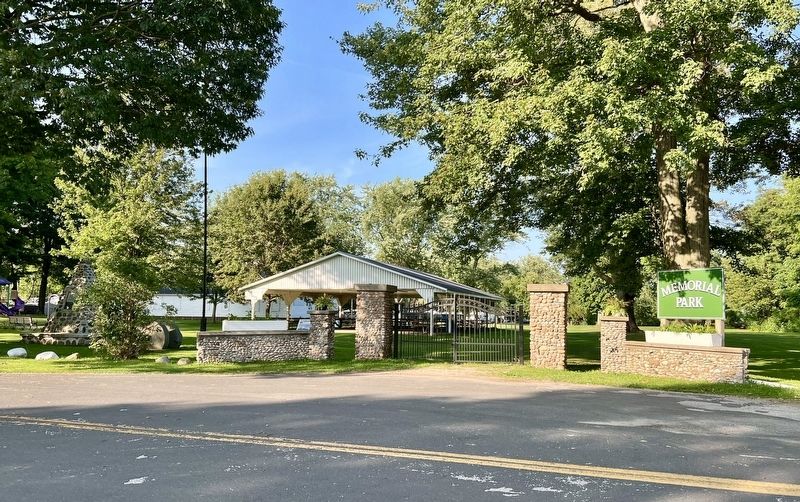
Photographed by Tim Boyd, August 23, 2024
5. Memorial Park, Port Glasgow
Credits. This page was last revised on May 27, 2026. It was originally submitted on August 29, 2024, by Tim Boyd of Hamilton, Ontario. This page has been viewed 131 times since then and 16 times this year. Photos: 1, 2, 3, 4, 5. submitted on August 29, 2024, by Tim Boyd of Hamilton, Ontario. • Andrew Ruppenstein was the editor who published this page.
