Highland in Denver in Denver County, Colorado — The American Mountains (Southwest)
Trolley Town
Photographed by Craig Baker, August 25, 2024
1. Trolley Town Marker
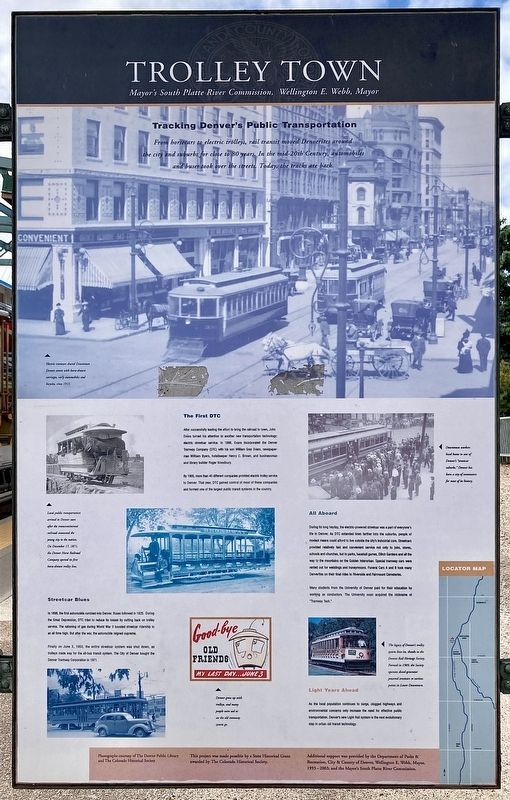
Tracking Denver's Public Transit
From horsecars to electric trolleys, rail transit moved Denver-ites around the city and suburbs for close to 80 years. In the mid-20th Century, automobiles and buses took over the streets. Today, the tracks are back.
Local public transportation arrived in Denver soon after the transcontinental railroad connected the young city to the nation. On December 17, 1871, the Denver Horse Railroad Company opened its first horse-drown trolley line.
The First DTC
After successfully leading the effort to bring the railroad to town, John Evans turned his attention to another new transportation technology: electric streetcar service. In 1856, Evans incorporated the Denver Tramway Company (DTC) with his son William Gray Evans, newspaperman William Byers, hotelkeeper Henry C. Brown, and businessman and library builder Roger Woodbury.
By 1900, more than 40 different companies provided electric trolley service to Denver. That year, DTC gained control of most of these companies and formed one of the largest public transit systems in the country.
All Aboard
During its long heyday, the electric-powered streetcar was a part of everyone's life in Denver. As DTC extended lines farther into the suburbs, people of modest means could afford to live outside the city's industrial core. Streetcars provided relatively fast and convenient service not onty to jobs, stores, schools and churches, but to parks, baseball games, Elitch Gardens and all the way to the mountains on the Golden Interurban. Special tramway cars were rented out for weddings and honeymoons, Funeral Cars A and B took many Denver-ites on their final rides to Riverside and Fairmount Cemeteries.
Many students from the University of Denver paid for their education by working as conductors.
this page online
Streetcar Blues
In 1898, the first automobile ambled into Denver. Buses followed in 1925. During the Great Depression, DTC tried to reduce its losses by cutting back on trolley service. The rationing of gas during World War II boosted streetcar ridership to an all-time high. But after the war, the automobile reigned supreme.
Finally, on June 3, 1950, the entire streetcar system was shut down, as trolleys made way for the all-bus transit system. The City of Denver bought the Denver Tramway Corporation in 1971.
Topics. This historical marker is listed in this topic list: Railroads & Streetcars. A significant historical date for this entry is June 3, 1950.
Location. 39° 45.279′ N, 105° 0.554′ W. Marker is in Denver, Colorado, in Denver County. It is in Highland. It can be reached from the intersection of Water Street and Platte Street. Located at the Denver Trolley, behind REI, along the South Platte River. Touch for map. Marker is at or near this postal address: 1400 Water St, Denver CO 80202, United States of America. Touch for directions.

Regionally, this marker is

Photographed by Craig Baker
2. Trolley Town Marker and Denver Trolly
Other nearby markers. At least 8 other markers are within walking distance of this marker: Denver Tramway Power Plant (here, next to this marker); Confluence Park: Reclaiming Denver's Birthplace (within shouting distance of this marker); Commons Park (approx. 0.2 miles away); Union Station (approx. 0.2 miles away); Riverfront Park (approx. 0.2 miles away); Little Raven (approx. ¼ mile away); Cheyenne Dog Soldiers (approx. ¼ mile away); Manny's Bridge (approx. 0.4 miles away). Touch for a list and map of all markers in Denver.
Credits. This page was last revised on August 29, 2024. It was originally submitted on August 29, 2024, by Craig Baker of Sylmar, California. This page has been viewed 579 times since then and 79 times this year. Photos: 1, 2. submitted on August 29, 2024, by Craig Baker of Sylmar, California.
