
Amsterdam-Centrum , North Holland, Netherlands — Northwestern Europe
Monument van Joodse Erkentelijkheid
⎯⎯⎯
Monument of Jewish Recognition
Photographed by Andrew Ruppenstein, July 15, 2024
1. Monument van Joodse Erkentelijkheid / Monument of Jewish Recognition Marker

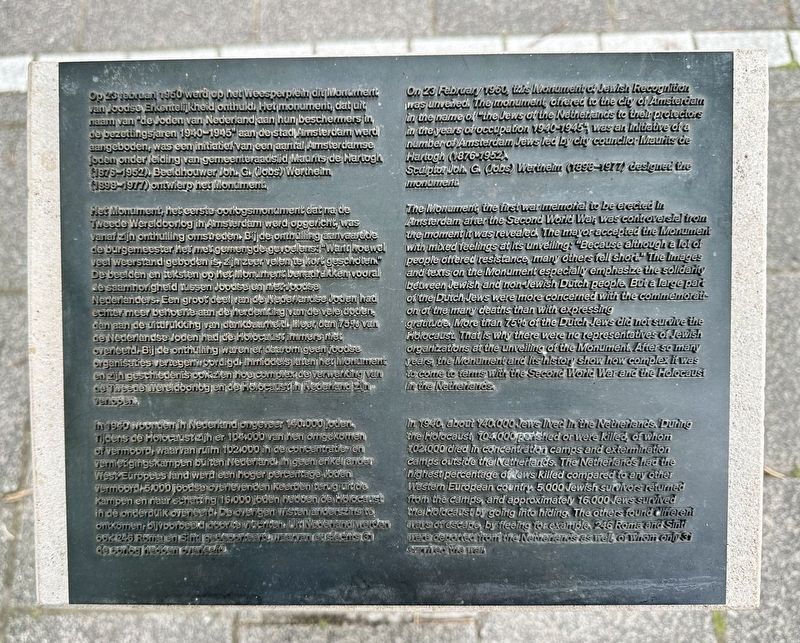
Het Monument, het eerste oorlogsmonument dat na do Tweede Wereldoorlog in Amsterdam werd opgericht, was vanaf zijn onthulling omstreden. Bij de onthulling aanvaardde de burgemeester het met gemengde gevoelens: "Want hoewel veel weerstand geboden is, zijn zeer velen te kort geschoten." De beelden en teksten op het Monument benadrukken vooral de saamhorigheid tussen Joodse en niet-Joodse Nederlanders. Een groot deel van de Nederlandse Joden had echter meer behoefte aan de herdenking van de vele doden, dan aan de uitdrukking van dankbaarheid. Meer dan 75% van de Nederlandse Joden had de Holocaust immers niet overleefd. Bij de onthulling waren er daarom geen joodse organisaties vertegenwoordigd. Inmiddels laten het Monument. en zijn geschiedenis ook zien hoe complex de verwerking van do Tweede Wereldoorlog en de Holocaust in Nederland zijn verlopen.
In 1940 woonden in Nederland ongeveer 140.000 joden. Tijdens de Holocaust zijn er 104.000 van hen omgekomen of vermoord, waarvan ruim 102.000 in de concentratie- en vernietigingskampen buiten Nederland. In geen enkel ander West-Europees land werd een hoger percentage Joden vermoord. 5.000 foodst overlevenden keerden terug uit de kampen en naar schatting 16.000 joden hebben de Holocaust in de onderduik overleefd. De overigen wisten anderszihs te ontkomen, bijvoorbeeld door te vluchten. Uit Nederland werden ook 246 Roma en Sinti gedeporteerd, waarvan er slechts 31 de orlog hebben overleefd.
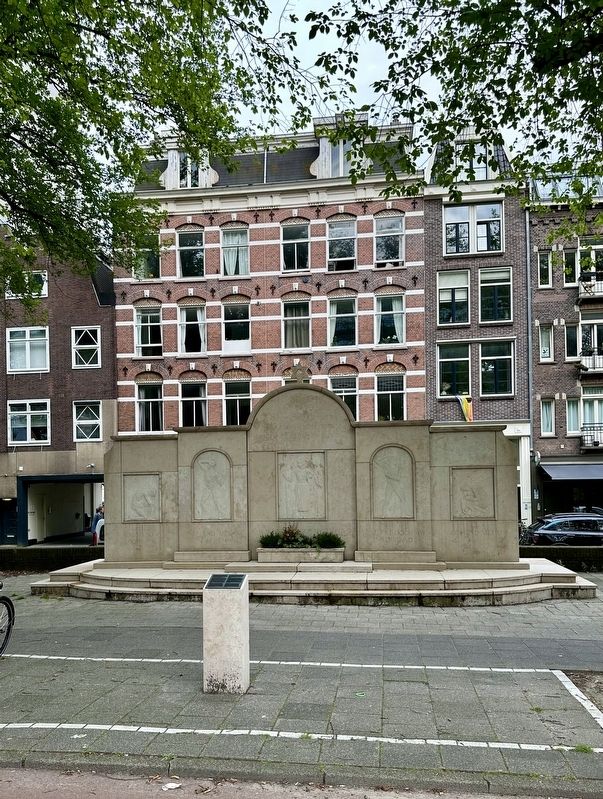
On 23 February 1950, this Monument of Jewish Recognition was unveiled. The monument, offered to the city of Amsterdam in the name of "the Jews of the Netherlands to their protectors in the years of occupation 1940-1945" was an initiative of a number of Amsterdam Jews led by city councilor Maurits de Hartogh (1876-1952). Sculptor Joh. G. (Jobs) Wertheim (1898-1977) designed the monument.
The Monument, the first war memorial to be erected in Amsterdam after the Second World War, was controversial from the moment it was revealed. The mayor accepted the Monument with mixed feelings at its unveiling: "Because although a lot of people offered resistance, many others fell short." The images and texts on the Monument especially emphasize the solidarity between Jewish and non-Jewish Dutch people. But a large part of the Dutch Jews were more concerned with the commemoration of the many deaths than with expressing gratitude. More than 75% of the Dutch Jews did not survive the Holocaust. That is why there were no representatives of Jewish organizations at the unveiling of the Monument. After so many years, the Monument and its history show how complex it was to come to terms with the Second World War and the Holocaust in the Netherlands.
In 1940, about 140.000 Jews lived in the Netherlands. During the Holocaust, 104.000 perished or were killed, of whom 102.000 died in concentration camps and extermination camps outside the Netherlands. The Netherlands had the highest percentage of Jews killed compared to any other Western European country. 5.000 Jewish survivors returned from the camps, and approximately 16.000 Jews survived the Holocaust by going into hiding. The others found different ways of escape, by fleeing for example. 246 Roma and Sinti were deported from the Netherlands as well, of whom only 31 survived the war.
Erected 2021.
this page online
Topics and series. This memorial is listed in this topic list: War, World II. In addition, it is included in the The Holocaust series list. A significant historical date for this entry is February 23, 1950.
Location. 52° 21.713′ N, 4° 54.471′ E. Memorial is in Amsterdam, Noord-Holland (North Holland). It is in Amsterdam-Centrum. It is on Weesperplein, on the right when traveling north. Touch for map. Memorial is at or near this postal address: Weesperplein, Amsterdam, Noord-Holland 1018 GN, Netherlands. Touch for directions.

Regionally, it is in Europe, the European Union, Atlantic Europe, the Benelux Low Countries, the Schengen Area, Western Europe, and the Western World. Historically, it finds itself in what was once the Roman Empire and specifically also the Holy Roman Empire.
Other nearby markers. At least 8 other markers are within walking distance of this marker: De Joodse Invalide / The Jewish Invalid Society (within shouting distance of this marker); De Joodsche Invalide (within shouting distance of this marker); Lippmann, Rosenthal & Co. (LiRo Bank) (about 120 meters away, measured in a direct line); Joodse HBS + Joods Lyceum (secondary modern Jewish school)
Photographed by Andrew Ruppenstein, August 31, 2024
2. Monument of Jewish Recognition and marker
Also see . . .
1. Monument van de Joodse Erkentelijkheid… (Buurtorganisatie1018, in Dutch). Full title is Monument van de joodse erkentelijkheid keert terug naar het Weesperplein = “Monument of Jewish recognition returns to the Weesperplein”.
Excerpt (in translation): The monument was only on Weesperplein for a short time. In the 1960s, it moved to the temporary location on Weesperstraat, due to the construction of the metro line. It remained there until last summer. Then it had to be removed due to the construction of the National Holocaust Names Monument. After a participation process in which various locations were discussed, the executive board of the Centrum district decided to place it back on Weesperplein.(Submitted on August 31, 2024.)
2. Monument van Joodse Erkentelijkheid (Gemeente Amsterdam Stadsarchief, in Dutch).
Photographed by Andrew Ruppenstein, July 15, 2024
3. Monument of Jewish Recognition
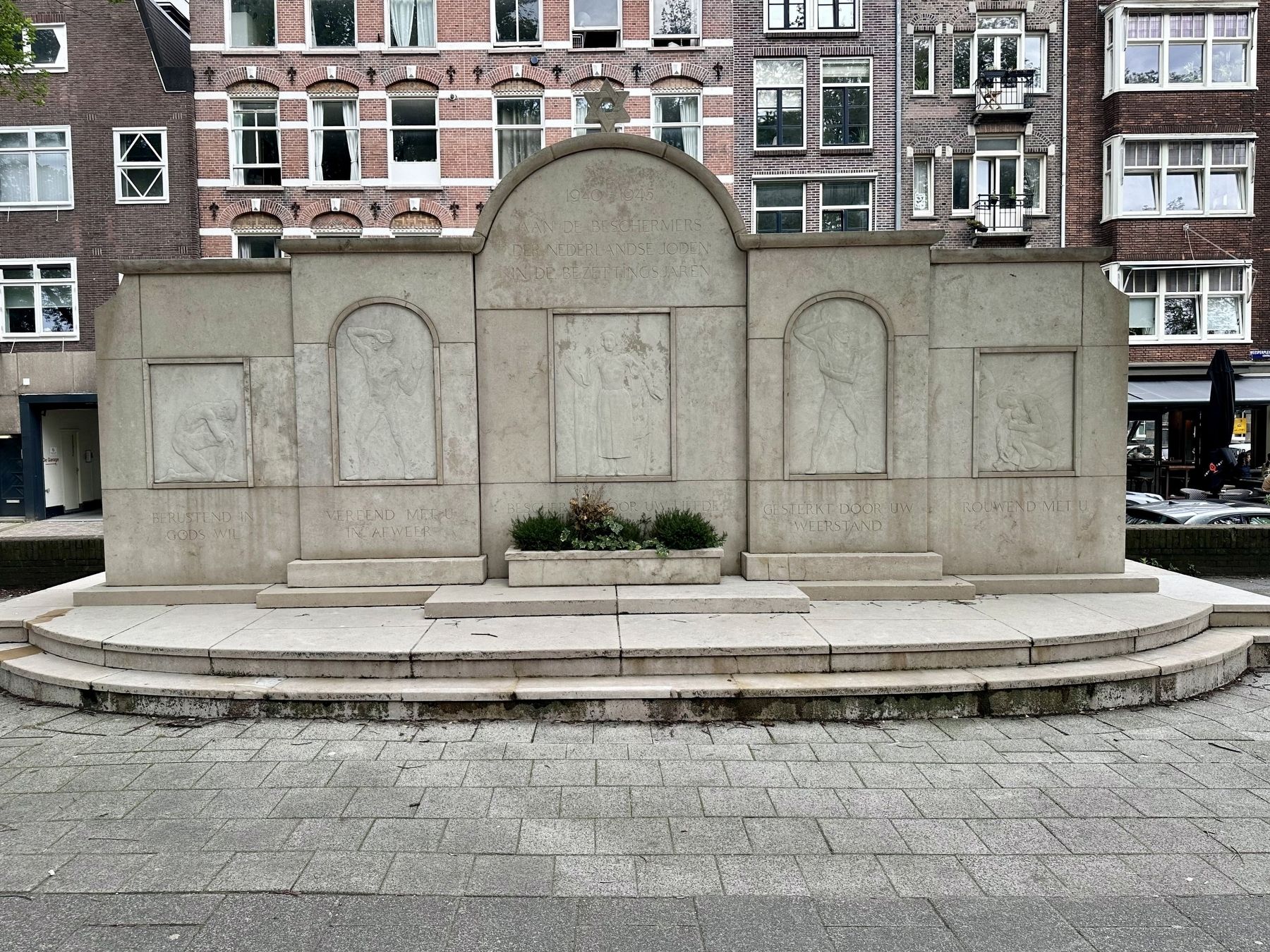
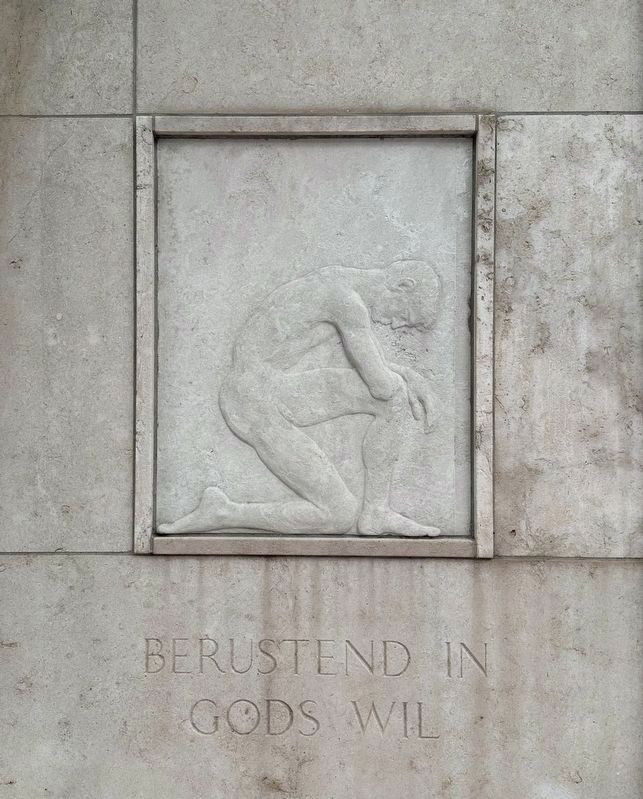
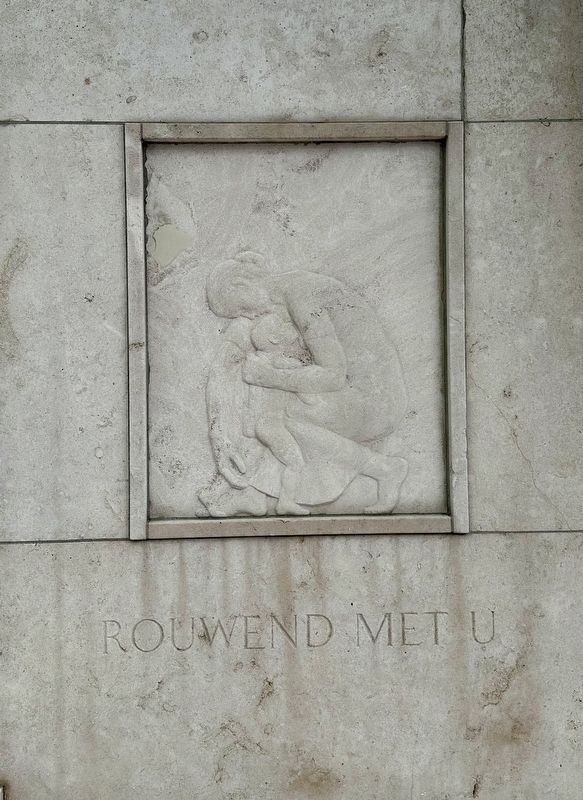
The dedication on the upper center portion of the inscription reads (in translation): 1940-1945 To the protectors of the Dutch Jews during the years of occupation. The five bottom panels read, left to right (in translation): Resigned to God’s will; United with you in defense; Protected by your love; Strengthened by your defense; Mourning with you.
Criticism (in translation): Criticism of the monument was present within the Jewish community from the very beginning. Why a sign of gratitude suggesting that ‘Dutch Jews’ were saved by Dutch people when only a small number of people returned from the camps? Later generations within the Jewish community expressed their aversion. The view of the monument also changed outside the Jewish community. How could a monument appear in Amsterdam so soon after the Second World War that was funded by the Jewish community to show gratitude instead of a memorial in memory of the people murdered in the camps?…(Submitted on August 31, 2024.)
3. ‘Voorzie waar mogelijk omstreden erfgoed van de juiste context’ (Het Parool, March 2, 2022). Dutch-language opinion piece, in translation titled: ‘Where possible, provide controversial heritage with the right context’.
Excerpt: A fundamental error in thinking about the monument has, in my opinion, been underexposed. The initiators were survivors and wanted to show gratitude. But by offering the monument on behalf of ‘the (read: all) Jews of the Netherlands to their protectors in the occupation(Submitted on August 31, 2024.)years 1940–1945’ they turned their private gratitude into an unfelt collective gratitude and rigorously overrode the collective grief.Photographed by Andrew Ruppenstein, July 15, 20244. Far right panel - resign to God’s will
Additional keywords. Holocaust
Photographed by Andrew Ruppenstein, July 15, 2024
5. Far left panel: mourning with you
Credits. This page was last revised on August 31, 2024. It was originally submitted on August 31, 2024, by Andrew Ruppenstein of Lamorinda, California. This page has been viewed 132 times since then and 15 times this year. Photos: 1, 2, 3, 4, 5. submitted on August 31, 2024, by Andrew Ruppenstein of Lamorinda, California.
