St. Thomas in Elgin County, Ontario — Central Canada (North America)
Col. the Hon. Thomas Talbot 1771-1853
Photographed by Tim Boyd, August 23, 2024
1. Col. the Hon. Thomas Talbot 1771-1853 Marker
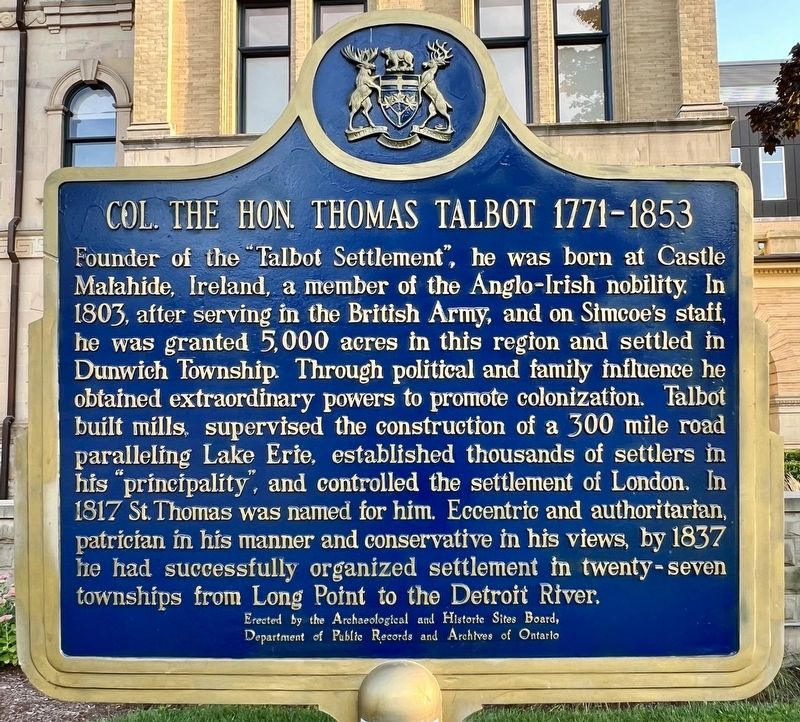
Founder of the Talbot Settlement, he was born at Castle Malahide, Ireland, a member of the Anglo-Irish nobility. In 1803, after serving in the British Army, and on Simcoe's staff, he was granted 5,000 acres in this region and settled in Dunwich township. Through political and family influence he obtained extraordinary powers to promote colonization. Talbot built mills, supervised the construction of a 300 mile road paralleling Lake Erie, established thousands of settlers in his "principality", and controlled the settlement of London. In 1817 St. Thomas was named for him. Eccentric and authoritarian, patrician in his manner and conservative in his views, by 1837 he had successfully organized settlement in twenty-seven townships from Long Point to the Detroit River.
Erected by the Archaeological and Historic Sites Board, Department of Public Records and Archives of Ontario
Erected by Ontario Archaeological and Historic Sites Board.
Topics and series. This historical marker is listed in this topic list: Settlements & Settlers. In addition, it is included in the Canada, Ontario Heritage Trust series list. A significant historical year for this entry is 1803.
Location. 42° 46.516′ N,
this page online

Regionally, this marker is in the Southwest Ontario Area and in Southwestern Ontario. It is also in Central Canada. Globally, it is in North America, on the Great Lakes, in the Western Hemisphere, in the Western World, and in the Anglosphere. Historically, it finds itself in what was once a British colony, the Viceroyalty of New France, the Haudenosaunee (Iroquois) Confederacy, and Rupert’s Land.
Other nearby markers. At least 8 other markers are within walking distance of this marker: Elgin County Courthouse/ Palais de Justice Elgin County (2014) (a few steps from this marker); Elgin County Courthouse/ Palais de Justice Elgin County (1898) (within shouting distance of this marker); Elgin County Courthouse/ Palais de Justice Elgin County

Photographed by Tim Boyd, August 23, 2024
2. Col. the Hon. Thomas Talbot 1771-1853 Marker
Also see . . . Talbot, Thomas (biographi.ca).
Promoting his intention to bring in British rather than American settlers (and thereby, in the spirit of Simcoe, check “the growing tendency to insubordination and revolt” in Upper Canada), Talbot succeeded in obtaining a field officer’s grant of 5,000 acres in May 1803. He selected his grant in the townships of Dunwich and Aldborough, in Middlesex County, and that same month settled at the mouth of Talbot Creek in Dunwich, the site of Port Talbot, his home for the next 50 years. To stimulate settlement in these townships,(Submitted on August 31, 2024, by Tim Boyd of Hamilton, Ontario.)he acquired mill machinery in 1804 and two years later constructed a water-powered grist-mill which was of great value to the emerging settlement until its destruction by American troops in 1814. 3. Portrait of Col. Thomas Talbot (no date)Source: Western University (public domain)
Credits. This page was last revised on September 25, 2024. It was originally submitted on August 31, 2024, by Tim Boyd of Hamilton, Ontario. This page has been viewed 930 times since then and 272 times this year. Photos: 1, 2, 3. submitted on August 31, 2024, by Tim Boyd of Hamilton, Ontario. • Andrew Ruppenstein was the editor who published this page.
