Belleville in Hastings County, Ontario — Central Canada (North America)
Albert Carman 1833-1917

Photographed by Cosmos Mariner, May 30, 2024
1. Albert Carman 1833-1917 Marker
(south side • English)
(south side • English)

this page online
Erected by Ontario Heritage Foundation, Ministry of Culture and Communications / Fondation du patrimoine ontarien, Ministre de la Culture et des Communications.
Topics and series. This historical marker is listed in these topic lists: Education • Religion & Religious Structures. In addition, it is included in the Canada, Ontario Heritage Trust series list. A significant historical date for this entry is June 27, 1833.
Location. 44° 10.139′ N, 77° 22.985′ W. Marker is in Belleville, Ontario, in Hastings County. It is on Church Street 0.2 kilometers north of Victoria Avenue, on the right when traveling north. The marker is located at the

Photographed by Cosmos Mariner, May 30, 2024
2. Albert Carman 1833-1917 Marker
(north side • Français)
(north side • Français)

Regionally, this marker is in Eastern Ontario and specifically in Southeastern Ontario. It is also in Central Canada. Globally, it is in North America, on the Great Lakes, in the Western Hemisphere, in the Western World, and in the Anglosphere. Historically, it finds itself in what was once a British colony, the Viceroyalty of New France, the Haudenosaunee (Iroquois) Confederacy, and Rupert’s Land.
Other nearby markers. At least 8 other markers are within walking distance of this marker: Site of Tabernacle United Church (here, next to this marker); Fire Station No. 2 (about 240 meters away, measured in a direct line); Argyll Chapter IODE Parkette (approx. 0.3 kilometers away); Captain / Captaine John W. Meyers 1745-1821 (approx. 0.3 kilometers away); Belleville Collegiate Institute & Vocational School (approx. 0.3 kilometers away); Pinnacle Playhouse (approx. 0.4 kilometers away); O'Hare-Chant House (approx.
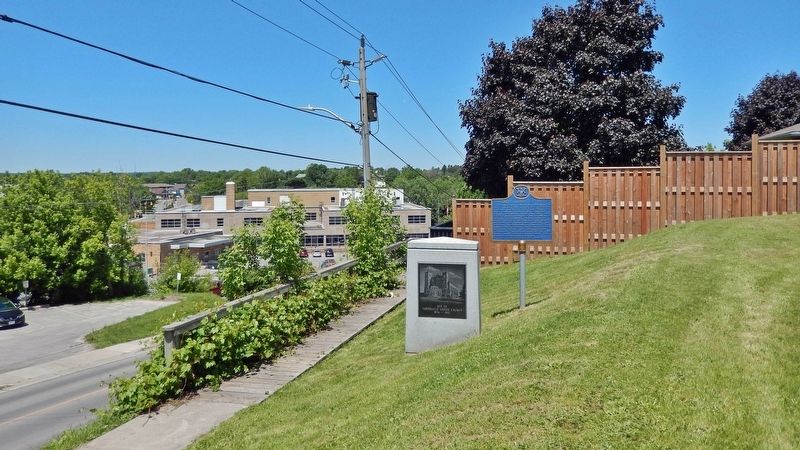
Photographed by Cosmos Mariner, May 30, 2024
3. Albert Carman 1833-1917 Marker
Looking north; Church Street is on the left.
Related markers. Click here for a list of markers that are related to this marker.
Also see . . .
1. Albert Carman (Wikipedia).
Excerpt: Albert Carman was born on 27 June 1833 in Iroquois, Ontario, Canada. His family on both sides were loyalists who settled in Matilda Township in 1784 on crown land grants after the American Revolutionary War. Carman joined the Methodist Episcopal Church in 1857 as a probationer. In 1857 he became a professor of mathematics at the Belleville Seminary, and in 1858 he became principal of the institution. It gave a three-year course in classics, philosophy, mathematics and science to young Methodist Episcopals, both men and women. Carman made the Belleville Seminary succeed through advocacy within the church and through his ability as a teacher and administrator.(Submitted on September 2, 2024, by Cosmos Mariner of Cape Canaveral, Florida.)He was ordained a Deacon in 1859. Carman completed a master's degree in 1860. The seminary was affiliated with the University of Toronto in 1861. Carman became a full minister in 1864. In 1866 the Seminary
became Albert College. In 1870 Carman established a faculty of divinity, and organized faculties of arts, engineering, law and music. Carman was president of Albert College until 1875. Between 1868 and 1874 Carman was involved in the negotiations for unity with the other Methodist churches in Canada. In September 1883 a provisional General Conference of the uniting churches elected Carman and Samuel Dwight Rice of the Methodist Church of Canada as the general superintendents. Rice died in December 1884 and his successor died in December 1889. After this Carman was sole general superintendent until 1910.Photographed by Cosmos Mariner, May 30, 20244. Albert Carman 1833-1917 MarkerLooking south; Church Street is on the right. Saint Michael the Archangel Catholic Church is in the right background.

2. Albert Carman (Dictionary of Canadian Biography).
Excerpt: Dedicated, vigorous, and tenacious in thought and action, Carman obstructed but did not prevent the reshaping of Canadian Methodist theology in response to new currents in biblical scholarship and philosophy. His rearguard action, one that probably reflected the majority opinion in his church, combined with his tacit support of diverse attempts at innovation, may in fact have facilitated acceptance of new ways of defining the evangelical tradition. His aggressive leadership both within the church and outside it in temperance, sabbath observance, and other organizations gave substance to the Methodists’ image as uncompromising adversaries of routine wickedness such as dancing, card-playing, and gambling, as well as of that great evil, alcohol. Ironically, his authoritarian, dogmatic style obscured his goal, and his theology, based on a traditional view of the Bible and the “facts” of religious experience, had become obsolete in his own lifetime. (by Goldwin S. French)(Submitted on September 2, 2024, by Cosmos Mariner of Cape Canaveral, Florida.)
Credits. This page was last revised on September 3, 2024. It was originally submitted on September 1, 2024, by Cosmos Mariner of Cape Canaveral, Florida. This page has been viewed 173 times since then and 28 times this year. Photos: 1, 2, 3, 4. submitted on September 2, 2024, by Cosmos Mariner of Cape Canaveral, Florida.
