Holladay in Salt Lake County, Utah — The American Mountains (Southwest)
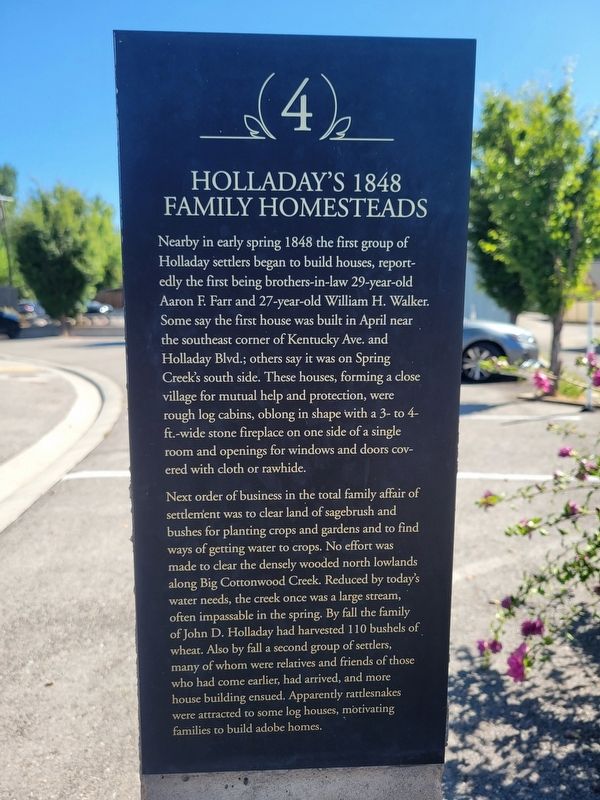
Holladay's 1848 Family Homesteads
Photographed by Jeremy Snow, August 19, 2024
1. Holladay's 1848 Family Homesteads Marker
Inscription.
Nearby in early spring 1848 the first group of Holladay settlers began to build houses, reportedly the first being brothers-in-law 29-year-old
Aaron F. Farr and 27-year-old William H. Walker. Some say the first house was built in April near the southeast corner of Kentucky Ave. and Holladay Blvd.; others say it was on Spring Creek's south side. These houses, forming a close village for mutual help and protection, were rough log cabins, oblong in shape with a 3- to 4-ft.-wide stone fireplace on one side of a single room and openings for windows and doors covered with cloth or rawhide.
Next order of business in the total family affair of settlement was to clear land of sagebrush and bushes for planting crops and gardens and to find ways of getting water to crops. No effort was made to clear the densely wooded north lowlands along Big Cottonwood Creek. Reduced by today's water needs, the creek once was a large stream, often impassable in the spring. By fall the family of John D. Holladay had harvested 110 bushels of wheat. Also by fall a second group of settlers, many of whom were relatives and friends of those who had
Click or scan to see this page online
come earlier, had arrived, and more house building ensued. Apparently rattlesnakes were attracted to some log houses, motivating
families to build adobe homes.
Erected by Holladay Historical Commission. (Marker Number 4.)
Topics. This historical marker is listed in this topic list: Settlements & Settlers. A significant historical year for this entry is 1848.
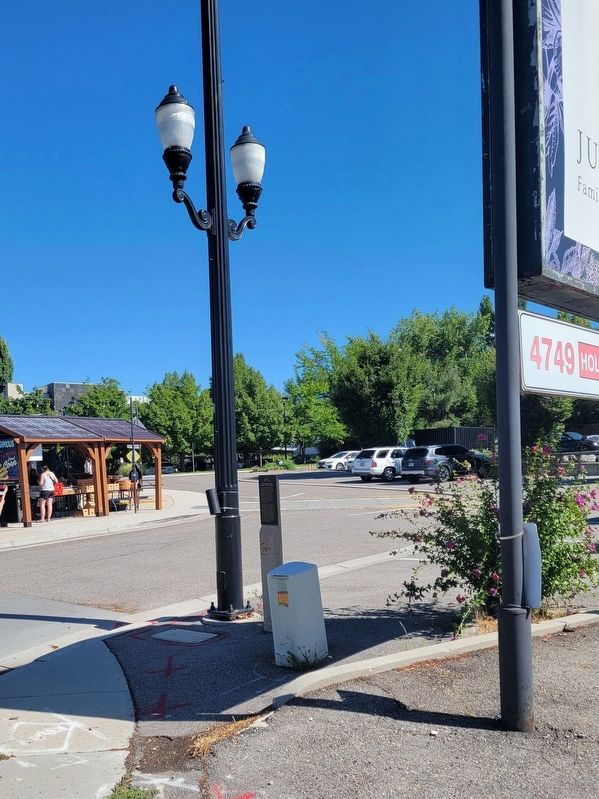
Location. 40° 39.994′ N, 111° 49.34′ W. Marker is in Holladay, Utah, in Salt Lake County. It is on Holladay Boulevard east, on the right when traveling north. Touch for map. Marker is at or near this postal address: 4741 Holladay Blvd E, Salt Lake City UT 84117, United States of America. Touch for directions.
Regionally, this marker is in the Wasatch Front and in Greater Salt Lake. It is also in the American Mountain West and on the Colorado Plateau. Globally, it is in North America, the Rocky Mountains, the Western Hemisphere, the Western World, and the Anglosphere. Historically, it finds itself in what was once New Spain and also Mexico’s Alta California.
Other nearby markers. At least 8 other markers are within walking distance of this marker: The 1847 Dugouts
Credits. This page was last revised on September 25, 2024. It was originally submitted on September 2, 2024, by Jeremy Snow of Cedar City, Utah. This page has been viewed 190 times since then and 18 times this year. Photos:1, 2. submitted on September 2, 2024, by Jeremy Snow of Cedar City, Utah. • Andrew Ruppenstein was the editor who published this page.