Hohenschwangau in Schwangau in Ostallgäu, Bavaria, Germany — Central Europe
Schloss Neuschwanstein
⎯⎯⎯
Neuschwanstein Castle
Burgenregion Allgäu
Photographed by James Hulse, February 24, 2024
1. Schloss Neuschwanstein Marker

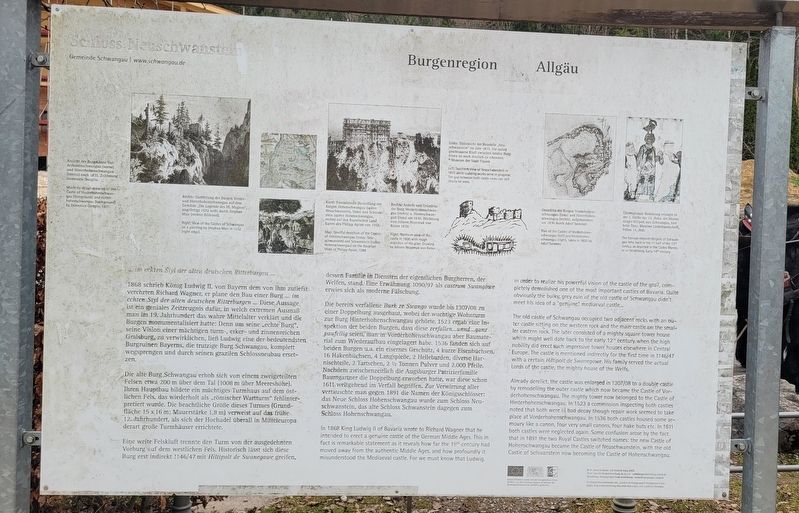
…im echten Styl der alten deutschen Ritterburgen…
1868 schrieb König Ludwig II. von Bayern dem von ihm zutiefst verehrten Richard Wagner, er plane den Bau einer Burg... im echten Styl der alten deutschen Ritterburgen ... Diese Aussage ist ein geniales Zeitzeugnis dafür, in welch extremen Ausmaß man im 19. Jahrhundert das wahre Mittelalter verklärt und die Burgen monumentalisiert hatte: Denn um seine „echte Burg", seine Vision einer mächtigen turm-, erker- und zinnenreichen Gralsburg, zu verwirklichen, ließ Ludwig eine der bedeutendsten Burgruinen Bayerns, die trutzige Burg Schwangau, komplett wegsprengen und durch seinen grazilen Schlossneubau ersetzen.
Die alte Burg Schwangau erhob sich von einem zweigeteilten Felsen etwa 200 m über dem Tal (1008 m über Meereshöhe). Ihren Hauptbau bildete ein mächtiges Turmhaus auf dem östlichen Fels, das wiederholt als „römischer Wartturm" fehlinterpretiert wurde. Die beachtliche Größe dieses Turmes (Grundfläche 15 x 16 m; Mauerstärke 1,8 m) verweist auf das frühe 12. Jahrhundert, als sich der Hochadel überall in Mitteleuropa derart große Turmhäuser errichtete.
Eine
this page online
Die bereits verfallene Burk ze Swango wurde bis 1307/08 zu einer Doppelburg ausgebaut, wobei der wuchtige Wohnturm zur Burg Hinterhohenschwangau gehörte. 1523 ergab eine Inspektion der beiden Burgen, dass diese zerfallen...unnd...ganz paufellig seien, man in Vorderhohenschwangau aber Baumaterial zum Wiederaufbau eingelagert habe. 1536 fanden sich auf beiden Burgen u.a. ein eisernes Geschütz, 4 kurze Eisenbüchsen, 16 Hakenbüchsen, 4 Langspieße, 2 Hellebarden, diverse Harnischteile, 2 Tartschen, 2 1/2 Tonnen Pulver und 2.000 Pfeile. Nachdem zwischenzeitlich die Augsburger Patrizierfamilie Baumgartner die Doppelburg erworben hatte, war diese schon 1611 weitgehend im Verfall begriffen. Zur Verwirrung aller vertauschte man gegen 1891 die Namen der Königsschlösser: das Neue Schloss Hohenschwangau wurde zum Schloss
Photographed by James Hulse, February 24, 2024
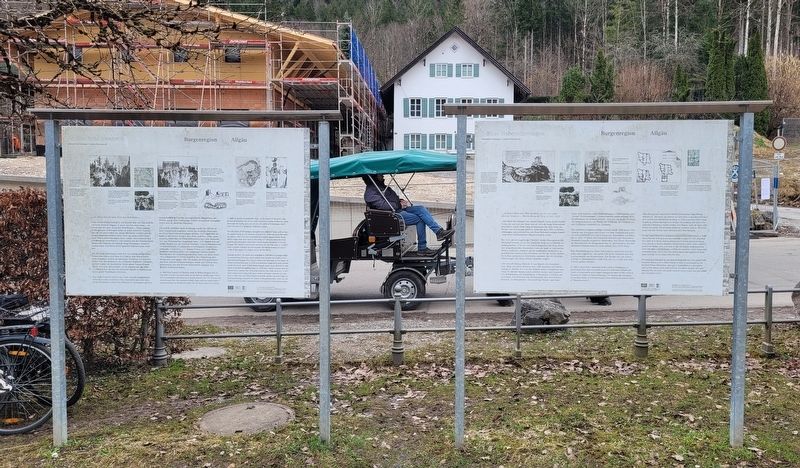
2. Schloss Neuschwanstein Marker (left side)
Bildunterschriften
Ansicht der Burgruinen Vorderhohenschwangau (vorne) und Hinterhohenschwangau (hinten) nach 1831. Zeichnung Domenico Quaglio.
Rechts: Darstellung der Burgen Vorder- und Hinterhohenschwangau auf dem Gemälde „Die Legende des Hl. Magnus", angefertigt 1572 wohl durch Stephan Mair (rechter Bildrand).
Karte: Fantasievolle Darstellung der Burgen Hohenschwangau (später Neuschwanstein, links) und Schwanstein (später Hohenschwangau, rechts) auf den Bayerischen Land karten des Philipp Apian von 1568.
Rechts: Ansicht und Grundriss der Burg Vorderhohenschwangau (rechts) u. Hinterschwangau (links) um 1830. Zeichnung von Johann Nepomuk von Raiser 1830.
Links: Südansicht der Baustelle „Neuschwanstein im Jahr 1875. Die später geschlossene Kluft zwischen beiden Burgfelsen ist noch deutlich zu erkennen. Museum der Stadt Füssen.
Grundriss der Burgen Vorderhohenschwangau (links) und Hinterhohenschwangau (rechts), aufgenommen um 1830 durch Adolf Sommer.
Überregionale Bedeutung erlangte in der 1. Hälfte des 13. Jhdts. der Minnesänger Hiltpolt von Schwangau, hier beim Tanz. Manesse Liederhandschrift, frühes 14. Jhdt.
© Dr. Joachim Zeune und Andreas Koop 2006, Text: "üro für Burgenforschung Dr. Zeune- www.burgenforschung-zeune.de, Gestaltung: designgruppe koop nesselwang www.designgruppe-koop.de, Ein Kooperationsvorhaben der „Lokalen Aktionsgruppen" Kneippland Unterallgäu, Regionalentwicklung Altusried-Oberallgäu und Landkreis Ostallgäu
In
Photographed by James Hulse, February 24, 2024
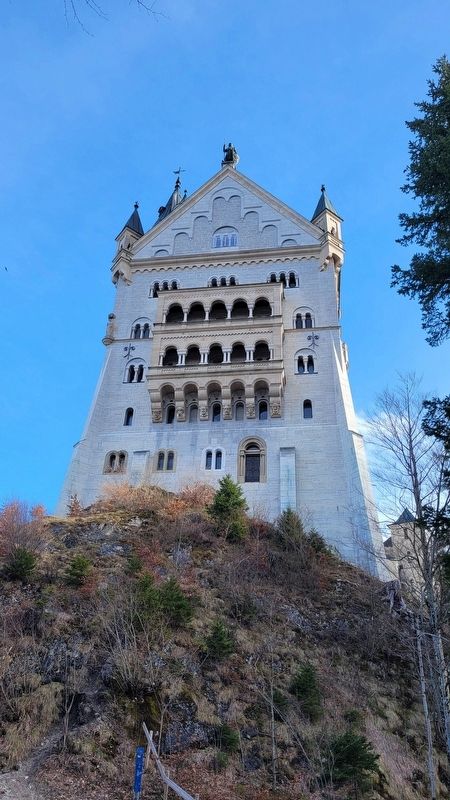
3. Neuschwanstein Castle
The old castle of Schwangau occupied two adjacent rocks with an outer castle sitting on the western rock and the main castle on the smaller eastern rock. The later consisted of a mighty square tower house which might well date back to the early 12th century when the high nobility did erect such impressive tower houses elsewhere in Central Europe. The castle is mentioned indirectly for the first time in 1146/47 with a certain Hiltipolt de Swanegowe. His family served the actual Lords of the castle, the mighty house of the Welfs.
Already derelict, the castle was enlarged in 1307/08 to a double castle by remodelling the outer castle which now became the Castle of Vorderhohenschwangau. The mighty tower now belonged to the Castle of Hinterhohenschwangau. In 1523 a commission inspecting both castles noted that both were in bad decay though repair work seemed to take place at Vorderhohenschwangau. In 1536 both castles housed some armoury like a canon, four very small canons, four hake buts etc. In 1611 both castles were neglected again. Some confusion arose by the fact that in 1891 the two Royal Castles switched names: the new Castle of Hohenschwangau became the Castle of Neuschwanstein, with the old Castle of Schwanstein now becoming
Photographed by James Hulse, February 24, 2024
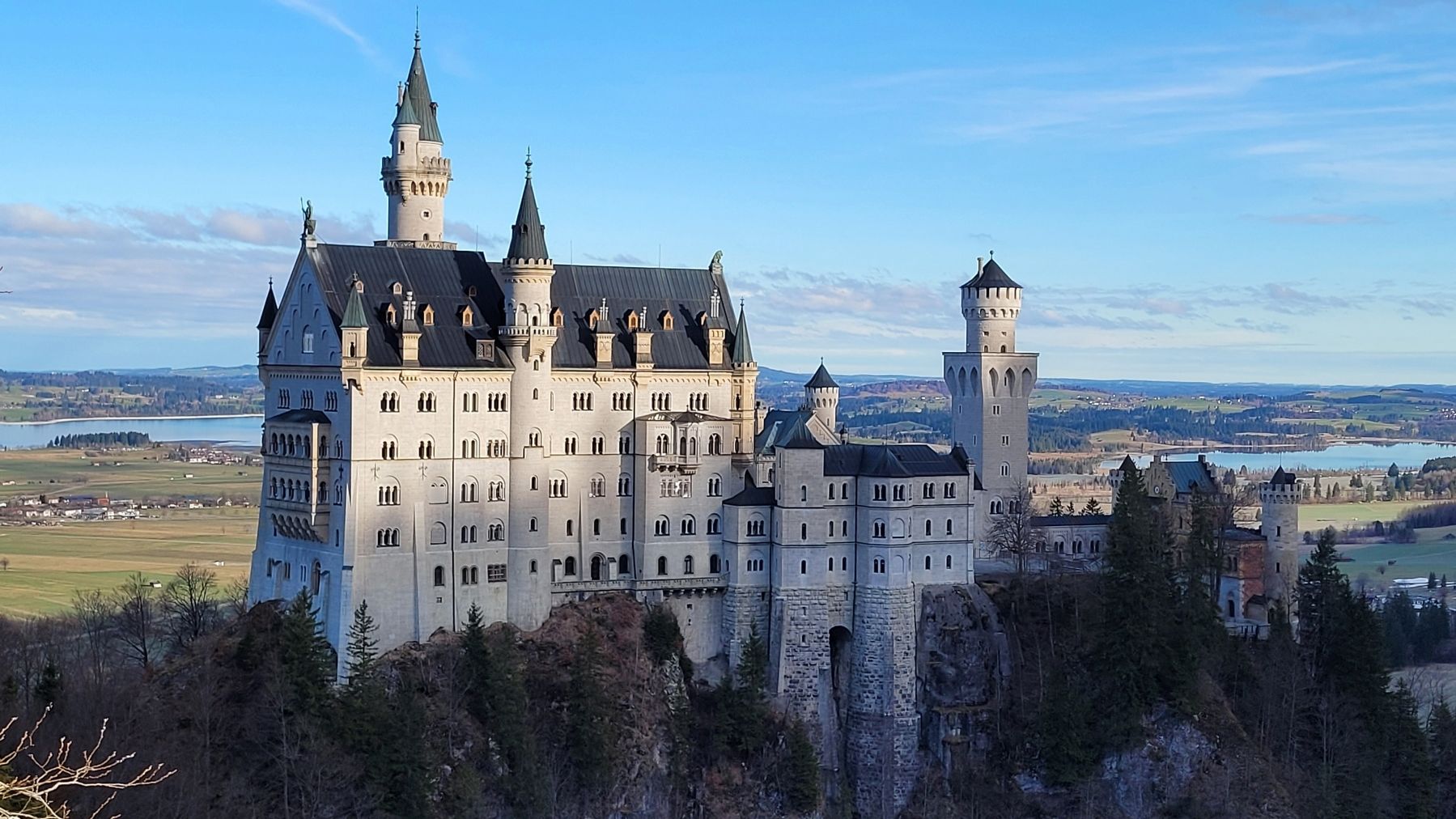
4. The view of the Neuschwanstein Castle
Captions
Much-to-detail-drawing of the Castle of Vorderhohenschwangau (foreground) and Hinterhohenschwangau (background) by Domenico Quaglio, 1831.
Right: View of the Castles of Schwangau on a painting by Stephan Mair in 1572 (right edge).
Map: Fanciful depiction of the Castles of Hohenschwangau (today: Neuschwanstein) and Schwanstein (today: Hohenschwangau) on the Bavarian Maps of Philipp Apian, 1568.
Right: Northern view of the castle in 1830 with rough depiction of the plan. Drawing by Johann Nepomuk von Raiser.
Left: Southern view of Neuschwanstein in 1875 while building works were in progress. The gap between both castle rocks can still clearly be seen.
Plan of the Castles of Vorderhohenschwangau (left) and Hinterhohenschwangau (right), taken in 1830 by Adolf Sommer.
The famous minstrel Hiltpolt of Schwangau who lived in the 1st half of the 13th centuy, as depicted in the Codex Manesse of Heidelberg. Early 14th century.
Erected 2006 by Gemeinde Schwangau.
Topics. This historical marker is listed in this topic list: Forts and Castles. A significant historical year for this entry is 1868.
Location. 47° 33.309′ N, 10° 44.361′ E. Marker is in Schwangau, Bayern (Bavaria), in Ostallgäu. It is in Hohenschwangau. It is on Alpseestraße just south of Parkstraße, on the right when traveling west. The marker is located near the ticket office for the castle. Touch for map. Marker is at or near this postal address: Alpseestraße 12, Schwangau BY 87645, Germany. Touch for directions.

Regionally, this marker is in German Swabia, in the Allgäu, and on the Romantic Road. Globally, it is in Europe, the European Union, Atlantic Europe, Central Europe, the Schengen Area, Western Europe, and the Western World. Historically, it finds itself in what was once the Roman Empire, the Holy Roman Empire, and the former West Germany.
Other nearby markers. At least 8 other markers are within 3 kilometers of this marker, measured as the crow flies: Schloss Hohenschwangau / Hohenschwangau Castle (here, next to this marker); Marienbrücke (approx. 0.7 kilometers away); Schloss Neuschwanstein (approx. 0.9 kilometers away); Imperial-Royal Austrian Soldiers Memorial (approx. 3 kilometers away); Franziskanerkloster Alter Friedhof St. Sebastian (approx. 3.1 kilometers away); Füssen im Königswinkel • Stadtmauer / Füssen in the King's Corner • City Wall (approx. 3.1 kilometers away); Lechtor (approx. 3.2 kilometers away); Hier wohnten die Geigenmacher / The Violin Makers Lived Here (approx. 3.2 kilometers away). Touch for a list and map of all markers in Schwangau.
Also see . . . Füssen – The romantic soul of Bavaria. Füssen Tourismus und Marketing (Submitted on September 3, 2024, by James Hulse of Medina, Texas.)
Credits. This page was last revised on September 3, 2024. It was originally submitted on September 2, 2024, by James Hulse of Medina, Texas. This page has been viewed 191 times since then and 45 times this year. Photos: 1, 2, 3, 4. submitted on September 3, 2024, by James Hulse of Medina, Texas.
