
Eschach in Füssen in Ostallgäu, Bavaria, Germany — Central Europe
Hohes Schloss zu Füssen
⎯⎯⎯
High Castle at Füssen

Photographed by James Hulse, February 24, 2024
1. Hohes Schloss zu Füssen / High Castle at Füssen Marker

Kleinod spätgotischer Profanarchitektur
Das Hohe Schloss in Füssen geht auf einen widerrechtlichen Burgbau der bayerischen Herzöge 1291/92 zurück, den der neue Stadtherr Bischof Friedrich I. von Augsburg nach 1322 vollendete. Ein Großausbau 1486-1505 unter Fürstbischof Friedrich II. von Zollern machte das Hohe Schloss zu einem Kleinod spätgotischer Profanarchitektur, dessen Flair Kaiser Maximilian damals durchaus zu schätzen wusste. Der punktuellen Barockisierung um 1680 folgte eine längere Phase des baulichen Niedergangs, die erst 1931 und 1982 durch die Einrichtung der staatlichen Gemäldegalerie, dann der städtischen Galerie nachhaltig aufgehalten wurde.
Heute beherbergt das Schloss im Nordflügel noch immer beide Galerien, im Süd- und Westflügel die Außenstellen des Staatlichen Bauamts Kempten und des Finanzamts Kaufbeuren. Etliche Baulichkeiten sind heute zugänglich: der Nordflügel, der Torturm und der Wehrgang über die beiden Galerien, der Fallturm, die St. Veitskapelle und der Apothekergarten über die Lange Stiege.
Bildunterschriften
Kunsthistorisch besonders sehenswert sind die großartigen Illusionsmalereien von 1500 an Innenhoffassaden und Torturm, die Architekturelemente, Personen und Waffen vortäuschen. Landratsamt Ostallgäu
Aus der Zeit um 1500 stammt der herrliche Rittersaal im Inneren des Nordflügels mit seiner reich verzierten Kasettendecke. Auch die in beiden Galerien ausgestellten gotischen und romantischen Kunstwerke sind einen Besuch wert. Landratsamt Ostallgäu
Diese kostbare Rundscheibe mit Jagdszenen, 1504 datiert, in einem Fenster des Rittersaals entstand nach Entwürfen des Hans Holbein d. Ä. und des Meisters des Mittelalterlichen Hausbuchs.
Blick in die St. Veitskapelle. • Foto Büro für Burgenforschung Dr. Zeune 2017
© Dr. Joachim Zeune und Andreas Koop 2018, Text: Büro für Burgenforschung Dr. Zeune www.burgenforschung-zeune.de, Gestaltung: designgruppe koop Rückholz www.designgruppe-koop.de, Im Auftrag der Galerien im Hohen Schloss www.hohesschloss.fuessen.de
A gem of late-gothic secular architecture
The Castle of Füssen had its origin in an illegal fortification 1291 begun by the Bavarian dukes which was finished after 1322 by the new lord of the town, bishop Frederic of Augsburg. But it was bishop Frederic II. who turned the castle between 1486 and 1505 into a splendid residence - well appreciated by the German emperor Maximilan I.
Apart from slight modifications in Baroque style around 1680, the place got neglected until 1931 and 1982 when first a national art gallery, then a municipal art gallery were established in the northern wing. Today parts of the castle are open to public: the northern wing with its art galleries, the wall-walk and the gatetower, the prison tower ("Fallturm") the Chapel of St Vitus, the Long Stairway with the Chemist's Garden.
Captions
Of outstanding importance in art history are the illionistic paintings that adorn the courtyard walls, dating from the end of the 15th century. They imitate architectural elements, persons and weapons.
The splendid main hall ("Knights' Hall") with its rich decorated wooden ceiling, housed in the northern wing, dates from 1500.
This stained glas of 1504 is still inserted into a window of the main hall.
View into the Chapel of Saint Vitus.
Erected 2018
this page online
Topics. This historical marker is listed in this topic list: Forts and Castles. A significant historical year for this entry is 1291.
Location. 47° 34.016′ N, 10° 41.942′ E. Marker is in Füssen, Bayern (Bavaria), in Ostallgäu. It is in Eschach. It is on Magnusplatz just west of Lechhalde, on the right when traveling west. The marker is located at the base of the castle near the church. Touch for map. Marker is at or near this postal address: Magnuspl 6, Füssen BY 87629, Germany. Touch for directions.

Regionally, it is in Europe, the European Union, Atlantic Europe, Central Europe, the Schengen Area, Western Europe, and the Western World. Historically, it finds itself in what was once the Holy Roman Empire.
Other nearby markers. At least 8 other markers are within walking distance of this marker: Annakapelle / Anna Chapel (within shouting distance of this marker); Hohes Schloß zu Füssen • der Fallturm / High Castle at Füssen • The Drop Tower (within shouting distance of this marker); Basilika St. Mang / St. Mang Monastery (within shouting distance of this marker); Hohes Schloss Füssen „Lange Stiege" / High Castle Füssen "Long Staircase"

Photographed by James Hulse, February 24, 2024
2. The view of the Hohes Schloss zu Füssen / High Castle at Füssen Marker along the entrance trail
Also see . . . Füssen – The romantic soul of Bavaria. Füssen Tourismus und Marketing (Submitted on September 3, 2024, by James Hulse of Medina, Texas.)
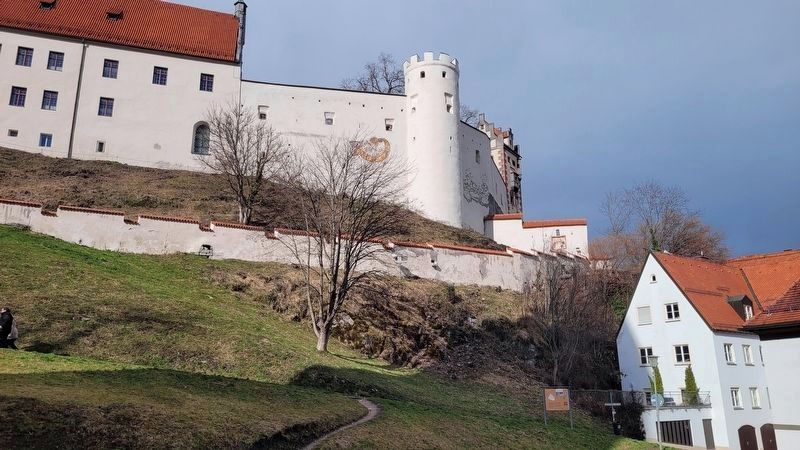
Photographed by James Hulse, February 24, 2024
3. The view of the castle from below
The marker can be seen at the far right in the photo.
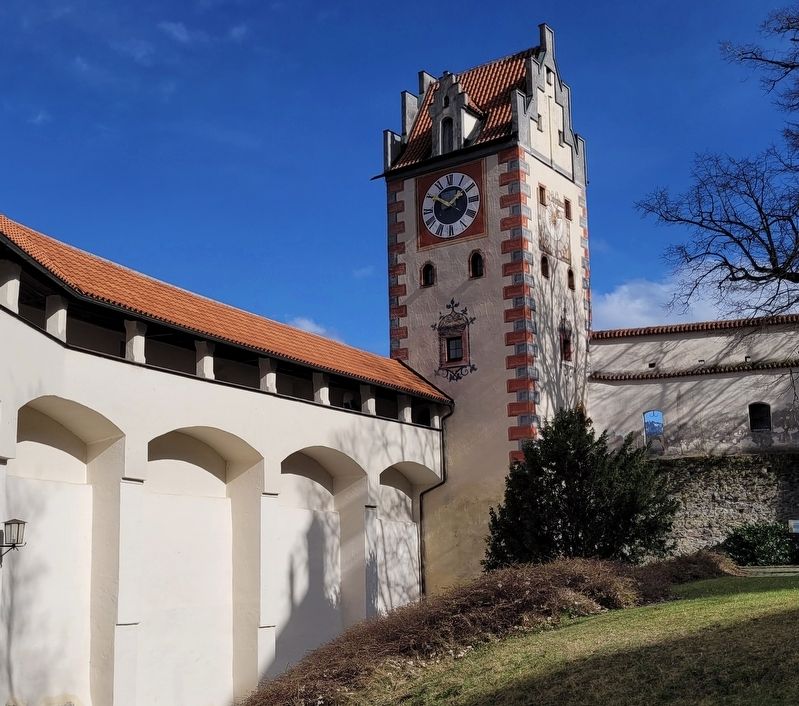
Photographed by James Hulse, February 24, 2024
4. Inside view of the courtyard of the castle

Photographed by James Hulse, February 24, 2024
5. The courtyard view of the High Castle at Füssen
Credits. This page was last revised on September 3, 2024. It was originally submitted on September 2, 2024, by James Hulse of Medina, Texas. This page has been viewed 151 times since then and 18 times this year. Photos: 1, 2, 3, 4, 5. submitted on September 3, 2024, by James Hulse of Medina, Texas.
