Ballantyne in Charlotte in Mecklenburg County, North Carolina — The American South (South Atlantic)
Finance
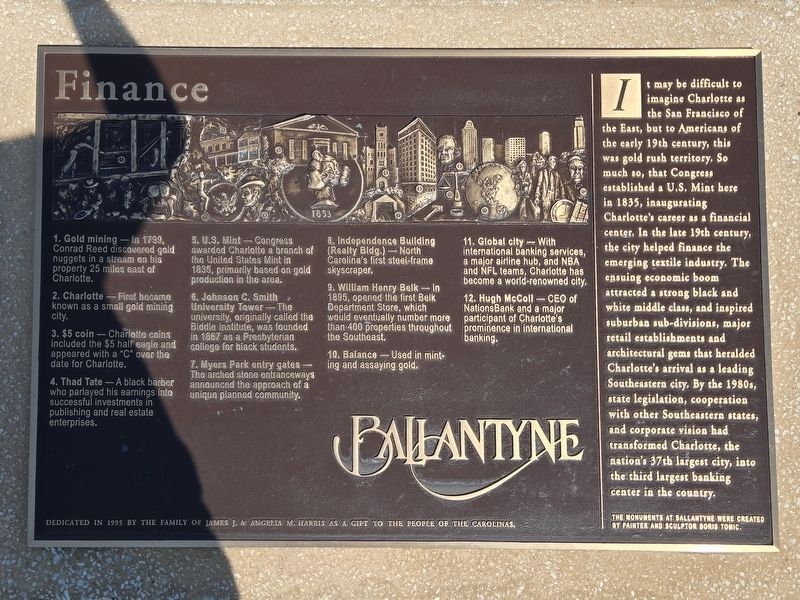
Photographed by Mark Parker, September 3, 2024
1. Finance Marker
(Main panel with the key to the mural on the plaque and accompanying sculpture)
1. Gold mining - In 1799, Conrad Reed discovered gold nuggets in a stream on his property 25 miles east of Charlotte.
2. Charlotte - First became known as a small gold mining city.
3. $5 coin - Charlotte coins included the $5 half eagle and appeared with a "C" over the date for Charlotte.
4. Thad Tate - A black barber who parlayed his earnings into successful investments in publishing and real estate enterprises.
5. U.S. Mint - Congress awarded Charlotte a branch of the United States Mint in 1835, primarily based on gold production in the area.
6. Johnson C. Smith University Tower - The university, originally called the Biddle Institute, was founded in 1867 as a Presbyterian college for black students.
7. Myers Park entry gates - The arched stone entranceways announced the approach of a unique planned community.
8. Independence Building (Realty Bldg.) - North Carolina's first steel-frame skyscraper.
9. William Henry Belk - In 1895, opened the first Belk Department Store, which would eventually number more than 400
this page online
10. Balance - Used in minting and assaying gold.
11. Global city - With international banking services, a major airline hub, and NBA and NFL teams, Charlotte has become a world-renowned city.
12. Hugh McColl - CEO of Nations Bank and a major participant of Charlotte's prominence in international banking.
(right panel)
It may be difficult to imagine Charlotte as the San Francisco of the East, but to Americans of the early 19th century, this was gold rush territory. So much so, that Congress established a U.S. Mint here in 1835, inaugurating Charlotte's career as a financial center. In the late 19th century, the city helped finance the emerging textile industry. The ensuing economic boom attracted a strong black and white middle class, and inspired suburban sub-divisions, major retail establishments and architectural gems that heralded Charlotte's arrival as a leading Southeastern city. By the 1980s, state legislation, cooperation with other Southeastern states, and corporate vision had transformed Charlotte, the nation's 37th largest city, into the third largest banking center in the

Photographed by Mark Parker, September 3, 2024
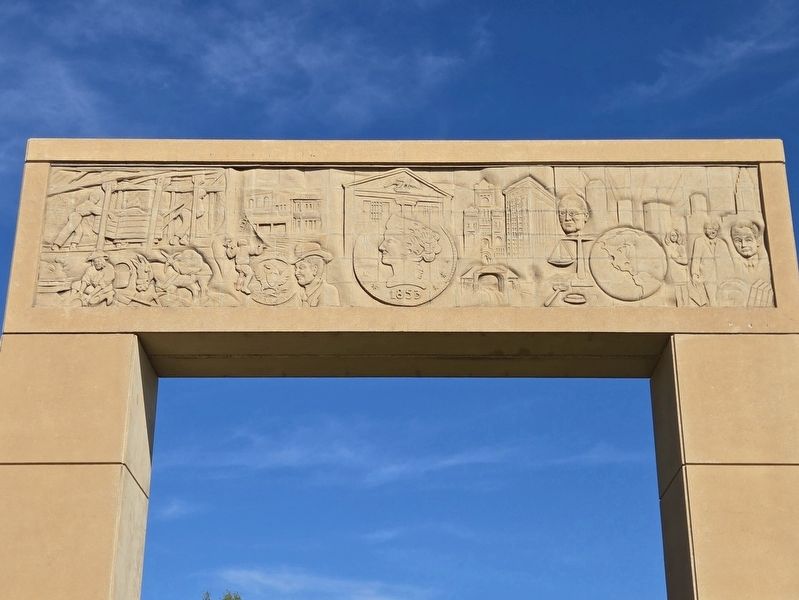
2. Finance Marker and arch
Shopping complex beyond the trees provides the closest parking, located off Conlan Circle
The monuments at Ballantyne were created by painter and sculptor Boris Tomic.
Erected 1995 by The family of James J. & Angela M. Harris.
Topics. This historical marker is listed in these topic lists: African Americans • Architecture • Education • Industry & Commerce • Settlements & Settlers. A significant historical year for this entry is 1799.
Location. 35° 3.297′ N, 80° 51.038′ W. Marker is in Charlotte, North Carolina, in Mecklenburg County. It is in Ballantyne. It can be reached from the intersection of Ballantyne Commons Parkway and Johnston Road (U.S. 521), on the right when traveling west. The marker is at ground level in front of the large arch. Parking is available nearby at the shopping complex on Conlan Circle. Touch for map. Marker is at or near this postal address: 10380 Ballantyne Commons Pkwy, Charlotte NC 28277, United States of America. Touch for directions.

Regionally, this marker is in North Carolina’s Piedmont. It is also in the American South and specifically in the Upper South. Globally, it is in North America, the Western Hemisphere, the Western World, and the
Photographed by Mark Parker, September 3, 2024
3. Closeup of Finance Sculpture
Other nearby markers. At least 8 other markers are within 3 miles of this marker, measured as the crow flies: Transportation (within shouting distance of this marker); Human Spirit (within shouting distance of this marker); Technology (about 300 feet away, measured in a direct line); The Revolution in the Back Country / Sumpter's Camp at Clems Branch (approx. 2 miles away in South Carolina); The Revolution in the Backcountry / Sumter's Camp at Clems Branch (approx. 2.3 miles away in South Carolina); Trading Path (approx. 2.3 miles away); Polk Family Cemetery (approx. 2.3 miles away); President James K. Polk S.H.S. (approx. 2.4 miles away). Touch for a list and map of all markers in Charlotte.
Additional keywords. Mining
Credits. This page was last revised on September 4, 2024. It was originally submitted on September 4, 2024, by Mark Parker of Hickory, North Carolina. This page has been viewed 243 times since then and 40 times this year. Photos: 1, 2, 3. submitted on September 4, 2024, by Mark Parker of Hickory, North Carolina. • Bernard Fisher was the editor who published this page.
