Niederdorf in Zürich, Switzerland — Central Europe (the Alps)
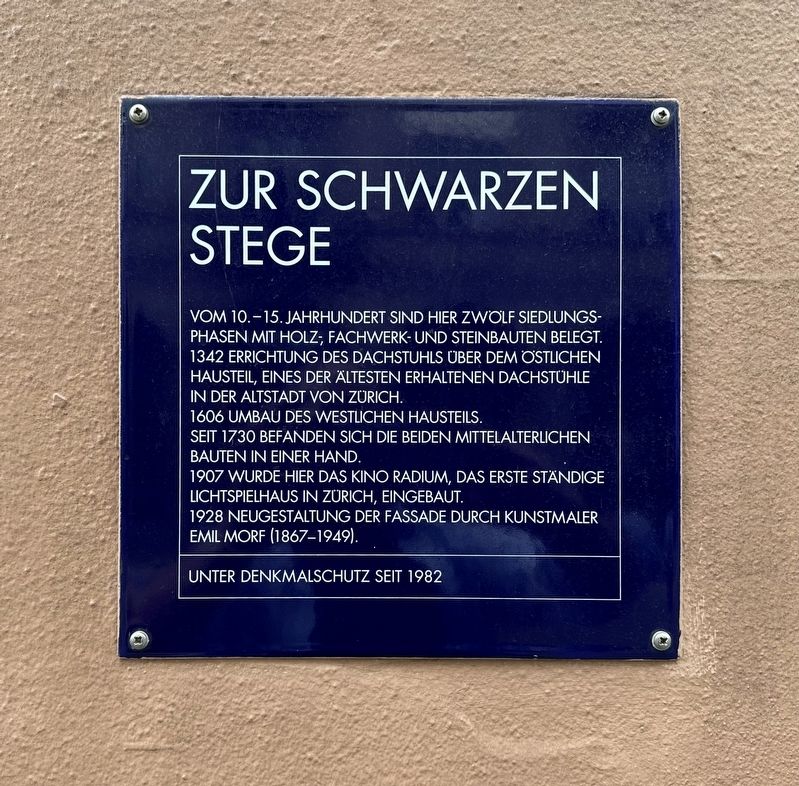
Zur Schwarzen Stege
Photographed by Andrew Ruppenstein, August 17, 2024
1. Zur Schwarzen Stege Marker

Vom 10.-15. Jahrhundert sind hier zwölf Siedlungsphasen mit Holz; Fachwerk- und Steinbauten belegt.
1342 errichtung des Dachstuhls über dem östlichen Hausteil, eines der ältesten erhaltenen Dachstühle in der Altstadt von Zürich.
1606 umbau des westlichen Hausteils.
Seit 1730 befanden sich die beiden mittelalterlichen bauten in einer Hand.
1907 wurde hier das Kino Radium, das erste ständige Lichtspielhaus in Zürich, eingebaut.
1928 neugestaltung der Fassade durch Kunstmaler Emil Morf (1867-1949).
Unter Denkmalschutz seit 1982
Twelve settlement phases with wood, half-timbered and stone construction are documented here from the 10th to the 15th century.
1342 construction of the roof truss over the eastern part of the house, one of the oldest surviving roof trusses in the old town of Zurich.
1606 reconstruction of the western part of the house.
Since 1730 the two medieval buildings have been in the same hands.
1907 the Kino Radium (Radium Cinema), the first permanent cinema in Zurich, was built here.
1928 redesign of the facade by painter Emil Morf (1867-1949).
Listed
this page online
Topics and series. This historical marker is listed in these topic lists: Architecture • Arts, Letters, Music. In addition, it is included in the Zurich Blue Square series list. A significant historical date for this entry is October 12, 1907.
Location. 47° 22.461′ N, 8° 32.607′ E. Marker is in Zürich. It is in Niederdorf. It is on Mühlegasse, on the left when traveling east. Touch for map. Marker is at or near this postal address: Mühlegasse 5, Zürich 8001, Switzerland. Touch for directions.

Regionally, it is in Europe, Central Europe, the Schengen Area, Western Europe, and the Western World. Historically, it finds itself in what was once the Roman Empire and specifically also the Holy Roman Empire.
Other nearby markers. At least 8 other markers are within walking distance of this marker: Tiefe Schmitte (within shouting distance of this marker); Johann Georg Bodmer (within shouting distance of this marker); Hirschen (about 90 meters away, measured in a direct line); Pestalozzihaus (about 90 meters away); Schwule, Lesben und trans Menschen / Gays, Lesbians, and Transgender Persons in Zurich (about
Photographed by Andrew Ruppenstein, August 17, 2024
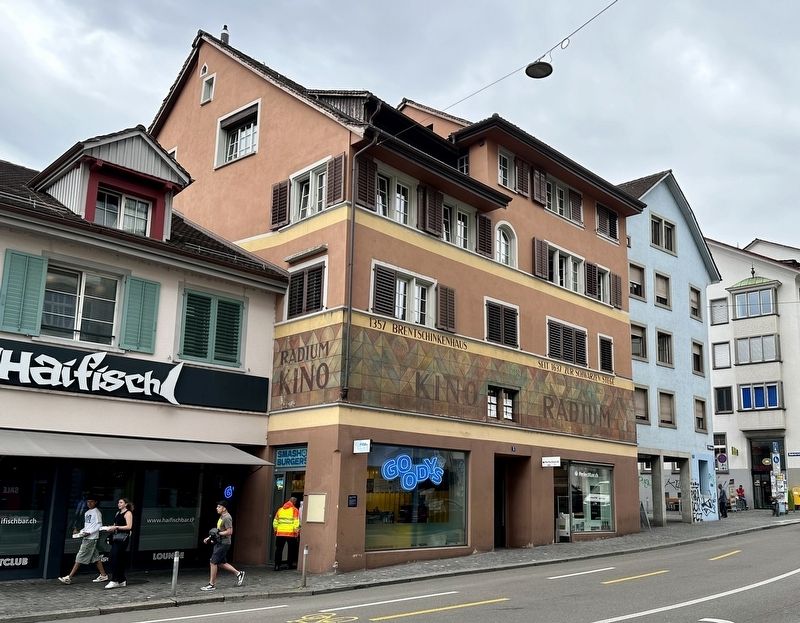
2. Zur Schwarzen Stege Marker - wide view
Also see . . . Kino Radium (Wikipedia, in German).
Excerpt (in translation): Film screenings had been taking place in Zurich since 1896 with mobile facilities. Contrary to information in media reports and scientific literature, which describe the Radium cinema as the first cinema in Zurich, there were already two stationary cinemas before that. A stationary cinema had already been set up in Geneva in 1906, and other Swiss cities quickly followed in 1907. In Zurich, too, the first applications for a permit had already been submitted in the autumn of 1906, and in March 1907 the film pioneer Jean Speck received the corresponding permit. His Speck cinematograph was opened in April 1907 near the train station on Waisenhausstrasse. Anton Fischer and Carl Simon-Sommer also opened a cinema near the train station, on Löwenstrasse, at the end of March 1907, but they only obtained the necessary permits later. Both also operated the Radium cinema on Mühlegasse, but Fischer withdrew before the opening. The Radium cinema was then opened on October 12, 1907.(Submitted on September 4, 2024.)
Credits. This page was last revised on September 4, 2024. It was originally submitted on September 4, 2024, by Andrew Ruppenstein of Lamorinda, California. This page has been viewed 113 times since then and 19 times this year. Photos: 1, 2. submitted on September 4, 2024, by Andrew Ruppenstein of Lamorinda, California.
