Near Munhall in Allegheny County, Pennsylvania — The American Northeast (Mid-Atlantic)
Rivers of Steel
⎯⎯⎯
Homestead

Photographed by Bradley Owen, September 3, 2024
1. Rivers of Steel / Homestead Marker
(Panel 1):
Telling Steel's Story
■ Created by Congress and the Commonwealth of Pennsylvania in 1996, the Rivers of Steel National Heritage Area is committed to preserving, interpreting, and managing the historic, cultural, and natural resources associated with Big Steel and its related industries. Encompassing eight counties - Allegheny, Armstrong, Beaver, Butler, Greene, Fayette, Washington, and Westmoreland - Rivers of Steel builds on southwestern Pennsylvania's transition from heavy industry to high technology and diversified services by promoting tourism and economic development based on the region's historic industrial legacy.
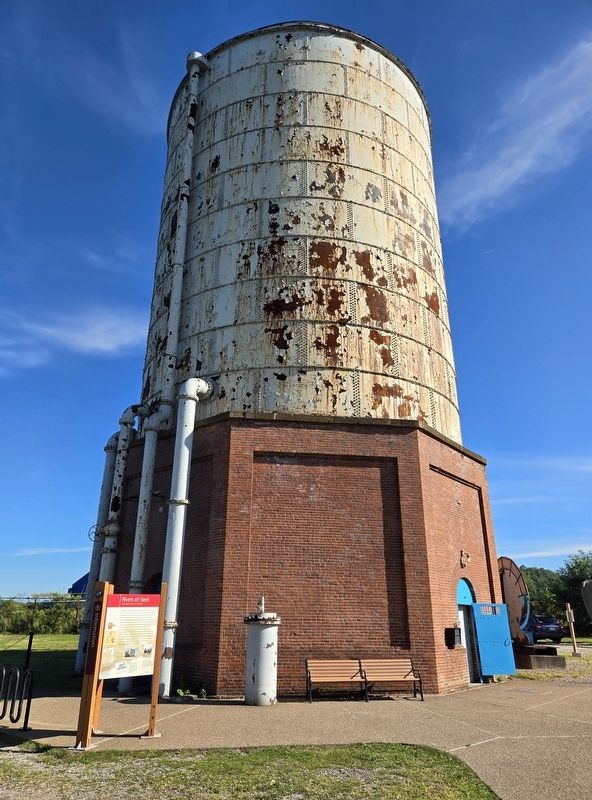
■ Rivers of Steel owns and manages this Historic Pump House and Water Tower - site of the 1892 Battle of Homestead - used as a center for community events, lectures, interpretation, and as a trailhead for the Great Allegheny Passage. Visit other Rivers of Steel attractions including the National Historic Landmark Bost Building on E. 8th Avenue in Homestead, the National Historic Landmark Carrie Blast Furnaces in Rankin/Swissvale, and the W. A. Young Foundry and Machine
this page online
National Heritage Area: National Heritage Areas (NHAs), like the Rivers of Steel National Heritage Area, are designated by Congress as places where natural, cultural, and historic resources combine to form a cohesive, nationally important landscape. NHAs are a grassroots, community-driven approach to heritage conservation and economic development. Through public-private partnerships, NHA entities support historic preservation, natural resource conservation, recreation, heritage tourism, and educational projects.
www.nps.gov/heritageareas
Image by Rivers of Steel National Heritage Area
Bost Building: The Bost Building was built in 1892 as a hotel, restaurant, and bar to serve the growing workers ward of Homestead. During the summer of 1892, it served as headquarters and lookout for the Amalgamated Association of Iron and Steel Workers during the Homestead Lockout and Strike, and as the base for newspaper correspondents following the events. This National Historic Landmark is now the Rivers of Steel National Heritage Area's visitor center and museum.
Images courtesy of Rivers of Steel National Heritage Area
Accessing History: The structures preserved by Rivers of Steel allow people to visit places that have been off-limits to the public in their useful lifetimes and would otherwise have disappeared to history. Here, visitors can arrange guided tours, attend events, or take part in photo outings of the National Historic Landmark Carrie Blast Furnaces across the river. The Pump House is open for community events throughout the year.
Photo by Trail Town Program
(Panel 2):
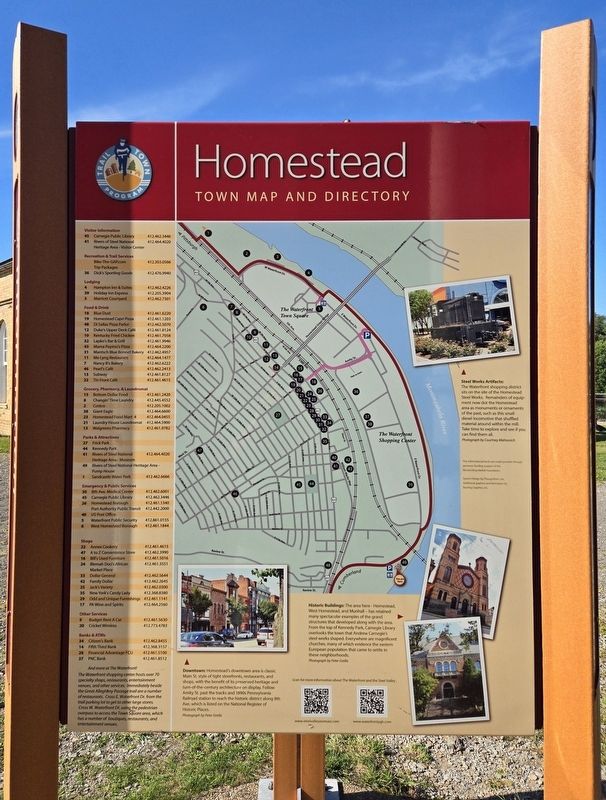
Town Map and Directory
Steel Works Artifacts:
The
Photographed by Bradley Owen, September 3, 2024
2. Rivers of Steel / Homestead Marker
Photograph by Courtney Mahronich
Downtown: Homestead's downtown area is classic Main St. style of tight storefronts, restaurants, and shops, with the benefit of its preserved heritage and turn-of-the-century architecture on display. Follow Amity St. past the tracks and 1890s Pennsylvania Railroad station to reach the historic district along 8th Ave, which is listed on the National Register of Historic Places.
Photograph by Peter Grella
Historic Buildings: The area here - Homestead, West Homestead, and Munhall - has retained many spectacular examples of the grand structures that developed along with the area. From the top of Kennedy Park, Carnegie Library overlooks the town that Andrew Carnegie's steel works shaped. Everywhere are magnificent churches, many of which evidence the eastern European population that came to settle

Photographed by Bradley Owen, September 3, 2024
3. Rivers of Steel / Homestead Marker
Photograph by Peter Grellia
(Panel 3):
Trail Map and Points of Interest
Point State Park
9 miles north
Point State Park serves as the terminus of the Great Allegheny Passage, which is marked with a medallion at the tip of Pittsburgh's "Golden Triangle." Once a strategic location in colonial times, the park commemorates the sites of Fort Duquesne and Fort Pitt and is today a popular attraction.
Park photo courtesy of Pressley.
Medallion photo by Joshua Franzos.
South Side Pittsburgh
6 miles north
The historic South Side has resurged to become a premier destination in Pittsburgh. Linked by trails to the rest of the city and other major attractions, this walkable and bikeable neighborhood has over 100 restaurants, entertainment venues, and shops as well as a full calendar of cultural activities.
Photo by Jonathan Growall, courtesy of South Side Chamber of Commerce
Edgar Thomson Steel Works
2.5 miles south
This massive steel plant, seen here c.1900, is a remnant of the dozens that once populated these rivers' shores. Commissioned in 1875 as the first mill in the US to use
Photographed by Bradley Owen, September 3, 2024
4. Rivers of Steel / Homestead Marker
Photo by Rivers of Steel National Heritage Area
Kennywood Park
2.5 miles south
Kennywood Park, a National Historic Landmark, opened as a picnic grove in 1898 and grew to become an amusement park located on a Pittsburgh trolley line. It is home over 30 rides, including several rare and antique rides from the early 20th Century. From the trail, you can see the 1968 classic wooden roller coaster, The Thunderbolt, and the 2001 Phantom's Revenge steel coaster.
Photo by William Prince
Dead Man's Hollow
10 miles south
Dead Man's Hollow, protected by the Allegheny Land Trust, has a storied past as a bivouac for outlaws, with tales of hangings and murders. Today, it is a 440 acre wildlife preserve with three miles of gentle hiking paths, rock formations, and ruins to explore.
Photo by Steve Bozynak, courtesy of Allegheny Land Trust
Erected by Rivers of Steel, Pennsylvania Department of Conservation and Natural Resources and National Park Service.
Topics. This historical marker is listed in these topic lists: Architecture • Entertainment • Industry & Commerce • Railroads & Streetcars. A significant historical year for this entry is 1996.
Location. 40° 24.778′ N, 79° 53.797′ W. Marker is near Munhall, Pennsylvania, in Allegheny County. It is on East Waterfront Drive 0.7 miles west of East 8th Avenue (Pennsylvania Route 837), on the right when traveling west. Marker is located near the trail access parking area for the Great Allegheny Passage at The Pump House. Touch for map. Marker is at or near this postal address: 880 East Waterfront Drive, Homestead PA 15120, United States of America. Touch for directions.

Regionally, this marker is in Greater Pittsburgh. It is also in the American Northeast, in the Mid-Atlantic, in the Ohio River Valley, in Appalachia, and specifically in Northern Appalachia. Globally, it is in North America, the Western Hemisphere, the Western World, and the Anglosphere. Historically, it finds itself in what was once the Viceroyalty of New France, the Haudenosaunee (Iroquois) Confederacy, and one of the original Thirteen Colonies.
Other nearby markers. At least 8 other markers are within walking distance of this marker: Capstan (here, next to this marker); Pump House (a few steps from this marker); United States Steel Sign (a few steps from this marker); Iron Making (within shouting distance of this marker); The Battle of Homestead (within shouting distance of this marker); July 6, 1892 (within shouting distance of this marker); Homestead Strike (within shouting distance of this marker); Blast Furnace Bells and Hopper (within shouting distance of this marker). Touch for a list and map of all markers in Munhall.
Credits. This page was last revised on September 10, 2024. It was originally submitted on September 4, 2024, by Bradley Owen of Morgantown, West Virginia. This page has been viewed 301 times since then and 37 times this year. Photos: 1, 2, 3, 4. submitted on September 10, 2024, by Bradley Owen of Morgantown, West Virginia.
