Green Island in Albany County, New York — The American Northeast (Mid-Atlantic)
Water Fire Iron
⎯⎯⎯
.7 Sq. Mi.
⎯⎯⎯
Age of Rail

Photographed by Steve Stoessel, September 2, 2024
1. .7 Sq. Mi. Side of Marker
This map shows the State Dam, which was destroyed by the 1913 flood. The Federal Dam, pictured above, was built in 1916.
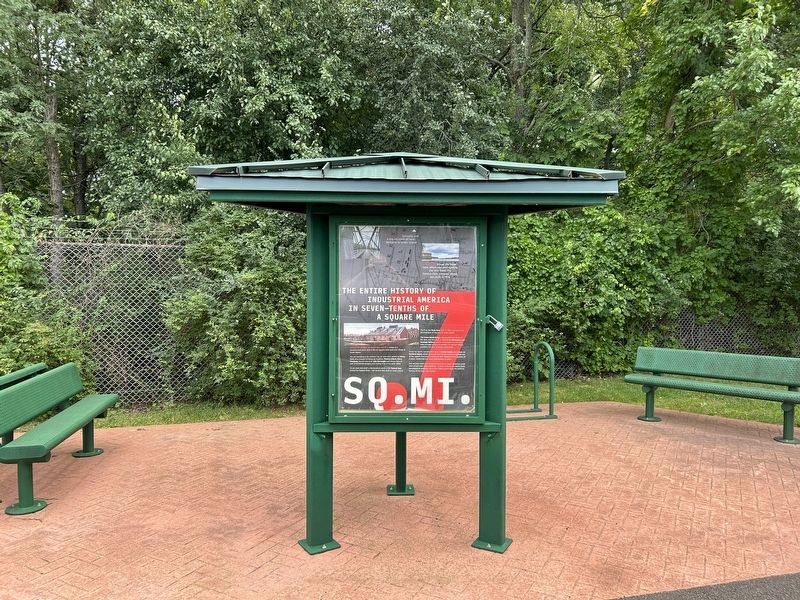
The entire history of Industrial America in seven-tenths of a square mile.
The entire history of Industrial America comes to a concentrated point here in the 0.7-square-mile town and village of Green Island.
You are standing at its northern tip, on land once owned by Henry Ford, who enjoyed bringing his buddies, Thomas Edison, Henry Firestone, famed naturalist John Burroughs and others here on well-provisioned camping and fishing trips in the early 1900s.
To our east and south a few hundred yards is the Federal Dam across the Hudson River - the second dam built at Green Island.
The first, the State Dam, built in 1823, was key to the development of industry on Green Island.
The Green Island Bridge, about 4,000 feet south of the dam, was first built in 1835 by the Rensselaer and Saratoga Railway, and for many years was the only train passage across the Hudson. Its storied history parallels the
this page online
To our far south, just one mile away, is Center Island, also known as Starbuck Island, where Nathaniel and George Starbuck opened one of the region's first iron foundries in 1821. Today, it is the location of a major residential and retail development project.
And between here and Starbuck Island sits a classic American small town of just over 2,600 residents - a town, that like the island itself, has played an outsized role in the history, particularly the political history, of the state and country.
Starbuck Brothers Foundry was built on Center Island, part of the Village of Green Island, in 1821.
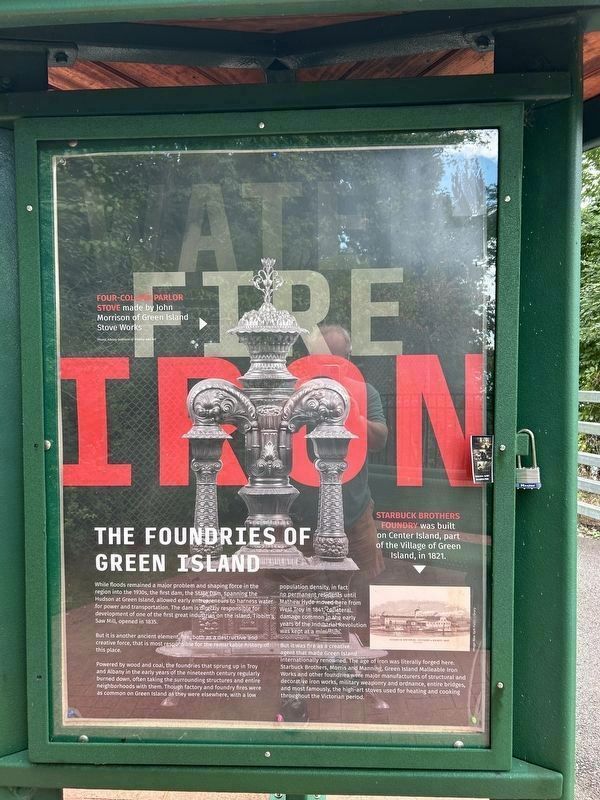
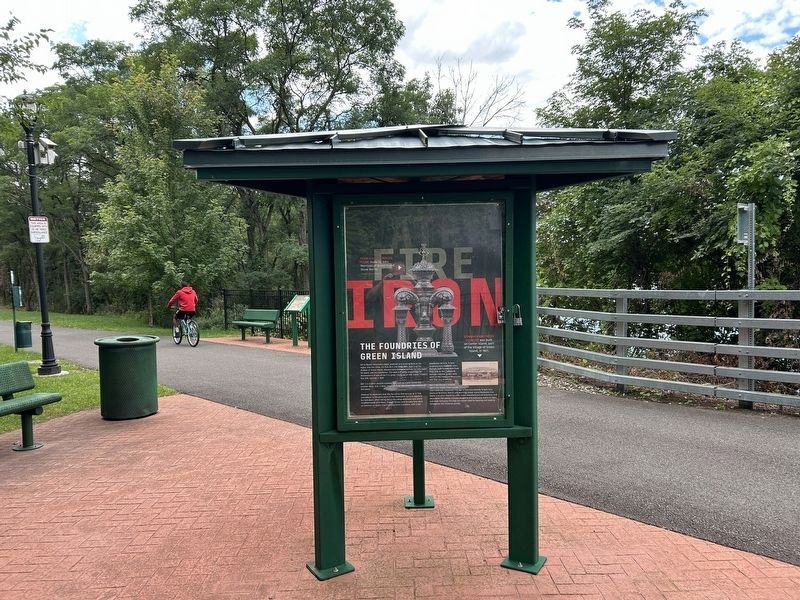
The Foundries of Green Island
While floods remained a major problem and shaping force in the region into the 1930s, the first dam, the State Dam, spanning the Hudson at Green Island, allowed early entrepreneurs to harness water for power and transportation. The dam is directly responsible for development of one of the first great industries on the island, Tibbitt’s Saw Mill, opened in 1835. But it
Photographed by Steve Stoessel, September 2, 2024
2. Water Fire Iron Side of Marker
Powered by wood and coal, the foundries that sprung up in Troy and Albany in the early years of the nineteenth century regularly burned down, often taking the surrounding structures and entire neighborhoods with them. Though factory and foundry fires were as common on Green Island as they were elsewhere, with a low population density, in fact no permanent residents until Mathew Hyde moved here from West Troy in 1841, collateral damage common in the early years of the Industrial Revolution was kept at a minimum.
But it was fire as a creative agent that made Green Island internationally renowned. The age of iron was literally forged here. Starbuck Brothers, Morris and Manning, Green Island Malleable Iron Works and other foundries were major manufacturers of structural and decorative iron works, military weaponry and ordnance, entire bridges, and most famously, the high-art stoves used for heating and cooking throughout the Victorian period.

Photographed by Steve Stoessel, September 2, 2024
3. Age of Rail Side of Marker
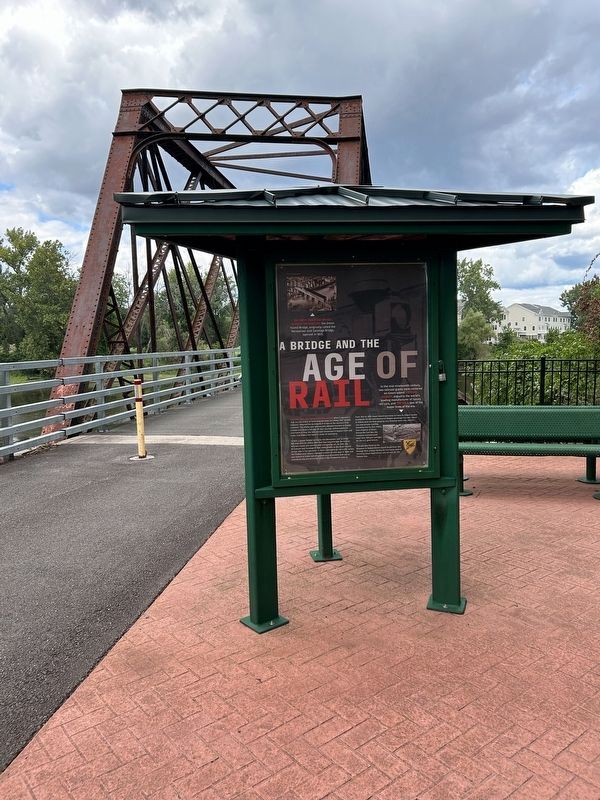
In the mid-nineteenth century, two railroad giants were centered on Green Island: Eaton & Gilbert, arguably the world's leading manufacturer of luxury rail cars, and The D&H, one of the major lines of the era.
The Erie Canal was an engineering marvel when it opened in 1825, but the ordeal of traversing the locks at Cohoes, the "terrible sixteens," inspired the development of one of the country's first railroads. The Albany and Schenectady allowed travelers to bypass Cohoes and shave a full day off their journey. Unfortunately for merchants in Troy, the new railroad threatened to bypass them and make rival Albany the region's center of commerce.
In 1832, a group formed to charter the Rensselaer and Saratoga Railroad with the radical idea that they would bridge the Hudson. at Green Island and connect west and east by rail. By 1835, the Rensselaer and Saratoga Bridge, today known as the Green Island Bridge, was in full operation. It held a monopoly on rail traffic across the Hudson until Albany managed to build its own span in 1866,
Photographed by Steve Stoessel, September 2, 2024
4. Water Fire Iron/.7 Sq. Mi./ Age of Rail Marker
This was also home to the Delaware & Hudson Green Island Shops from 1872 through 1912, a major facility for the heavy work of servicing steam locomotives and rail cars for the famous line.
Topics. This historical marker is listed in these topic lists: Industry & Commerce • Settlements & Settlers.
Location. 42° 45.61′ N, 73° 41.261′ W. Marker is on Green Island, New York, in Albany County. It is on Empire State Trail half a mile north of Cannon Street, on the left when traveling south. Marker is on the bicycle trail just south of the bridge to Van Schaick Island. Touch for map.
Photographed by Steve Stoessel, September 2, 2024
5. Water Fire Iron/.7 Sq. Mi./ Age of Rail Marker

Regionally, this marker is in Upstate New York, in the Capital District, and in the Albany Metropolitan Area. It is also in the American Northeast and in the Mid-Atlantic. Globally, it is in North America, the Western Hemisphere, the Western World, and the Anglosphere. Historically, it finds itself in what was once New Netherland and also one of the original Thirteen Colonies.
Other nearby markers. At least 8 other markers are within walking distance of this marker: Welcome to Green Island (a few steps from this marker); Unique Urban Village/ Resilient Factory Town/ Ford (about 700 feet away, measured in a direct line); Suffragist (approx. 0.4 miles away); World War Memorial (approx. 0.4 miles away); Van Schaick Mansion (approx. half a mile away); a different marker also named Van Schaick Mansion (approx. half a mile away); a different marker also named Van Schaick Mansion (approx. half a mile away); Camp Van Schaick (approx. 0.6 miles away). Touch for a list and map of all markers in Green Island.
More about this marker.
Photographed by Steve Stoessel, September 2, 2024
6. Water Fire Iron/.7 Sq. Mi./ Age of Rail Marker
Also see . . .
1. The Gilbert Car Company (Wikipedia). (Submitted on September 5, 2024, by Steve Stoessel of Niskayuna, New York.)
2. The Delaware & Hudson(Wikipedia). (Submitted on September 5, 2024, by Steve Stoessel of Niskayuna, New York.)
3. Green Island (Wikipedia). (Submitted on September 5, 2024, by Steve Stoessel of Niskayuna, New York.)
Credits. This page was last revised on September 5, 2024. It was originally submitted on September 4, 2024, by Steve Stoessel of Niskayuna, New York. This page has been viewed 325 times since then and 33 times this year. Photos: 1, 2, 3, 4, 5, 6. submitted on September 4, 2024, by Steve Stoessel of Niskayuna, New York.
