Near Munhall in Allegheny County, Pennsylvania — The American Northeast (Mid-Atlantic)
Iron Making
Photographed by Bradley Owen, September 3, 2024
1. Iron Making Marker
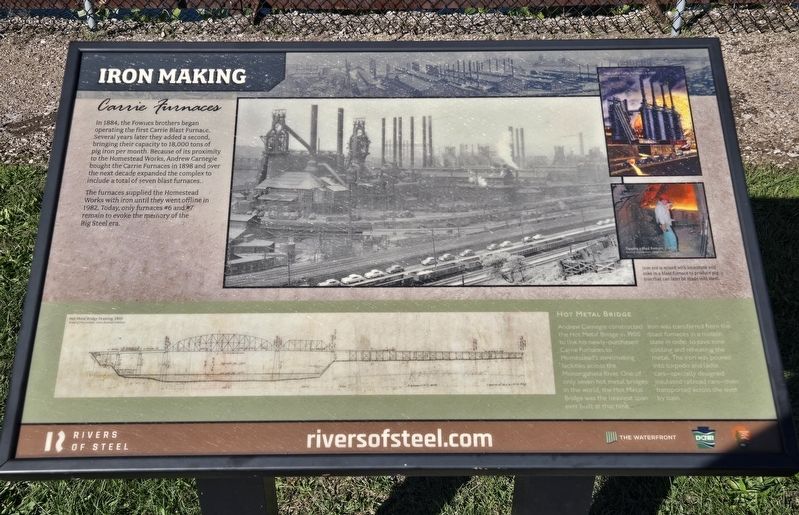
Carrie Furnaces
In 1884, the Fownes brothers began operating the first Carrie Blast Furnace. Several years later they added a second, bringing their capacity to 18,000 tons of pig iron per month. Because of its proximity to the Homestead Works, Andrew Carnegie bought the Carrie Furnaces in 1898 and over the next decade expanded the complex to include a total of seven blast furnaces.
The furnaces supplied the Homestead Works with iron until they went offline in 1982. Today, only furnaces #6 and #7 remain to evoke the memory of the Big Steel era.
(Sidebar):
Hot Metal Bridge
Andrew Carnegie constructed the Hot Metal Bridge in 1900 to link his newly-purchased Carrie Furnaces to Homestead's steelmaking facilities across the Monongahela River. One of only seven hot metal bridges in the world, the Hot Metal Bridge was the heaviest span ever built at that time.
Iron was transferred from the blast furnaces in a molten state in order to save time cooling and reheating the metal. The iron was poured into torpedo and ladle cars - specially designed insulated railroad cars - then transported across the river by train.
(Captions):
Hot Metal Bridge Drawing, 1900
Rivers of Steel Archives, Union Railroad Collection
Postcard of Carrie Furnaces, c. 1900
Rivers of Steel Archives
Tapping a Blast Furnace, c. 1970
Rivers of Steel Archives, Chikiris Collection
Iron ore is mixed with limestone and coke in a blast furnace to produce pig iron that can later be made into steel.
Erected by Rivers
this page online
Topics. This historical marker is listed in these topic lists: Bridges & Viaducts • Industry & Commerce. A significant historical year for this entry is 1884.
Location. 40° 24.782′ N, 79° 53.777′ W. Marker is near Munhall, Pennsylvania, in Allegheny County. It can be reached from East Waterfront Drive west of East 8th Avenue (Pennsylvania Route 837), on the right when traveling west. Marker is located near the trail access parking area for the Great Allegheny Passage at The Pump House. Touch for map. Marker is at or near this postal address: 880 East Waterfront Drive, Homestead PA 15120, United States of America. Touch for directions.

Regionally, this marker is in Greater Pittsburgh. It is also in the American Northeast, in the Mid-Atlantic, in the Ohio River Valley, in Appalachia, and specifically in Northern Appalachia. Globally, it is in North America, the Western Hemisphere, the Western World, and the Anglosphere. Historically, it finds itself in what was once the Viceroyalty of New France, the Haudenosaunee (Iroquois)
Photographed by Bradley Owen, September 3, 2024
2. Iron Making Marker
Other nearby markers. At least 8 other markers are within walking distance of this marker: Capstan (a few steps from this marker); Rivers of Steel / Homestead (within shouting distance of this marker); Pump House (within shouting distance of this marker); United States Steel Sign (within shouting distance of this marker); The Battle of Homestead (within shouting distance of this marker); July 6, 1892 (within shouting distance of this marker); Homestead Strike (within shouting distance of this marker); Blast Furnace Bells and Hopper (about 300 feet away, measured in a direct line). Touch for a list and map of all markers in Munhall.
Credits. This page was last revised on September 8, 2024. It was originally submitted on September 4, 2024, by Bradley Owen of Morgantown, West Virginia. This page has been viewed 329 times since then and 29 times this year. Photos: 1, 2. submitted on September 8, 2024, by Bradley Owen of Morgantown, West Virginia.
