Near Munhall in Allegheny County, Pennsylvania — The American Northeast (Mid-Atlantic)
Pump House
Photographed by Bradley Owen, September 3, 2024
1. Pump House Marker
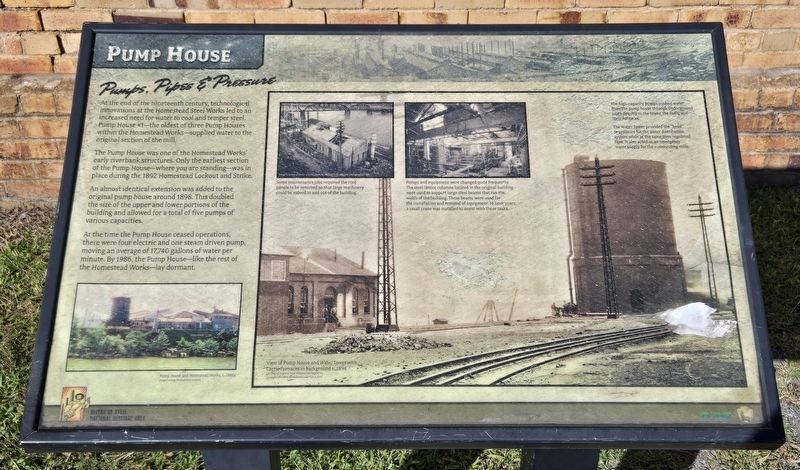
Pumps, Pipes & Pressure
At the end of the nineteenth century, technological innovations at the Homestead Steel Works led to an increased need for water to cool and temper steel. Pump House #1-the oldest of three Pump Houses within the Homestead Works-supplied water to the original section of the mill.
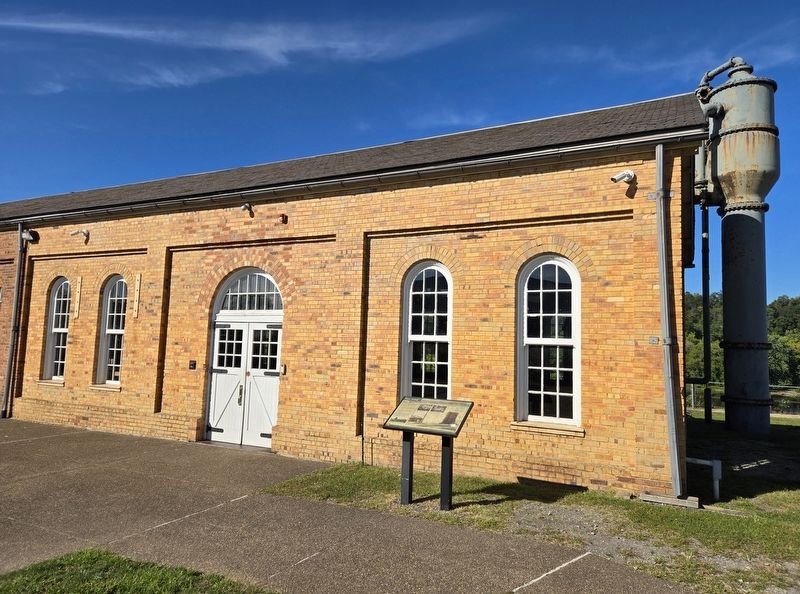
The Pump House was one of the Homestead Works' early riverbank structures. Only the earliest section of the Pump House-where you are standing-was in place during the 1892 Homestead Lockout and Strike.
An almost identical extension was added to the original pump house around 1898. This doubled the size of the upper and lower portions of the building and allowed for a total of five pumps of various capacities.
At the time the Pump House ceased operations, there were four electric and one steam driven pump, moving an average of 17,740 gallons of water per minute. By 1986, the Pump House-like the rest of the Homestead Works-lay dormant.
(Captions):
Image Courtesy of Rivers of Steel, HAER No. PA-200 P20, Jet Lowe, Photographer, 1989
Some maintenance jobs required the roof panels to be removed so that large machinery could be moved in and out of the building.
Courtesy of Rivers of Steel, HAER No. PA-200 P23, Jet Lowe, Photographer, 1989
Pumps and equipment were changed quite frequently. The steel lattice columns located in the original building were used to support large steel beams that ran the width of the building. These beams were used for the installation and removal of equipment. In later years, a small crane was installed to assist with these tasks.
The high-capacity pumps pushed water from the pump house through underground pipes directly to the tower, the mills, and their furnaces.
The Water Tower provided the "head" or pressure for the water distribution system while at the same time regulated flow. It also acted as an emergency water supply for the surrounding mills.
Pump House and Homestead Works, c. 1980s
Image Courtesy Rivers of Steel Archives
View of Pump House and Water Tower with Carrie Furnaces in background c. 1894.
Courtesy of Rivers of Steel National Heritage Area, Carnegie Library of Homestead Collection, c.1894
Erected by Rivers
this page online
Topics. This historical marker is listed in this topic list: Industry & Commerce. A significant historical year for this entry is 1892.
Location. 40° 24.784′ N, 79° 53.806′ W. Marker is near Munhall, Pennsylvania, in Allegheny County. It is on East Waterfront Drive 0.7 miles east of East 8th Avenue (Pennsylvania Route 837), on the right when traveling west. Marker is located near the trail access parking area for the Great Allegheny Passage at The Pump House. Touch for map. Marker is at or near this postal address: 880 East Waterfront Drive, Homestead PA 15120, United States of America. Touch for directions.

Regionally, this marker is in Greater Pittsburgh. It is also in the American Northeast, in the Mid-Atlantic, in the Ohio River Valley, in Appalachia, and specifically in Northern Appalachia. Globally, it is in North America, the Western Hemisphere, the Western World, and the Anglosphere. Historically, it finds itself in what was once the Viceroyalty of New France, the Haudenosaunee (Iroquois) Confederacy, and one of the
Photographed by Bradley Owen, September 3, 2024
2. Pump House Marker
Other nearby markers. At least 8 other markers are within walking distance of this marker: Rivers of Steel / Homestead (a few steps from this marker); Capstan (a few steps from this marker); The Battle of Homestead (a few steps from this marker); United States Steel Sign (within shouting distance of this marker); July 6, 1892 (within shouting distance of this marker); Iron Making (within shouting distance of this marker); Homestead Strike (within shouting distance of this marker); Blast Furnace Bells and Hopper (within shouting distance of this marker). Touch for a list and map of all markers in Munhall.
Credits. This page was last revised on September 9, 2024. It was originally submitted on September 5, 2024, by Bradley Owen of Morgantown, West Virginia. This page has been viewed 435 times since then and 64 times this year. Photos: 1, 2. submitted on September 9, 2024, by Bradley Owen of Morgantown, West Virginia.
