Mitte in Nürnberg, Bavaria, Germany — Central Europe
Kaiserkapelle
⎯⎯⎯
Imperial Chapel

Photographed by James Hulse, February 22, 2024
1. Kaiserkapelle / Imperial Chapel Marker

Die Kaiserkapelle stammt aus der frühesten erhaltenen Bauperiode, aus der Zeit der Staufer um 1200. Sie ist der bedeutendste Bau der Burg und einer der eindrucksvollsten Räume aus der staufischen Kaiserzeit. Es handelt sich um eine Doppelkapelle mit Ober- und Unterkapelle, die durch eine Öffnung im Boden bzw. in der Decke räumlich und akustisch miteinander verbunden sind. Die Unterkapelle, die nur vom Außeren Burghof zugänglich ist, wurde von der adligen Gefolgschaft genutzt. Die vom Palas zu betretende Oberkapelle war dem Kaiser und dem höherrangigen Hofstaat vorbehalten. Der erhöhte Platz auf der Westempore der Oberkapelle stand allein der kaiserlichen Familie zu. Neben der romanischen Bauplastik ist das Altarkreuz in der Oberkapelle hervorzuheben. Es wurde von Veit Stoß gefertigt, einem der berühmtesten Bildhauer und Bildschnitzer der Spätgotik.
The Imperial Chapel dates from the earliest preserved construction period, the era of the Hohenstaufen in around 1200. It is the most important structure in the castle and one of the most impressive examples of architecture during the Hohenstaufen imperial period. It is a double chapel with an upper and lower section, connected with each other spatially and acoustically by an aperture in the floor and ceiling respectively. The Lower Chapel, only accessible from the Outer Courtyard, was used by noble retainers. The Upper Chapel, accessible from the Palas, was reserved for the emperor and high-ranking members of the imperial court. The raised section on the west gallery of the Upper Chapel was the exclusive preserve of the imperial family. Apart from the Romanesque sculpture, the cross on the altar in the Upper Chapel is also worthy of note. It was made by Veit Stoß, one of the most famous sculptors and woodcarvers of the Late Gothic period.
Erected by Bayerische
this page online
Topics. This historical marker is listed in these topic lists: Forts and Castles • Religion & Religious Structures. A significant historical year for this entry is 1200.
Location. 49° 27.469′ N, 11° 4.539′ E. Marker is in Nürnberg, Bayern (Bavaria). It is in Mitte. It is on Burg just west of Burgstraße. The marker is located on the inside of the castle courtyard on the upper chapel building. Touch for map. Marker is at or near this postal address: Burg 16, Nürnberg BY 90403, Germany. Touch for directions.

Regionally, it is in Europe, the European Union, Atlantic Europe, Central Europe, the Schengen Area, Western Europe, and the Western World. Historically, it finds itself in what was once the Holy Roman Empire.
Other nearby markers. At least 8 other markers are within walking distance of this marker: Maria Sibylla Merian-Garten / Maria Sibylla Merian Garden (a few steps from this marker); Tiefer Brunnen / Deep Well (within shouting distance of this marker); Sinwellturm / Sinwell Tower (within shouting distance of this marker); Kaiserburg und Burggrafenburg / Imperial Castle and Burgrave's Castle
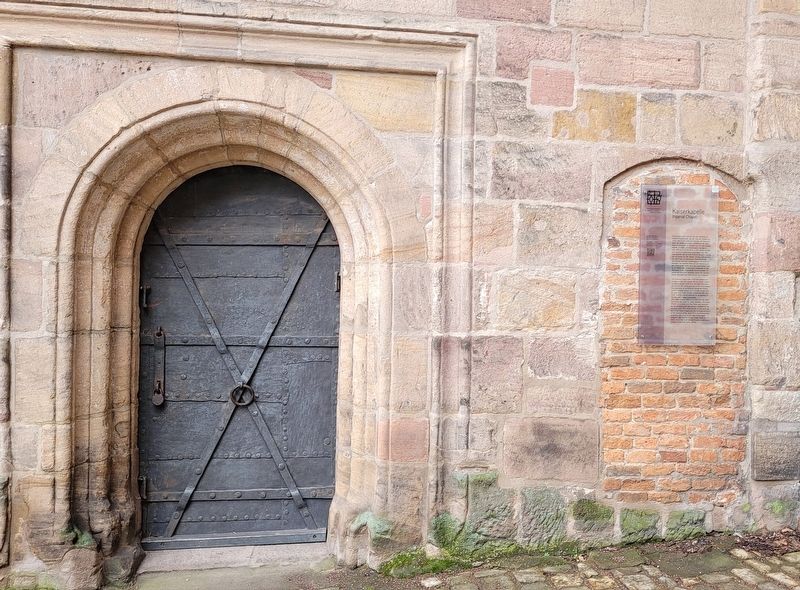
Photographed by James Hulse, February 22, 2024
2. Kaiserkapelle / Imperial Chapel Marker
Also see . . . Imperial Castle of Nuremberg Historical overview. Bayerische Schlösserverwaltung
The Imperial Castle is the symbol of Nuremberg. Since the Middle Ages its silhouette has represented the power and importance of the Holy Roman Empire of the German Nation and the outstanding role of the imperial city of Nuremberg.(Submitted on September 6, 2024, by James Hulse of Medina, Texas.)
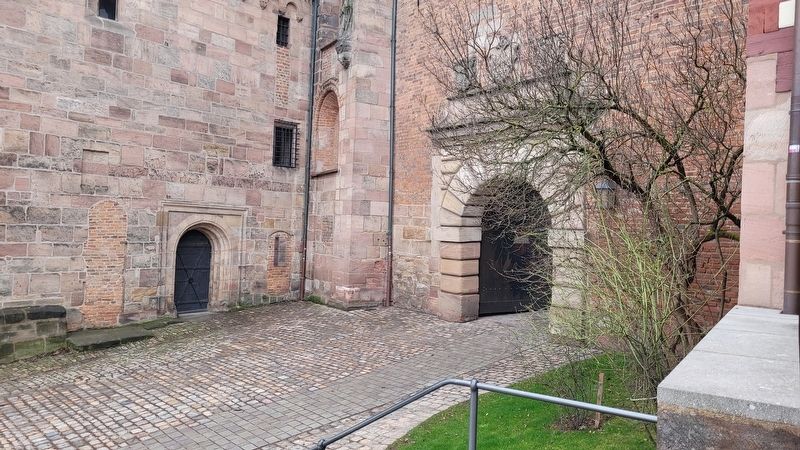
Photographed by James Hulse, February 22, 2024
3. Kaiserkapelle / Imperial Chapel Marker
The marker is located to the right side of the smaller archway.

Photographed by James Hulse, February 22, 2024
4. The view of the Kaiserkapelle / Imperial Chapel from the tower
Credits. This page was last revised on September 7, 2024. It was originally submitted on September 6, 2024, by James Hulse of Medina, Texas. This page has been viewed 201 times since then and 39 times this year. Photos: 1, 2, 3, 4. submitted on September 7, 2024, by James Hulse of Medina, Texas.
