Carnegie in Allegheny County, Pennsylvania — The American Northeast (Mid-Atlantic)
Rook
Photographed by Bradley Owen, September 3, 2024
1. Rook Marker
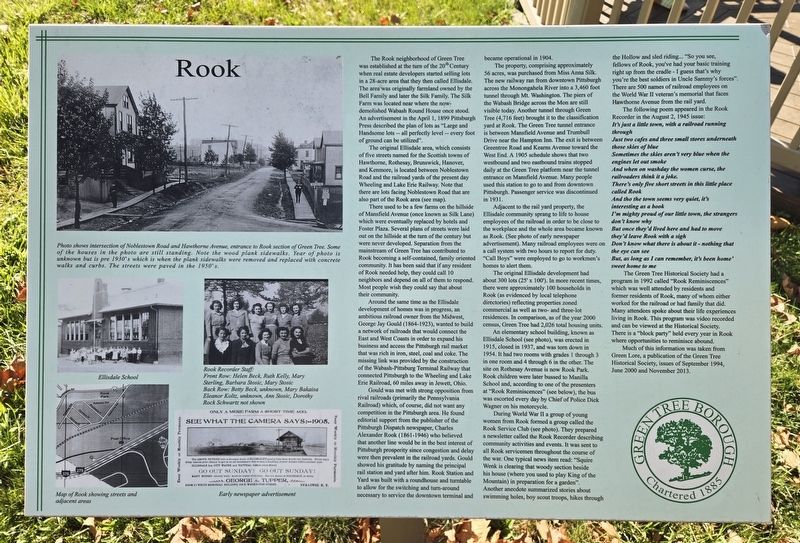
The Rook neighborhood of Green Tree was established at the turn of the 20th Century when real estate developers started selling lots in a 28-acre area that they then called Ellisdale. The area was originally farmland owned by the Bell Family and later the Silk Family. The Silk Farm was located near where the now-demolished Wabash Round House once stood. An advertisement in the April 1, 1899 Pittsburgh Press described the plan of lots as "Large and Handsome lots -- all perfectly level -- every foot of ground can be utilized".
The original Ellisdale area, which consists of five streets named for the Scottish towns of Hawthorne, Rothesay, Brunswick, Hanover, and Kenmore, is located between Noblestown Road and the railroad yards of the present day Wheeling and Lake Erie Railway. Note that there are lots facing Noblestown Road that are also part of the Rook area (see map).
There used to be a few farms on the hillside of Mansfield Avenue (once known as Silk Lane) which were eventually replaced by hotels and Foster Plaza. Several plans of streets were laid out on the hillside at the turn of the century but were never developed.
this page online
Around the same time as the Ellisdale development of homes was in progress, an ambitious railroad owner from the Midwest, George Jay Gould (1864-1923), wanted to build a network of railroads that would connect the East and West Coasts in order to expand his business and access the Pittsburgh rail market that was rich in iron, steel, coal and coke. The missing link was provided by the construction of the Wabash-Pittsburg Terminal Railway that connected Pittsburgh to the Wheeling and Lake Erie Railroad, 60 miles away in Jewett, Ohio.
Gould was met with strong opposition from rival railroads (primarily the Pennsylvania Railroad) which, of course, did not want any competition in the Pittsburgh area. He found editorial support from the publisher of the Pittsburgh Dispatch newspaper, Charles Alexander Rook (1861-1946) who believed
Photographed by Bradley Owen, September 3, 2024
2. Rook Marker
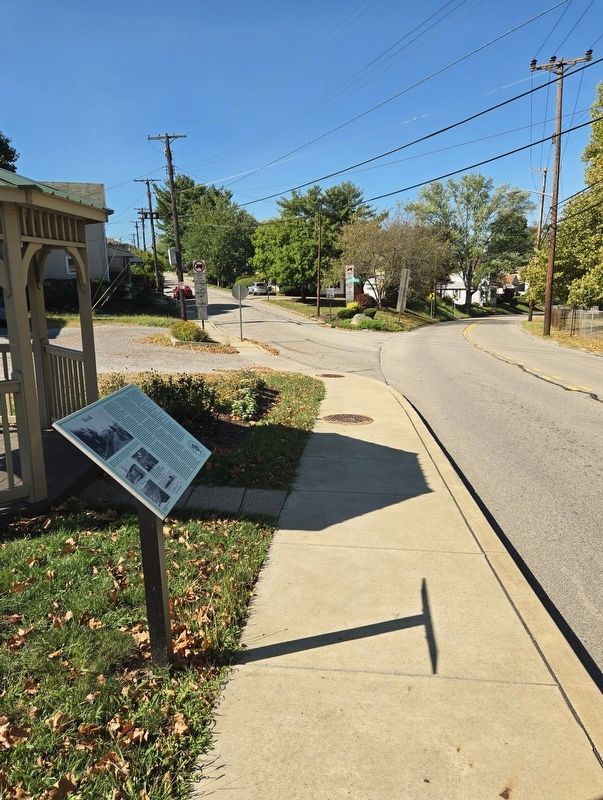
View is looking west.
The property, comprising approximately 56 acres, was purchased from Miss Anna Silk. The new railway ran from downtown Pittsburgh across the Monongahela River into a 3,460 foot tunnel through Mt. Washington. The piers of the Wabash Bridge across the Mon are still visible today. Another tunnel through Green Tree (4,716 feet) brought it to the classification yard at Rook. The Green Tree tunnel entrance is between Mansfield Avenue and Trumbull Drive near the Hampton Inn. The exit is between Greentree Road and Kearns Avenue toward the West End. A 1905 schedule shows that two westbound and two eastbound trains stopped daily at the Green Tree platform near the tunnel entrance on Mansfield Avenue. Many people used this station to go to and from downtown Pittsburgh. Passenger service was discontinued in 1931.
Adjacent to the rail yard property, the Ellisdale community sprang to life to house employees of the railroad in order to be close to the workplace and the whole area became known as Rook. (See photo of early newspaper advertisement). Many railroad employees were on a call system with two hours to report for duty. "Call Boys" were employed to go to workmen's homes to alert them.
The original Ellisdale development had about 300 lots (25' x 100'). In more recent times, there were approximately 100 households in Rook (as evidenced by local telephone directories) reflecting properties zoned commercial as well as two- and three-lot residences. In comparison, as of the year 2000 census, Green Tree had 2,026 total housing units.
An elementary school building, known as Ellisdale School (see photo), was erected in 1915, closed in 1937, and was torn down in 1954. It had two rooms with grades 1 through 3 in one room and 4 through 6 in the other. The site on Rothesay Avenue is now Rook Park. Rook children were later bussed to Manilla School and, according to one of the presenters at "Rook Reminiscences" (see below), the bus was escorted every day by Chief of Police Dick Wagner on his motorcycle.
During World War II a group of young women from Rook formed a group called the Rook Service Club (see photo). They prepared a newsletter called the Rook Recorder describing community activities and events. It was sent to all Rook servicemen throughout the course of the war. One typical news item read: "Squire Wenk is clearing that woody section beside his house (where you used to play King of the Mountain) in preparation for a garden". Another anecdote summarized stories about swimming holes, boy scout troops, hikes through the Hollow and sled riding... "So you see, fellows of Rook, you've had your basic training right up from the cradle - I guess that's why you're the best soldiers in Uncle Sammy's forces". There are 500 names of railroad employees on the World War II veteran's memorial that faces Hawthorne Avenue from the rail yard.
The following poem appeared in the Rook Recorder in the August 2, 1945 issue:
It's just a little town, with a railroad running through
Just two cafes and three small stores underneath those skies of blue
Sometimes the skies aren't very blue when the engines let out smoke
And when on washday the women curse, the railroaders think it a joke.
There's only five short streets in this little place called Rook
And tho the town seems very quiet, it's interesting as a book
I'm mighty proud of our little town, the strangers don't know why
But once they'd lived here and had to move they'd leave Rook with a sigh
Don't know what there is about it - nothing that the eye can see
But, as long as I can remember, it's been home' sweet home to me
The Green Tree Historical Society had a program in 1992 called "Rook Reminiscences" which was well attended by residents and former residents of Rook, many of whom either worked for the railroad or had family that did. Many attendees spoke about their life experiences living in Rook. This program was video recorded and can be viewed at the Historical Society. There is a "block party" held every year in Rook where opportunities to reminisce abound.
Much of this information was taken from Green Lore, a publication of the Green Tree Historical Society, issues of September 1994, June 2000 and November 2013.
(Captions):
Photo shows intersection of Noblestown Road and Hawthorne Avenue, entrance to Rook section of Green Tree. Some of the houses in the photo are still standing. Note the wood plank sidewalks. Year of photo is unknown but is pre 1930's which is when the plank sidewalks were removed and replaced with concrete walks and curbs. The streets were paved in the 1950's.
Ellisdale School
Rook Recorder Staff:
Front Row: Helen Beck, Ruth Kelly, Mary Sterling, Barbara Stosic, Mary Stosic
Back Row: Betty Beck, unknown, Mary Bakaisa Eleanor Koltz, unknown, Ann Stosic, Dorothy Rock Schwartz not shown
Map of Rook showing streets and adjacent areas
Early newspaper advertisement
Erected 2017 by Historical Society of Green Tree.
Topics. This historical marker is listed in these topic lists: Industry & Commerce • Railroads & Streetcars • Settlements & Settlers • War, World II. A significant historical date for this entry is April 1, 1899.
Location. 40° 24.976′ N, 80° 4.026′ W. Marker is in Carnegie, Pennsylvania, in Allegheny County. It is on Noblestown Road (Pennsylvania Route 50) north of Hawthorne Street, on the right when traveling north. Touch for map. Marker is at or near this postal address: 810 Noblestown Road, Carnegie PA 15106, United States of America. Touch for directions.

Regionally, this marker is in Greater Pittsburgh. It is also in the American Northeast, in the Mid-Atlantic, in the Ohio River Valley, in Appalachia, and specifically in Northern Appalachia. Globally, it is in North America, the Western Hemisphere, the Western World, and the Anglosphere. Historically, it finds itself in what was once the Viceroyalty of New France, the Haudenosaunee (Iroquois) Confederacy, and one of the original Thirteen Colonies.
Other nearby markers. At least 8 other markers are within one mile of this marker, measured as the crow flies: Civil War Monument, Chartiers Cemetery (about 600 feet away, measured in a direct line); World War I Honor Roll (approx. 0.4 miles away); East Carnegie Honor Roll (approx. 0.4 miles away); Union Electric Steel Honor Roll (approx. half a mile away); Oakwood Veterans Memorial (approx. 0.9 miles away); Chartiers Valley Memorial (approx. 0.9 miles away); Making Apple Butter in Green Tree in the Olden Days (approx. one mile away); Creighton Avenue (approx. one mile away). Touch for a list and map of all markers in Carnegie.
Credits. This page was last revised on July 19, 2025. It was originally submitted on September 6, 2024, by Bradley Owen of Morgantown, West Virginia. This page has been viewed 2,553 times since then and 229 times this year. Photos: 1, 2. submitted on September 6, 2024, by Bradley Owen of Morgantown, West Virginia.
