Mitte in Nürnberg, Bavaria, Germany — Central Europe
Kaiserburg Nürnberg
⎯⎯⎯
Imperial Castle Nuremberg

Photographed by James Hulse, February 22, 2024
1. Kaiserburg Nürnberg / Imperial Castle Nuremberg Marker

Die Kaiserburg Nürnberg ist eine der bedeutendsten Kaiserpfalzen des Mittelalters. Zwischen 1050 und 1571 hielten hier alle deutschen Kaiser und Könige des Heiligen Römischen Reichs ihre Hof-, Reichs- und Gerichtstage ab.
Bereits im 11. Jahrhundert entstand eine salische Königsburg auf dem Burgfelsen. Im 12. und 13. Jahr hundert erbauten Kaiser Friedrich I. Barbarossa (1123-1190) und seine Nachfolger auf dem westlichen Burgfelsen eine der größten und prachtvollsten Burganlagen des Reiches. Aus dieser Zeit stammt noch die romanische Doppelkapelle, während der Palas und weitere Bauten ab 1440 im spätgotischen Stil umgebaut und erneuert wurden. Der Neubau der mächtigen Bastionen folgte ein Jahrhundert später.
Die Kaiserburg wurde nur während der Kaiserbesuche bewohnt. Der ständige Verwalter des Kaisers lebte in der Burggrafenburg auf dem östlichen Burgfelsen.
The Imperial Castle Nuremberg is one of the most important imperial palaces of the Middle Ages. Between 1050 and 1571 it hosted the gatherings of the court, Diets and juridical sessions of all German emperors and kings of the Holy Roman Empire. A Salian royal castle was built on the rock here as early as the 11th century. In the 12th and 13th centuries, Emperor Friedrich I. Barbarossa (1123-1190) and his successors built one of the largest and most magnificent castle complexes of the empire on the western rock. The Romanesque double chapel still dates from this time, while the palace and other structures were converted and renewed from 1440 onwards in the Late Gothic style. The mighty bastions were first built one century later.
The Imperial Castle was only inhabited during imperial visits. The emperor's permanent administrator lived in the Burgrave's Castle on the eastern rock.
Erected by Bayerische Verwaltung der
this page online
Topics. This historical marker is listed in this topic list: Forts and Castles. A significant historical year for this entry is 1050 CE.
Location. 49° 27.456′ N, 11° 4.593′ E. Marker is in Nürnberg, Bayern (Bavaria). It is in Mitte. It is on Burg just west of Burgstraße. The marker is located at the front gate of the castle. Touch for map. Marker is at or near this postal address: Burg 10, Nürnberg BY 90403, Germany. Touch for directions.

Regionally, it is in Europe, the European Union, Atlantic Europe, Central Europe, the Schengen Area, Western Europe, and the Western World. Historically, it finds itself in what was once the Holy Roman Empire.
Other nearby markers. At least 8 other markers are within walking distance of this marker: Kaiserburg und Burggrafenburg / Imperial Castle and Burgrave's Castle (a few steps from this marker); Sinwellturm / Sinwell Tower (within shouting distance of this marker); Tiefer Brunnen / Deep Well (within shouting distance of this marker); Maria Sibylla Merian-Garten / Maria Sibylla Merian Garden (within shouting distance of this marker); Kaiserkapelle / Imperial Chapel

Photographed by James Hulse, February 22, 2024
2. The entrance gate to the Imperial Castle Nuremberg and Marker
Also see . . . Imperial Castle of Nuremberg Historical overview. Bayerische Schlösserverwaltung
The Imperial Castle is the symbol of Nuremberg. Since the Middle Ages its silhouette has represented the power and importance of the Holy Roman Empire of the German Nation and the outstanding role of the imperial city of Nuremberg.(Submitted on September 6, 2024, by James Hulse of Medina, Texas.)

Photographed by James Hulse, February 22, 2024
3. The front approach to the Imperial Castle Nuremberg
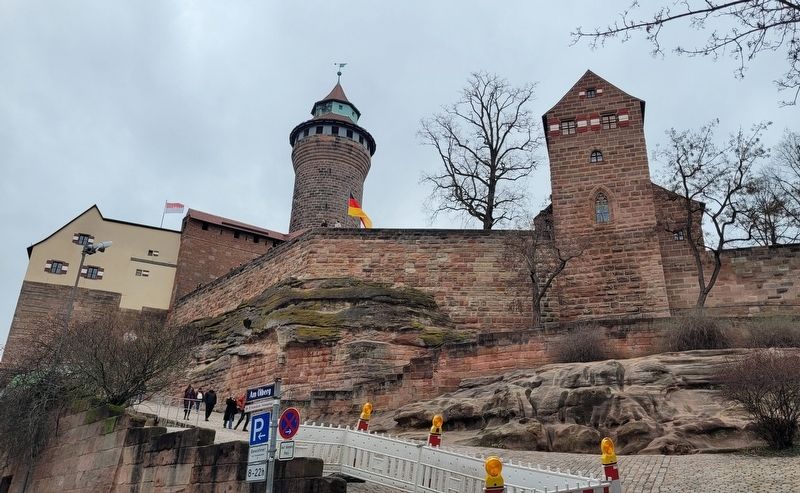
Photographed by James Hulse, February 22, 2024
4. The front view of the Imperial Castle Nuremberg
Credits. This page was last revised on September 7, 2024. It was originally submitted on September 6, 2024, by James Hulse of Medina, Texas. This page has been viewed 252 times since then and 62 times this year. Photos: 1, 2, 3, 4. submitted on September 7, 2024, by James Hulse of Medina, Texas.
