Neuhausen am Rheinfall in Schaffhausen, Switzerland — Central Europe (the Alps)
Eine Kirche mit Geschichte
⎯⎯⎯
A Church with History
Photographed by Andrew Ruppenstein, August 24, 2024
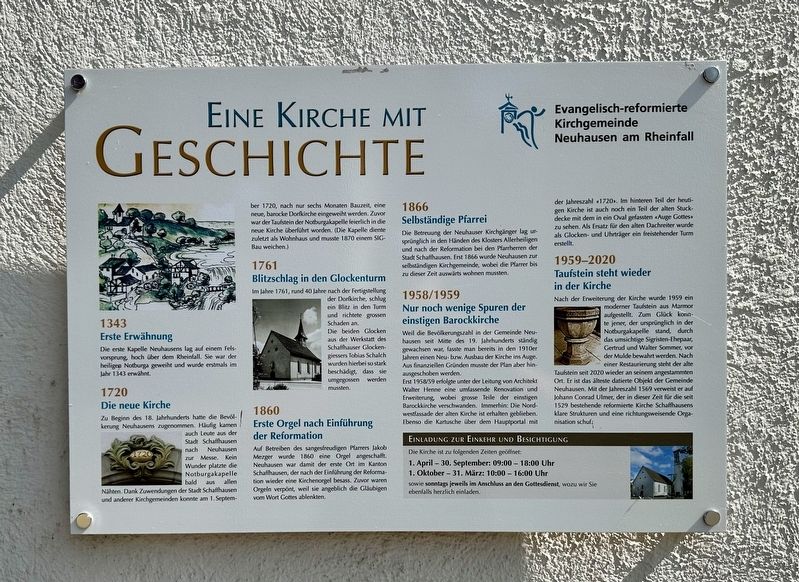
1. Eine Kirche mit Geschichte / A Church with History Marker

Erste Erwähnung
Die erste Kapelle Neuhausens lag auf einem Felsvorsprung, hoch über dem Rheinfall. Sie war der heiligen Notburga geweiht und wurde erstmals im Jahr 1343 erwähnt.
1720 Die neue Kirche
Zu Beginn des 18. Jahrhunderts hatte die Bevölkerung Neuhausens zugenommen. Häufig kamen auch Leute aus der Stadt Schaffhausen nach Neuhausen zur Messe. Kein Wunder platzte die Notburgakapelle bald aus allen Nähten. Dank Zuwendungen der Stadt Schaffhausen und anderer Kirchgemeinden konnte am 1. September 1720, nach nur sechs Monaten Bauzeit, eine neue, barocke Dorfkirche eingeweiht werden. Zuvor war der Taufstein der Notburgakapelle feierlich in die neue Kirche überführt worden. (Die Kapelle diente zuletzt als Wohnhaus und musste 1870 einem SIG-Bau weichen.)
1761
Blitzschlag in den Glockenturm
Im Jahre 1761, rund 40 Jahre nach der Fertigstellung der Dorfkirche, schlug 1860 ein Blitz in den Turm und richtete grossen Schaden an.
Die beiden Glocken aus der Werkstatt des Schaffhauser Glockengiessers Tobias Schalch wurden hierbei so stark beschädigt, dass sie umgegossen werden mussten.
1860
Erste Orgel nach Einführung der Reformation
Auf
this page online
1866
Selbständige Pfarrei
Die Betreuung der Neuhauser Kirchgänger lag ursprünglich in den Händen des Klosters Allerheiligen und nach der Reformation bei den Pfarrherren der Stadt Schaffhausen. Erst 1866 wurde Neuhausen zur selbständigen Kirchgemeinde, wobei die Pfarrer bis zu dieser Zeit auswärts wohnen mussten.
1958/1959
Nur noch wenige Spuren der einstigen Barockkirche
Weil die Bevölkerungszahl in der Gemeinde Neuhausen seit Mitte des 19. Jahrhunderts ständig gewachsen war, fasste man bereits in den 1910er Jahren einen Neu- bzw. Ausbau der Kirche ins Auge. Aus finanziellen Gründen musste der Plan aber hinausgeschoben werden.
Erst 1958/59 erfolgte unter der Leitung von Architekt Walter Henne eine umfassende Renovation und Erweiterung, wobei grosse Teile der einstigen Barockkirche verschwanden. Immerhin: Die Nordwestfassade
Photographed by Andrew Ruppenstein, August 24, 2024
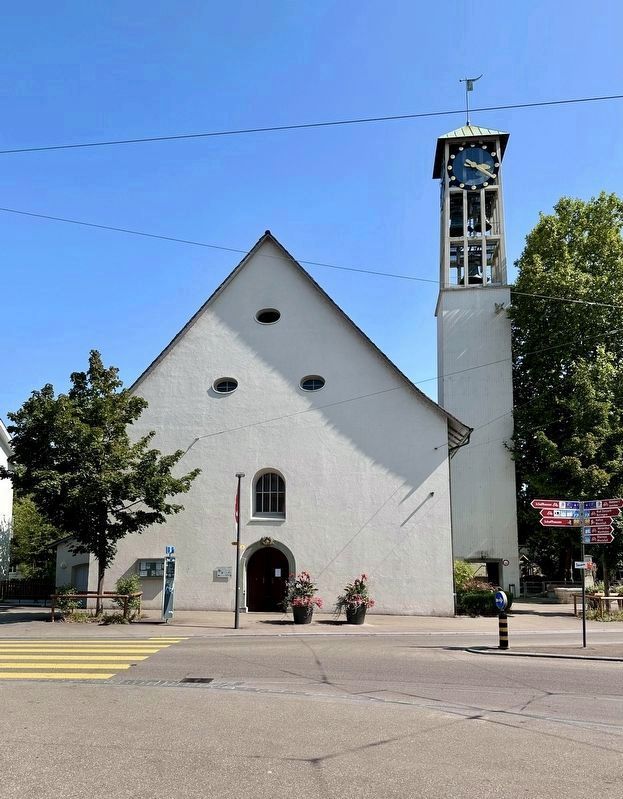
2. A Church with History Church and Marker
The marker is visible here just to the left of the entrance.
1959-2020
Taufstein steht wieder in der Kirche
Nach der Erweiterung der Kirche wurde 1959 ein moderner Taufstein aus Marmor aufgestellt. Zum Glück konnte jener, der ursprünglich in der Notburgakapelle stand, durch das umsichtige Sigristen-Ehepaar, Gertrud und Walter Sommer, vor der Mulde bewahrt werden. Nach einer Restaurierung steht der alte Taufstein seit 2020 wieder an seinem angestammten Ort. Er ist das älteste datierte Objekt der Gemeinde Neuhausen. Mit der Jahreszahl 1569 verweist er auf Johann Conrad Ulmer, der in dieser Zeit für die seit 1529 bestehende reformierte Kirche Schaffhausens klare Strukturen und eine richtungsweisende Organisation schuf.
1343
First mention
The first chapel in Neuhausen was located on a rocky outcrop, high above the Rhine Falls. It was dedicated to Saint Notburga and its first written mention dates back to 1343.
1720
The new church
At the beginning of the 18th century, Neuhausen's population had increased. People from the city of Schaffhausen often came to Neuhausen for mass. It's no wonder that the Notburg Chapel was soon bursting at the seams. Thanks to donations from the city of Schaffhausen and other church communities, a new, baroque village church was consecrated on September 1, 1720, after only six months of construction. Before that, the baptismal font from the Notburg Chapel had been ceremoniously transferred to the new church. (The chapel was ultimately used as a residential building and had to make way for a SIG building in 1870.)
1761
Lightning strikes the bell tower
In 1761, around 40 years after the village church was completed, lightning struck the tower in 1860 and caused major damage. The two bells from the foundry of the Schaffhausen bell maker Tobias Schalch were so badly damaged that they had to be recast.
1860
First organ after the introduction of the Reformation
At the instigation of the singing-loving pastor Jakob Mezger, an organ was purchased in 1860. Neuhausen was thus the first place in the canton of Schaffhausen to have a church organ again after the introduction of the Reformation. Before that, organs were frowned upon because they supposedly distracted believers from the word of God.
1866
Independent parish
The care of Neuhausen's churchgoers was originally in the hands of the All Saints' Monastery and, after the Reformation, in the hands of the pastors of the city of Schaffhausen. It was not until 1866 that Neuhausen became an independent parish, although up until that time the pastors had to live away from home.
1958/1959
Only a few traces of the former baroque church remain
Because the population in the municipality of Neuhausen had been growing steadily since the middle of the 19th century, plans to rebuild or expand the church were already being considered in the 1910s. However, the plan had to be postponed for financial reasons.
It was not until 1958/59 that a comprehensive renovation and extension was carried out under the direction of architect Walter Henne, during which large parts of the former baroque church disappeared. At least the north-west façade of the old church has been preserved. As has the cartouche above the main portal with the year "1720". In the rear part of the current church, part of the old stucco ceiling with the "Eye of God" set in an oval can still be seen. To replace the old roof turret, a free-standing tower was built to support the bells and clock.
1959-2020 Baptismal font is back in the church
After the church was expanded, a modern marble baptismal font was installed in 1959. Fortunately, the one that originally stood in the Notburg Chapel was saved from the Mulde by the prudent sexton couple, Gertrud and Walter Sommer. After a restoration, the old baptismal font has been back in its original location since 2020. It is the oldest dated object in the municipality of Neuhausen. With the year 1569, it refers to Johann Conrad Ulmer, who during this time created clear structures and a trend-setting organization for the Reformed Church of Schaffhausen, which had existed since 1529.
Topics. This historical marker is listed in this topic list: Religion & Religious Structures. A significant historical date for this entry is September 1, 1720.
Location. 47° 40.86′ N, 8° 37.151′ E. Marker is in Neuhausen am Rheinfall, Schaffhausen. It is on Zentralstrasse, on the right when traveling north. Touch for map. Marker is at or near this postal address: Zentralstrasse 22, Neuhausen am Rheinfall, Schaffhausen 8212, Switzerland. Touch for directions.

Regionally, it is in Europe, Central Europe, the Schengen Area, Western Europe, and the Western World. Historically, it finds itself in what was once the Roman Empire and specifically also the Holy Roman Empire.
Other nearby markers. At least one other marker is within walking distance of this marker: Glocke vom ehemaligen Hause “zum Sternen” / Bell from the Former “zum Sternen” Building (about 120 meters away, measured in a direct line).
Credits. This page was last revised on September 6, 2024. It was originally submitted on September 6, 2024, by Andrew Ruppenstein of Lamorinda, California. This page has been viewed 132 times since then and 18 times this year. Photos: 1, 2. submitted on September 6, 2024, by Andrew Ruppenstein of Lamorinda, California.
