Leesburg in Lake County, Florida — The American South (South Atlantic)
World War II
Veterans Memorial Park

Photographed by Brandon D Cross
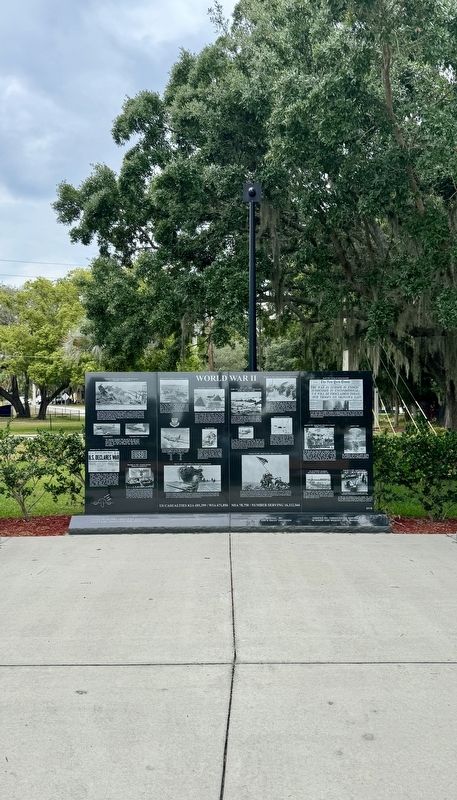
1. World War II Marker
(Panel 1)
December 7, 1941 - Japan Attacks Pearl Harbor, Hawaii
2,403 Died - 1,176 Wounded
The Battle of Pearl Harbor began on December 7, 1941 when the Imperial Japanese Navy Air Service led a surprise military strike on Pearl Harbor Naval Base in Hawaii. All eight U.S. Navy Battleships were damaged and four were sunk. The surprise attack led directly to the American entry into World War II. The USS Arizona marks the resting place of 1,102 of the 1,177 sailors and Marines killed on the battleship.
The Japanese launched 190 aircraft in the first wave and 171 in the second wave. Twenty nine were shot down. Following the attack 2,008 Sailors, 109 Marines, 218 Army men and 68 Civilians lost their lives at Pearl Harbor.
December 8, 1941 - U.S. Declares War on Japan
President Franklin D. Roosevelt walked into the Chamber of the House of Representatives on December 8 to request a declaration of war and address the nation. Following the attack President Roosevelt proclaimed that Dec. 7, 1941 would be “a date which would live in infamy” and that “the American people in their righteous might will win through absolute
this page online
December 11, 1941 - Germany and Italy Declare War Against USA
On Dec. 11, 1941 Italian dictator Benito Mussolini made a declaration from the balcony of the Piazza Venezia in Rome. German leader Adolph Hitler also declared war against the United States following Mussolini’s lead with American Secretary of State Cordell Hull receiving the formal documentation from the German diplomats later that day.
(captions) Nakajima B5N2 • Kawanishi N1K2J Shiden-Kai
(Panel 2)
April 18, 1942 - Doolittle Leads Air Raid on Tokyo
Lt. Col. James “Jimmy” Doolittle of the United States Army Air Forces planned and led the “Tokyo Raid”. The air raid consisted of sixteen B-25B Mitchell medium bombers with no escort, launching from the USS Hornet. This was the first air strike to hit the Japanese mainland. The retaliation for the Pearl Harbor attack proved that Japan would be vulnerable by air.
November 8, 1942 - US Invades North Africa
Operation Torch began on November 8, 1942 with Allied Forces, including the
Photographed by Brandon D Cross
2. World War II Marker
In the European Theater of Operations around 135,000 men flew in combat. In the 8th Air Force 35,000 were KIA, 14,000 WIA and some 33,000 were POW’s.
Aircraft Type • Number Lost
B-17 • 4,754
B-24 • 2,112
P-47 • 1,043
P-38 • 451
P-51 • 2,341
Total • 10,561
SGT. Bill Mauldin
He meant so much to millions of Americans who fought in World War II, and to those who waited for them to come home. He was a kid cartoonist for Stars and Stripes, the military newspaper. Mauldin’s drawings of his muddy, exhausted, whisker-stubble infantrymen Willie and Joe were the voice of truth about what it was like on the front lines.
June 4-7, 1942 - Battle of Midway: Four Japanese Carriers Sunk
The Battle of Midway proved to be the testing point of military might for the U.S. Navy forces under the command of Chester Nimitz, Frank Jack Fletcher, and Raymond Spruance. The naval fleet withstood and overcame an attack by the Imperial Japanese Navy, sinking all four of Japan’s large aircraft carriers. The decisive victory is widely considered a turning point in the Pacific War.
(Panel 3)
June 6, 1944 - D Day
73, 000+ U.S. Landed, 2,499 U.S. Died, 3,184 Wounded.
160,000 Allied Troops Landed
The Battle of Normandy began on June 6, 1944, also known as D-Day. The 160,000 Allied Troops, landed across five beaches of A 50-mile stretch of fortified French coastline. By the end of August, the Allies had reached the Seine River, liberating Paris and removing the occupying

Photographed by Brandon D Cross
3. Veterans Memorial Park sign
Leesburg Army Airfield
The airfield was commissioned in January 1943. Today, Lake Sumpter State College campus buildings occupy the space where the base barracks used to be located. The 312h Fighter Squadron was assigned to the airfield from 5 January until 17 November 1943. They trained students in the P-40 Warhawk for a short time and then the P-38 Lightening. The 312th left for the war zone and the barracks were turned into a German Prisoners of War (POW) camp. The camp hosted 250 prisoners. The P-38’s famous mission was when they shot down Admiral Yamamoto’s “Betty Bomber” in the Solomon Islands.
December 16, 1944 - January 25, 1945 - Battle of the Bulge
The Battle of the Bulge was the last major German campaign to weaken the Allied Forces in the European Theater. The battle led to the highest number of American casualties of any operation during the war with over 100,000 lives being lost. General George S. Patton’s maneuvering of the Third Army ended proving successful as the German counteroffensive was neutralized despite the staggering number of casualties.
Operation Market-Garden
General Montgomery of the United Kingdom convinced General Eisenhower that his plan, Market-Garden would shorten the war. The largest airborne operation ever mounted, Market-Garden cost the Allies between 15,137 killed, wounded or captured by the Germans. The fiasco lasted nine days. The 82nd and 101st Airborne casualties were 3,974.
February 19, 1945 - March 16, 1945 - Battle of Iwo Jima
The five week battle of Iwo Jima marked some of the fiercest and bloodiest fighting of World War II. The United States Marine Corps landed on the island of Iwo Jima on February 19, 1945 with the goal of capturing the entire island including three Japanese controlled Airfields. During the campaign, over 5,900 Marine lives were lost and more than 17,400 were wounded. Despite the difficult conditions, American Forces succeeded in securing the island for the Allies.
(Panel 4)
May 8, 1945 - V-E Day & German Surrender
On May 8, 1945 the Act of Military Surrender was signed by Germany in Berlin. The defeat of Germany by the Allied Forces resulted in celebration throughout the world. In New York City over one million people celebrated in the streets due to the end of fighting in Europe. President Harry Truman dedicated the victory to the memory of President Franklin D. Roosevelt, who had died a month earlier of a cerebral hemorrhage.
August 6-9, 1945 - Atomic Bombs at Hiroshima & Nagasaki
120,000+ Casualties
On July 26, 1945 the United States in conjunction with China and the British Empire called for the unconditional surrender of the Japanese armed forces with "prompt and utter destruction" being imminent if Japan did not comply. On August 6, Col. Paul Tibbets along with the crew flying the Enola Gay, a Boeing B-29 Bomber, dropped an atomic bomb on Hiroshima - an attack resulting in over 80,000 deaths. The Enola Gay also delivered a second atomic bomb to Nagasaki three days later with over 40,000 casualties
August 9, 1945
The mushroom cloud of the atomic bombing of the Japanese city of Nagasaki on August 9, rose some 11 miles above the bomb’s hypocenter.
The sub Tinosia returning to Pearl Harbor at the end of the war.
US Submarines were not active in the Atlantic Ocean during World War II. The German U-Boats were active in the Atlantic but they lost 700 subs and 26,897 crewmen. The US Subs operated in the Pacific and they decimated the Japanese Merchant Marine. The US lost 52 submarines, 374 officers and 3131 crewmen.
September 2, 1945 - Japan Surrenders
The surrender of Japan was formally signed on September 2, 1945 bringing World War II to a close.
At 9:08 a.m. U.S. General of the Army Douglas McArthur, the Commander in the Southwest Pacific and Supreme Commander for the Allied Powers, accepted the surrender on behalf of the Allied Powers and signed in his capacity as Supreme Commander.
Erected by Amvets Post 2006, Leesburg.
Topics. This memorial is listed in this topic list: War, World II. A significant historical date for this entry is December 7, 1941.
Location. 28° 48.823′ N, 81° 52.714′ W. Memorial is in Leesburg, Florida, in Lake County. It can be reached from the intersection of Orange Avenue and West Meadow Street, on the right when traveling north. The marker is located within Veterans Memorial Park at Fountain Lake Park. Touch for map. Memorial is at or near this postal address: 400 W Line St, Leesburg FL 34748, United States of America. Touch for directions.

Regionally, this memorial is in Greater Orlando and in Central Florida. It is also in the American South. Globally, it is in the North Atlantic Region, North America, a Gulf of Mexico state, the Western Hemisphere, the Western World, and the Anglosphere. Historically, it finds itself in what was once New Spain, the territory of the Mississippian Culture, one of the Confederate States of America, and the Antebellum South.
Other nearby markers. At least 8 other markers are within walking distance of this marker: WAVES / WAC (here, next to this marker); The Nurse Corp in WW II (here, next to this marker); Women Marines / Rosie the Riveter (here, next to this marker); Medal of Honor Recipients (within shouting distance of this marker); Korean War Memorial (within shouting distance of this marker); F. Brown Gregg (within shouting distance of this marker); Battlefield Cross (within shouting distance of this marker); Vietnam War Memorial (within shouting distance of this marker). Touch for a list and map of all markers in Leesburg.
Also see . . . Veterans Memorial at Fountain Park. (Submitted on September 7, 2024, by Brandon D Cross of Flagler Beach, Florida.)
Credits. This page was last revised on September 13, 2024. It was originally submitted on September 7, 2024, by Brandon D Cross of Flagler Beach, Florida. This page has been viewed 183 times since then and 22 times this year. Photos: 1, 2, 3. submitted on September 7, 2024, by Brandon D Cross of Flagler Beach, Florida. • Bernard Fisher was the editor who published this page.
