Holcomb Valley near Big Bear in San Bernardino County, California — The American West (Pacific Coastal)
People Came and Left This Meadow
Photographed by Craig Baker, September 7, 2024
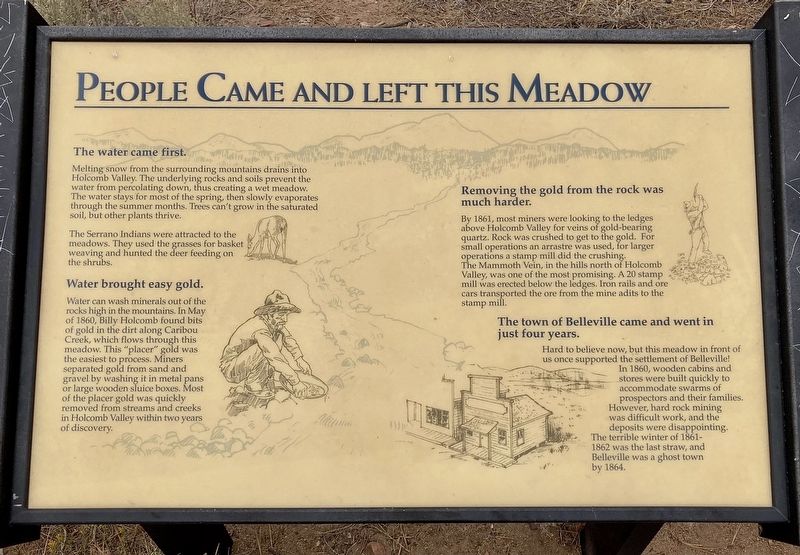
1. People Came and Left This Meadow Marker
The water came first.
Melting snow from the surrounding mountains drains into Holcomb Valley. The underlying rocks and soils prevent the water from percolating down, thus creating a wet meadow. The water stays for most of the spring, then slowly evaporates through the summer months. Trees can't grow in the saturated soil, but other plants thrive.
The Serrano Indians were attracted to the meadows. They used the grasses for basket weaving and hunted the deer feeding on the shrubs.
Water brought easy gold.
Water can wash minerals out of the rocks high in the mountains. In May of 1860, Billy Holcomb found bits of gold in the dirt along Caribou Creek, which flows through this meadow. This "placer" gold was the easiest to process. Miners separated gold from sand and gravel by washing it in metal pans or large wooden sluice boxes. Most of the placer gold was quickly removed from streams and creeks in Holcomb Valley within two years of discovery.
Removing the gold from the rock was much harder.
By 1861, most miners were looking to the ledges above Holcomb Valley for
this page online
The town of Belleville came and went in just four years.
Hard to believe now, but this meadow in front of us once supported the settlement of Belleville! In 1860, wooden cabins and stores were built quickly to accommodate swarms of prospectors and their families. However, hard rock mining was difficult work, and the deposits were disappointing. The terrible winter of 1861-1862 was the last straw, and Belleville was a ghost town by 1864.
Topics. This historical marker is listed in these topic lists: Industry & Commerce • Natural Resources • Settlements & Settlers. A significant historical month for this entry is May 1860.
Location. 34° 18.086′ N, 116° 53.159′ W. Marker is near Big Bear, California, in San Bernardino County. It
Photographed by Craig Baker, September 7, 2024
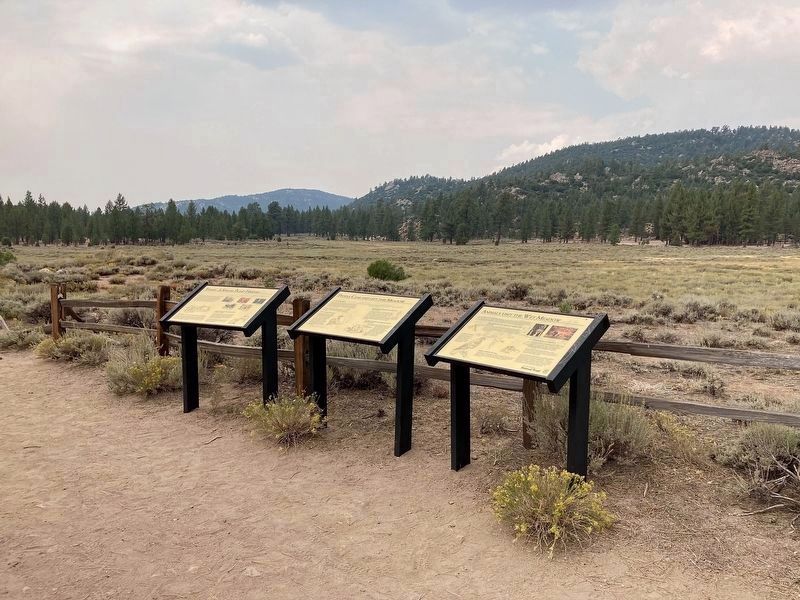
2. Markers and Meadow
Other panels describe local plants and animals.

Regionally, this marker is in Greater Los Angeles, in the San Bernardino Mountains, in the Peninsular Ranges, and specifically in the Transverse Ranges. It is also in the American Southwest. Globally, it is in North America, on the Ring of Fire, on the Pacific Rim, in the Western Hemisphere, in the Western World, and in the Anglosphere. Historically, it finds itself in what was once New Spain and also Mexico’s Alta California.
Other nearby markers. At least 8 other markers are within 4 miles of this marker, measured as the crow flies: Bellevill Holcomb Valley (a few steps from this marker); The Pigmy Cabin (approx. 0.4 miles away); Big Bear Valley (approx. 2.8 miles away); Woodland Club Caddy Shack (approx. 3.4 miles away); 5 Stamp Mill (approx. 3.4 miles away); Main Museum Building (approx. 3½ miles away); Big Bear Solar Observatory (approx. 3½ miles away); a different marker also

Photographed by Craig Baker, September 7, 2024
3. Markers and Cabin
The cabin was moved here to represent structures once common in Holcomb Valley.
Another marker is no longer nearby. Holcomb Valley (was a few steps from this marker but has been confirmed missing).
More about this marker. This site is part of a self-guided auto tour of the Holcomb Valley that highlights the rich gold mining history of the area. Visit the nearby Big Bear Discovery Center for a brochure, maps, and current conditions. Vehicle with high ground clearance recommended.
Also see . . . Printable Self-Guided Auto Tour Brochure. (Submitted on September 8, 2024.)
Photographed by Craig Baker, September 7, 2024
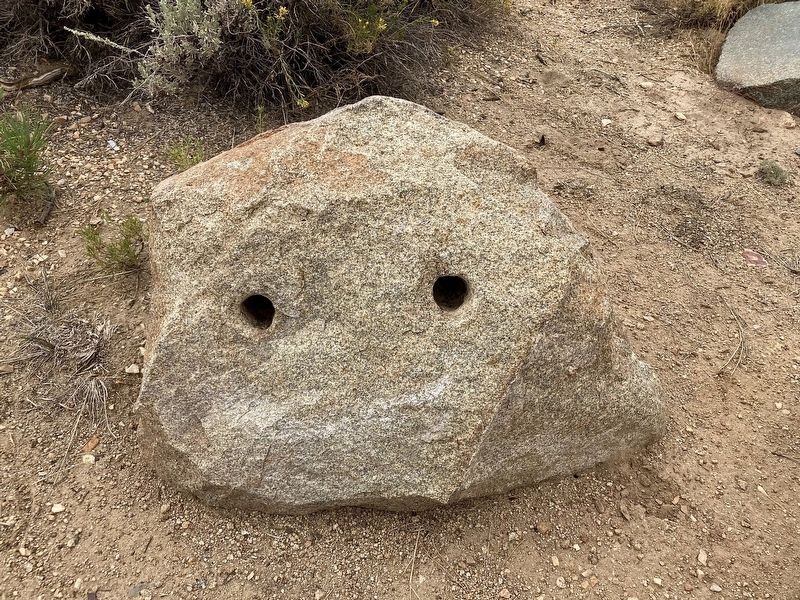
4. Remnants of Mining
Rocks have drill holes from mining operations.
Photographed by Craig Baker
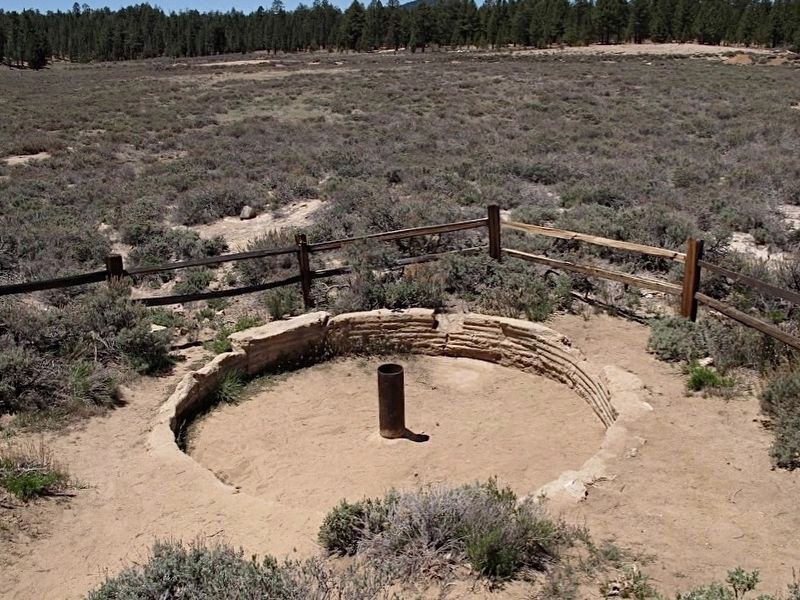
5. Arrastre (Gold Ore Grinder)
Over 100 arrastres once dotted Holcomb Valley.
Credits. This page was last revised on September 30, 2024. It was originally submitted on September 7, 2024, by Craig Baker of Sylmar, California. This page has been viewed 420 times since then and 76 times this year. Photos: 1, 2, 3, 4. submitted on September 7, 2024, by Craig Baker of Sylmar, California. 5. submitted on September 8, 2024, by Craig Baker of Sylmar, California.
