
Quinze-Vingts in Paris in Département de Paris, Île-de-France, France — Western Europe
La Tour de l’horloge
⎯⎯⎯
The Clock Tower

Photographed by Andrew Ruppenstein, September 10, 2024
1. La Tour de l’horloge / The Clock Tower Marker

En 1847, la première gare de Paris-Lyon, baptisée l'Embarcadère, est mise en service avec la ligne reliant Paris à Tonnerre. Elle a été dessinée par l'architecte François Alexis Cendrier.
La nouvelle gare de Paris-Lyon est construite pour l'Exposition Universelle de 1900 par l'architecte Marius Toudoire. Elle a été inaugurée le 06 avril 1901 par Émile Loubet, Président de la République.
Le beffroi, ou campanile, surnommé la "Tour de l'horloge", haut de 67 mètres, est couvert d'un dôme en zinc. Chaque face du fût, de section carrée, est large de 8,50 m. Le cube de l'horloge mesure 10 mètres de côté. On accède au sommet de cet édifice par un escalier de 400 marches.
L'horloge monumentale, conçue par Paul Garnier, comporte quatre cadrans de 6,40 m de diamètre avec au total 140 m² de vitraux. Les chiffres romains peints à la main sont en laiton et ont une hauteur de 1 m. Les aiguilles sont en aluminium; la grande pèse 38 kg et mesure 4 m, tandis que la petite pèse 26 kg et atteint 2,80 m. Jusqu'en 1929, les cadrans sont éclairés depuis l'intérieur au moyen de 250 becs à pétrole, remplacés en 2005 par un éclairage électrique.
La Tour de l'Horloge a été restaurée en 1948 et en 2005.
The Clock Tower
In 1847, the first Paris-Lyon station, named l'Embarcadère, was put into service with the line connecting Paris to Tonnerre. It was designed by the architect François Alexis Cendrier.
The new Paris-Lyon station was built for the 1900 Universal Exhibition by the architect Marius Toudoire. It was inaugurated on April 6, 1901 by Émile Loubet, President of the Republic.
The monumental clock, designed by Paul Garnier, has four dials of 6.40 m in diameter with a total of 140 m² of stained glass. The hand-painted Roman numerals are made of brass and are 1 meter high. The hands are made of aluminum; the large one weighs 38 kg and measures 4 meters, while the small one weighs 26 kg and reaches 2.80 meters. Until 1929, the dials were lit by 250 oil burners, replaced in 2005 by electric lighting.
The Clock Tower was restored in 1948 and 2005.
Topics.
this page online
Location. 48° 50.687′ N, 2° 22.378′ E. Marker is in Paris, Île-de-France, in Département de Paris. It is in Quinze-Vingts. It is on Place Louis Armand, on the left when traveling south. Touch for map. Marker is at or near this postal address: 4 Place Louis Armand, Paris, Île-de-France 75012, France. Touch for directions.

Regionally, it is in the North Atlantic Region, Europe, the European Union, Atlantic Europe, the Schengen Area, Western Europe, a coastal Mediterranean country, and the Western World. Historically, it finds itself in what was once a French colony and also the Roman Empire.
Other nearby markers. At least 8 other markers are within walking distance of this marker: Aux Travailleurs Chinois pendant la Première Guerre Mondial / Chinese Workers WWI Monument (within shouting distance of this marker); Réseau AGIR / Network for ACTION Memorial (about 120 meters away, measured in a direct line); Unknown Frenchman Liberation Memorial (about 150 meters away); Jean Jemini (about 150 meters away);
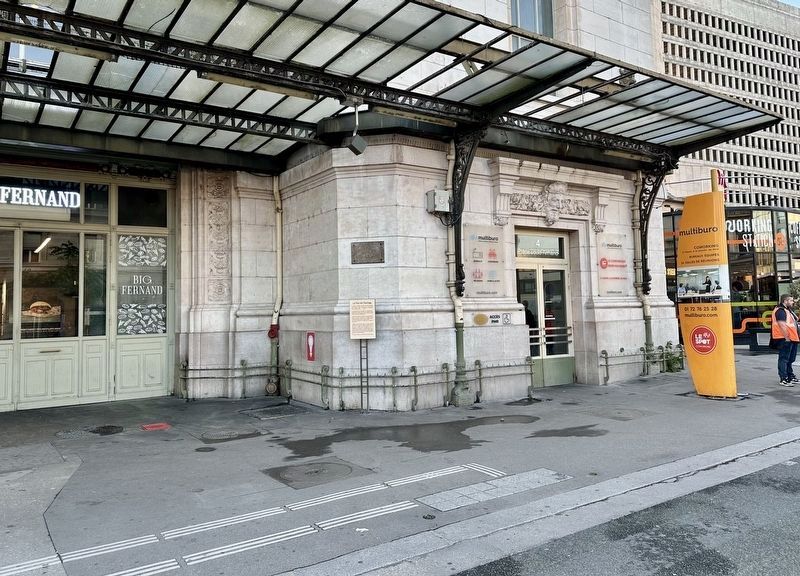
Photographed by Andrew Ruppenstein, September 10, 2024
2. La Tour de l’horloge / The Clock Tower Marker - wide view
Also see . . . Gare de Lyon (Wikipedia).
Overview: The Gare de Lyon, officially Paris Gare de Lyon, is one of the seven large mainline railway stations in Paris, France. It handles about 148.1 million passengers annually according to the estimates of the SNCF in 2018, with SNCF railways and the RER D accounting for around 110 million and the RER A accounting for 38 million, making it the second-busiest station of France after the Gare du Nord and one of the busiest in Europe.(Submitted on September 10, 2024.)
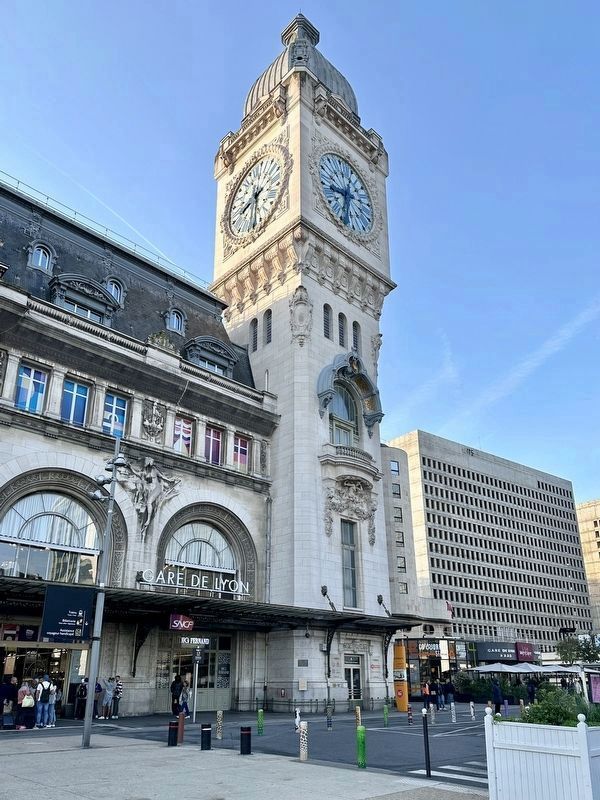
Photographed by Andrew Ruppenstein, September 10, 2024
3. La Tour de l’horloge / The Clock Tower
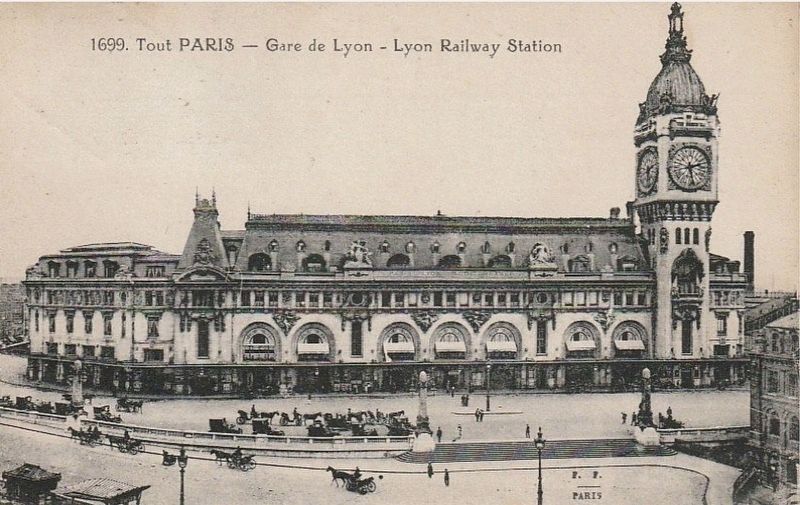
circa 1905
4. Gare de Lyon / Lyon Railway Station
Credits. This page was last revised on September 10, 2024. It was originally submitted on September 10, 2024, by Andrew Ruppenstein of Lamorinda, California. This page has been viewed 244 times since then and 83 times this year. Photos: 1, 2, 3, 4. submitted on September 10, 2024, by Andrew Ruppenstein of Lamorinda, California.
