Haddonfield in Camden County, New Jersey — The American Northeast (Mid-Atlantic)
Lafayette Comes to Haddonfield
Photographed by Thomas Anderson, September 5, 2024
1. Lafayette Comes to Haddonfield Marker
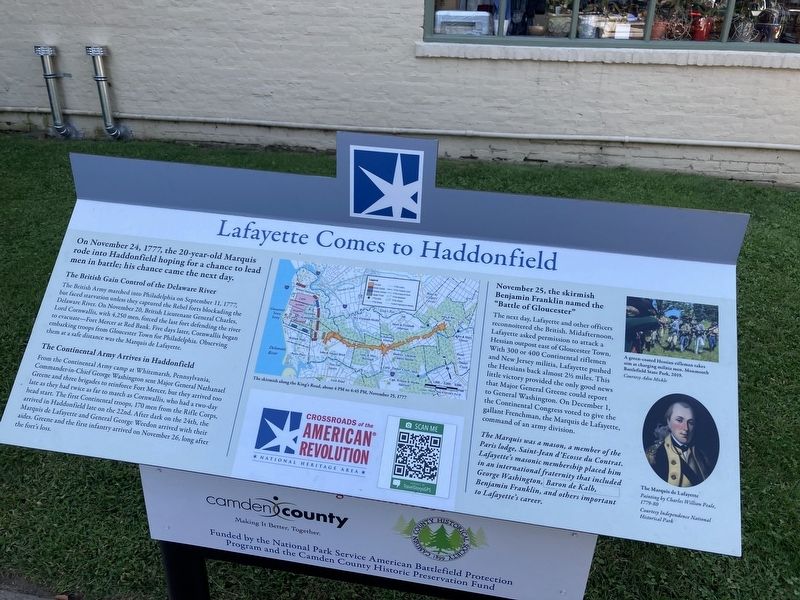
On November 24, 1777, the 20-year-old Marquis rode into Haddonfield hoping for a chance to lead men in battle; his chance came the next day.
The British Gain Control of the Delaware River
The British army marched into Philadelphia on September 11, 1777 but faced starvation unless they captured the Rebel forts blockading the Delaware River. On November 20, Lieutenant General Charles, Lord Cornwallis, with 4250 men, forced the last fort defending the river to evacuate-Fort Mercer at Red Bank. Five days later, Cornwallis began embarking troops from Gloucester Town for Philadelphia. Observing them at a safe distance was Marquis de Lafayette.
The Continental Army Arrives in Haddonfield
From the Continental Army camp at Whitemarsh, Pennsylvania, Commander-in-Chief George Washington sent Major General Nathaniel Greene and three brigades to reinforce Fort Mercer, but they arrived too late as they had twice as far to march as Cornwallis, who had a two-day head start. The first Continental troops, 170 men from the Rifle Corps arrived in Haddonfield late on the 22nd. After dark on the 24th, the Marquis de Lafayette and General
this page online
November 25, the skirmish Benjamin Franklin named "Battle of Gloucester"
The next day, Lafayette and other officers reconnoitered the British. Midafternoon, Lafayette asked permission to attack a Hessian outpost east of Gloucester Town. With 300 or 400 Continental riflemen and New Jersey militia, Lafayette pushed the Hessians back almost 2 1/2 miles. This little victory provided the only good news that Major General Greene could report to General Washington. On December 1, the Continental Congress voted to give the gallant Frenchman, the Marquis de Lafayette, command of an army division.
The Marquis was a mason, a member of the Paris lodge, Saint-Jean d'Ecosse du Contrat. Lafayette's masonic membership placed him in an international fraternity that included George Washington, Baron de Kalb, Benjamin Franklin, and others important to Lafayette's career.
( photo captions )
— The skirmish along the King’s Road, about 4PM to 4:45PM, November 25, 1777
— A green-coated Hessian rifleman takes aim
Photographed by Thomas Anderson, September 5, 2024
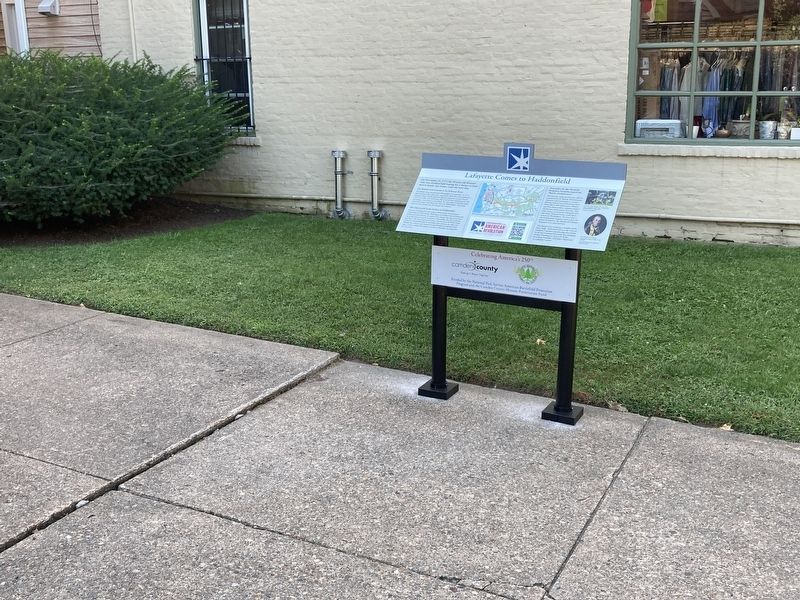
2. Lafayette Comes to Haddonfield Marker
— The Marquis de Lafayette
Erected by Camden County Historical Society.
Topics. This historical marker is listed in this topic list: War, US Revolutionary. A significant historical date for this entry is November 24, 1777.
Location. 39° 53.775′ N, 75° 2.12′ W. Marker is in Haddonfield, New Jersey, in Camden County. It can be reached from the intersection of Kings Highway East and Washington Avenue, on the right when traveling east. Located next to Haddonfield Masonic Temple. Touch for map. Marker is at or near this postal address: 14 Kings Hwy E, Haddonfield NJ 08033, United States of America. Touch for directions.

Regionally, this marker is in South Jersey and in Greater Philadelphia. It is also in the American Northeast, in the Mid-Atlantic, and on the Eastern Seaboard. Globally, it is in the North Atlantic Region, North America, the Western Hemisphere, the Western World, and the Anglosphere. Historically, it finds
Photographed by Thomas Anderson, September 5, 2024
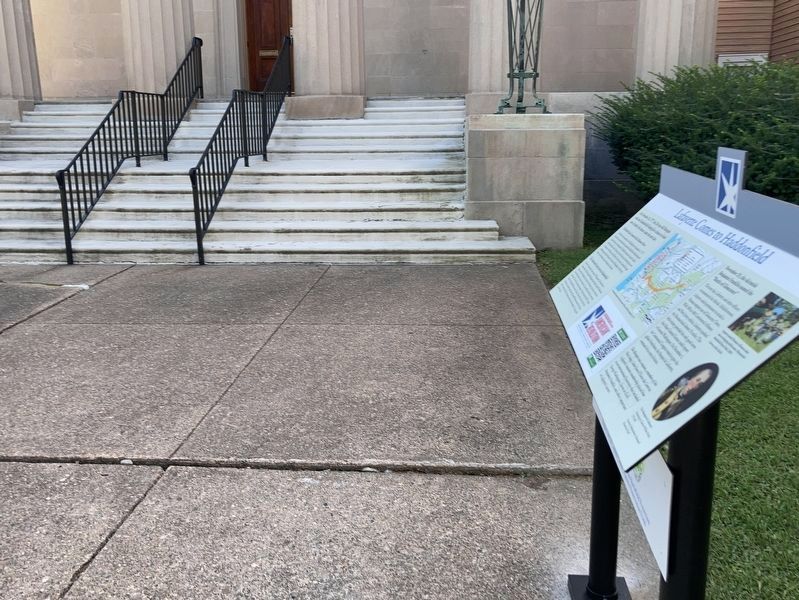
3. Marker on the Haddonfield Masonic Temple site
Other nearby markers. At least 8 other markers are within walking distance of this marker: Hadrosaurus foulkii (about 300 feet away, measured in a direct line); The Hadrosaurus foulkii Sculpture (about 400 feet away); New Jersey Building (about 800 feet away); Jonas Cattell (approx. 0.2 miles away); Haddonfield - A Quaker Village Engulfed by War (approx. 0.2 miles away); In Memory of Elizabeth Haddon (approx. 0.2 miles away); Reeves-Glover House (approx. ¼ mile away); Quaker Graveyard (approx. 0.3 miles away). Touch for a list and map of all markers in Haddonfield.
Another marker is no longer nearby. Ye Kings Highway (was approx. ¼ mile away but has been permanently removed).
Also see . . .
1. Camden County Historical Society. (Submitted on September 13, 2024, by Michael Herrick of Southbury, Connecticut.)
2. Battle of Gloucester (1777) (Wikipedia). (Submitted on September 13, 2024, by Michael Herrick of Southbury, Connecticut.)
3. Gilbert du Motier, Marquis de Lafayette (Wikipedia). (Submitted on September 13, 2024, by Michael Herrick of Southbury, Connecticut.)
Credits. This page was last revised on September 13, 2024. It was originally submitted on September 12, 2024, by Thomas Anderson of Haddon Township, New Jersey. This page has been viewed 426 times since then and 78 times this year. Photos: 1, 2, 3. submitted on September 12, 2024, by Thomas Anderson of Haddon Township, New Jersey. • Michael Herrick was the editor who published this page.
