Osgood in Darke County, Ohio — The American Midwest (Great Lakes)
History Of Stations Of The Cross

Photographed by Craig Doda, July 6, 2024
1. History Of Stations Of The Cross Marker
Tradition tells us that Jesus's mother Mary made the first Way of the Cross. On Holy Saturday, the day after Jesus was crucified, Mary walked the sorrowful path which her Son had walked the day before, thinking sadly of all that had taken place. Mary made daily visits to the sites of her Son's sufferings, death, and resurrection following His ascension into heaven. Later Mary, the disciples, and the holy women often walked that way in prayer and remembrance, visiting the scenes of the Savior's passion. Early Christian pilgrims followed the example of Mary and the disciples and journeyed to Jerusalem to walk in the footsteps of Christ on the road to Calvary.
Christians came in such vast numbers to walk the Way of the Cross at Jerusalem, that the Emperor Hadrian (117-138) built a pagan temple on Mount Calvary In order to keep the pilgrims away. After 250 years of persecution, in the year 313, Emperor Constantine permitted Christians to legally worship in the Roman Empire. Pilgrims were now free to go to Jerusalem and walk "Jesus's Passion." In 325 St. Helena found the true Cross of Christ on Calvary. She had a Christian
this page online
At an early date, a desire arose to reproduce these holy places in other lands, in order to satisfy the devotion of those who were hindered from making the actual pilgrimage. At the monastery of San Stefano at Bologne, St. Petronius, Bishop of Bologna, constructed a group of connected chapels which were intended to represent the more important shrines of Jerusalem. Perhaps, these may be regarded as the genesis or beginning from which the Stations of the Cross developed.
After the Crusades (1098-1492) and the fall of the Holy Land into the hands of the infidel Turks, the pilgrimage to the Holy Land could only be made in great danger

Photographed by Craig Doda, July 6, 2024
2. History Of Stations Of The Cross Marker
Devotion to the Way of the Cross began earnestly, in 1842 after the Franciscans were granted custody of Christian sites in Jerusalem. Entrusted with guardianship of these holy places, the Franciscans introduced a devotion to the Stations of the Cross in Europe. This devotion was in place of actually going to the Holy Land and the devotion soon spread all over the world.
The earliest use of the word "Stations," describing this devotion, occurs in the narrative of an English pilgrim, William Wey, who visited the Holy Land in 1458 and again in 1462. He describes the manner in which it was then usual to follow the footsteps of Christ in His sorrowful journey. The manner of meditating on or reenacting Christ's crucifixion in this way became known as the "Stations of the Cross. The object of the Stations of the Cross was to help the faithful to make in spirit, a pilgrimage to the important scenes of Christ's
Photographed by Craig Doda, July 6, 2024
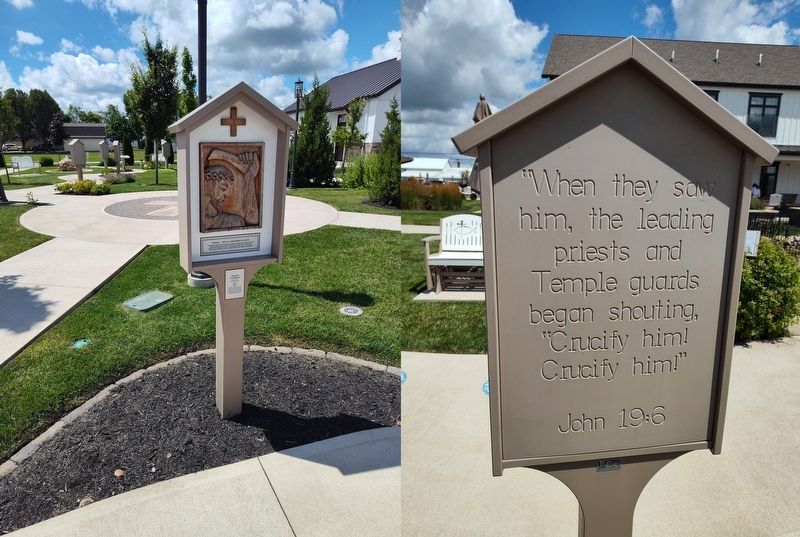
3. Station 1 Jesus Is Condemned To Death
Jesus stands before the Roman governor of Judaea, Pontius Pilate, accused of crimes He hasn't committed, and He Who is Without Sin mutely accepts the blame for the sins of all. Trust allows for this-Jesus's full trust in God's plan the promise of resurrection and salvation. This was the light that led Him through the darkness.
Greater Stichwort Known As The Tears Of Mary
This flower is said to have had its origin the moment that Jesus was condemned to death, for it is then that Mary wept. As her sorrowful tears fell and touched the earth, these small, white flowers sprang up.
"When they saw him, the leading priests and Temple guards began shouting, "Crucify him! Crucify him!"
John 19:6
Greater Stichwort Known As The Tears Of Mary
This flower is said to have had its origin the moment that Jesus was condemned to death, for it is then that Mary wept. As her sorrowful tears fell and touched the earth, these small, white flowers sprang up.
"When they saw him, the leading priests and Temple guards began shouting, "Crucify him! Crucify him!"
John 19:6
For many years, there was a question of the number of stations to be used in the Way of the Cross, also known as the Stations of the Cross. The Way of the Cross of Louvain in 1595, by Peter Sterckx had 8 stations. When Romanet Boffin visited Jerusalem in 1515 for the purpose of obtaining correct details for his set of Stations of the Cross at Romans, two friars there told him that there should be 31 in all. But in different versions of manuals used for these stations, the number of stations vary from 19, 25, and 37. The manuscript of Saint-Trond (1550) mentions 12 episodes or places. Even more important for the subsequent development of the Stations of the Cross were John Pascha's book, "Spiritual Pilgrimage" (1563), where his stations 4 through 15 correspond to the present order of the Way of the Cross. The 1435 account by Hans Lochner mentions the addition of Veronica and the daughters of Jerusalem to the Sorrowful Way. A book entitled "Jerusalem sicut Christi tempore floruit, a written reconstruction of John Pascha's stations by one Adrichomius published in 1584, gives 12 stations which correspond exactly

Photographed by Craig Doda, July 6, 2024
4. Station 2 Jesus Carries His Cross
Jesus is made to carry the cross on which He will die. We can only imagine the pain He endured as He walked, the beam of the cross chafing His flesh-torn back. Steadfast acceptance of God's will sustains Him as He puts one foot in front of the other. He walks the path of human suffering and misery.
Holly
Christian legend tells us the holly bush sprang up in the imprints of Christ's steps after He carried His cross. The holly berries were once white, but as Christ's blood was shed on the cross they turned red. The glossy but prickly leaves of the bush remind Christians of the crown of thorns Jesus wore during His passion and crucifixion.
"They took Jesus, therefore, and He went out, bearing His own cross, to the place called the Place of a Skull, which is called in Hebrew, Golgotha”
John 19:17
Holly
Christian legend tells us the holly bush sprang up in the imprints of Christ's steps after He carried His cross. The holly berries were once white, but as Christ's blood was shed on the cross they turned red. The glossy but prickly leaves of the bush remind Christians of the crown of thorns Jesus wore during His passion and crucifixion.
"They took Jesus, therefore, and He went out, bearing His own cross, to the place called the Place of a Skull, which is called in Hebrew, Golgotha”
John 19:17
During the sixteenth century, a number of devotional manuals, giving prayers for use when making the Stations of the Cross, were published in the Low Countries, and some of the 14 stations used today appear in them for the first time.
In 1686, Pope Innocent XI, realizing that few people could travel to the Holy Land due to the Moslem (Muslim) oppression, granted the right to erect stations in all Franciscan churches with depletion of the events described in the Stations of the Cross.
It was St. Leonard (1676-1751) of Port Maurice (or Porto Maurizio), Italy, a Franciscan of the Riformella, who formalized what we now know as the 14 Stations of the Cross.
In 1691, Pope Clement XII allowed all churches, not just Franciscan churches, to have Stations of the Cross. He confirmed the number of stations at 14, which is the number of stations we have had ever since.
During St.

Photographed by Craig Doda, July 6, 2024
5. Station 3 Jesus Falls The First Time
Jesus falls under the weight of His cross. He experiences the unfairness of the burden He carries and endures the crowd's mockery and hatred as He lays on the ground. Jesus succumbed to the physical vulnerabilities of the human body and all its frailties. He has experienced all of our weaknesses.
Cowslip
The flowers of this plant suggest a "bunch of keys. This reminds us that although Peter denied Christ, that he too "fell short,” he was given the keys to the kingdom of Heaven, and that he was the rock upon which God would build His church. Despite our many "falls" from grace, by God's mercy, we may also be given a key to enter the kingdom of Heaven.
"If anyone would come after me, let him deny himself and take up his cross and follow me"
Mark 8:34
Cowslip
The flowers of this plant suggest a "bunch of keys. This reminds us that although Peter denied Christ, that he too "fell short,” he was given the keys to the kingdom of Heaven, and that he was the rock upon which God would build His church. Despite our many "falls" from grace, by God's mercy, we may also be given a key to enter the kingdom of Heaven.
"If anyone would come after me, let him deny himself and take up his cross and follow me"
Mark 8:34
In 1787 St. Alphonsus Ligouri wrote the version of the Stations of the Cross that most Americans recognize. It was used in most churches in the United States throughout the 19th and 20th centuries.
The memory of Christ's passion, death, and resurrection has always been central to the Christian message. To prayerfully make the Way of the Cross enables us more literally to obey Christ's words, "to take up our cross and follow Him."
Topics. This historical marker is listed in this topic list: Religion & Religious Structures. A significant historical year for this entry is 1842.
Location. 40° 20.357′ N, 84° 29.745′ W. Marker is in Osgood, Ohio, in Darke County. It is at the intersection of Main Street and North Street, on the right when traveling east on Main Street. Touch for map. Marker is at or near this postal address: 35 Main St, Yorkshire OH 45388, United States of America. Touch for directions.

Regionally, this marker

Photographed by Craig Doda, July 6, 2024
6. Station 4 Jesus Meets His Mother
Face-to-face, Jesus and His Mother Mary meet. Jesus is covered in blood, sweat, and spit, bent under the weight of the cross, and subjected to angry shouts of hate. Mary, experiencing every mother's worst fear that her child will suffer harm, feels the sword pierce her soul. Moving with fiercely protective love, she offers her son the little she cant the comfort of her presence.
Costmary Known As Our Lady'S Seal
The root of this plant has great healing properties when crushed and spread in a medicinal plaster and applied to seal up a scar or bruise. It is known to be helpful in healing wounds and in mending bones. Many early legends say Mary must have wished to apply such a seal to the many wounds of her son Jesus during His crucifixion.
"Through Her Heart. His sorrow sharing, all His bitter anguish bearing, now at length the sword has passed"
Jacopone da Todi's poem 'Stabat Mater 1230 AD
Costmary Known As Our Lady'S Seal
The root of this plant has great healing properties when crushed and spread in a medicinal plaster and applied to seal up a scar or bruise. It is known to be helpful in healing wounds and in mending bones. Many early legends say Mary must have wished to apply such a seal to the many wounds of her son Jesus during His crucifixion.
"Through Her Heart. His sorrow sharing, all His bitter anguish bearing, now at length the sword has passed"
Jacopone da Todi's poem 'Stabat Mater 1230 AD
Other nearby markers. At least 8 other markers are within walking distance of this marker: Yarrow (here, next to this marker); Pinks (a few steps from this marker); False Solomon's Seal (a few steps from this marker); Basil (a few steps from this marker); Our Lady's Mantle (within shouting distance of this marker); Cyclamen (within shouting distance of this marker); Foxglove (within shouting distance of this marker); History Of The Rosary (within shouting distance of this marker). Touch for a list and map of all markers in Osgood.
Photographed by Craig Doda, July 6, 2024
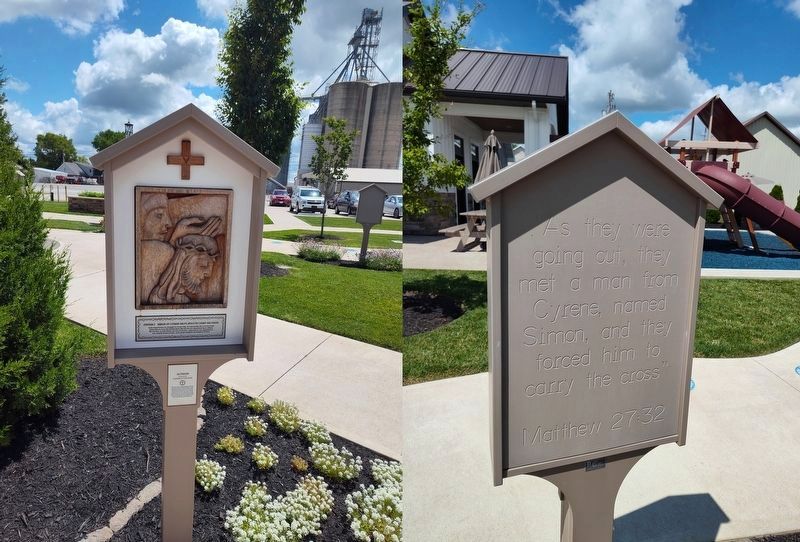
7. Station 5 Simon Of Cyrene Helps Jesus To Carry His Cross
Jesus experiences our struggle to accept help. He experiences the poverty of not being able to carry His burden alone, like all who are dependent upon others. We see that, as with Simon, our acts of service-expected or not, appointed or not, eagerly shared or not carry great weight in the Kingdom of God.
Alyssum Known As The Flowers Of The Cross
The tiny cross-shaped flowers of the alyssum bring to mind Christ's cross, reminding us that all of our sorrows and pains were bore by Jesus Christ, and that by our own bearing of pains and sorrows we can be in union with Jesus, our Savior and Redeemer.
"As they were going out, they met a man from Cyrene, named Simon, and they forced him to carry the cross"
Matthew 27:32
Alyssum Known As The Flowers Of The Cross
The tiny cross-shaped flowers of the alyssum bring to mind Christ's cross, reminding us that all of our sorrows and pains were bore by Jesus Christ, and that by our own bearing of pains and sorrows we can be in union with Jesus, our Savior and Redeemer.
"As they were going out, they met a man from Cyrene, named Simon, and they forced him to carry the cross"
Matthew 27:32
Photographed by Craig Doda, July 6, 2024
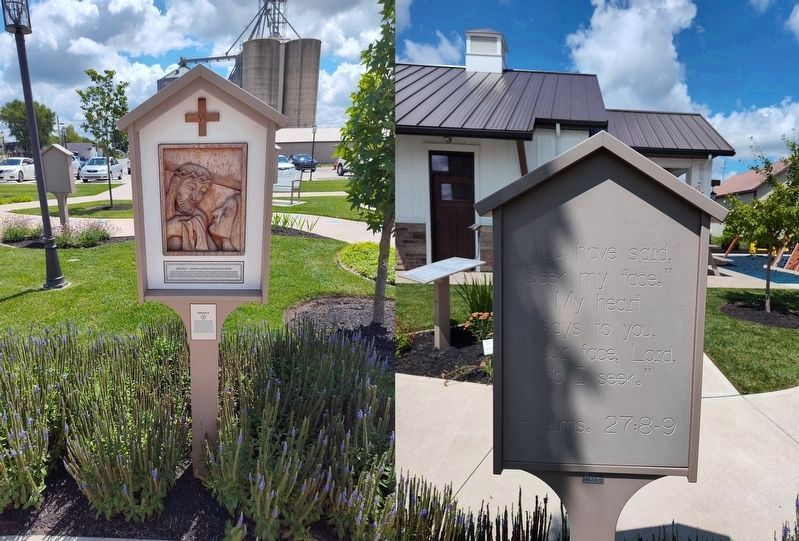
8. Station 6 Veronica Wipes The Face Of Jesus
Jesus continues on the brutal road to Golgotha, suffering rejection and injustice. He has been whipped and beaten; His face shows signs of the vile and abusive treatment He has endured. Veronica, moved by compassion, uses her veil to gently wipe the sweat and blood from His face. On her veil, she discovers the image of His face-His gift to her and for us to contemplate forever.
Veronica
While Jesus bore His cross on the way to Calvary, He passed the door of a woman named Veronica. With compassion, she wipes off the drops of agony on Jesus's brow with her veil. The Redeemer's face miraculously remained on this cloth. The flowers of the Veronica flower are said to look like the eyes of Christ imprinted on this veil.
You have said, "Seek my face." My heart says to you, "Your face, Lord, do I seek."
Psalms. 27:8-9
Veronica
While Jesus bore His cross on the way to Calvary, He passed the door of a woman named Veronica. With compassion, she wipes off the drops of agony on Jesus's brow with her veil. The Redeemer's face miraculously remained on this cloth. The flowers of the Veronica flower are said to look like the eyes of Christ imprinted on this veil.
You have said, "Seek my face." My heart says to you, "Your face, Lord, do I seek."
Psalms. 27:8-9

Photographed by Craig Doda, July 6, 2024
9. Station 7 Jesus Falls The Second Time
Even with help, Jesus stumbles and falls to the ground. In deep exhaustion, He stares at the earth beneath Him. "Remember, you are dust and to dust you will return. Jesus now feels the profound weakness of disability and infirmity of the human body there on His knees under the weight of His cross.
Straw Flower Known As Christ's Eyes
This flower symbolizes the eyes of Jesus as He looks to us as He carries His cross, appealing to us to share in His suffering.
He was despised and rejected by others; a man of suffering.
Isaiah 53:3
Straw Flower Known As Christ's Eyes
This flower symbolizes the eyes of Jesus as He looks to us as He carries His cross, appealing to us to share in His suffering.
He was despised and rejected by others; a man of suffering.
Isaiah 53:3

Photographed by Craig Doda, July 6, 2024
10. Station 8 Jesus Meets The Women Of Jerusalem
Jesus, dragging His cross through the streets, is surrounded by many people those who are jeering and yelling, others who are grief-stricken. The women of Jerusalem weep, for they had heard His words and saw His healings. Jesus suffers knowing He must leave them, but is comforted by the knowledge that eternal life will triumph over death by His sacrifice on the cross.
Ground Ivy Known As Where-God-Has-Walked
The leaves of this plant are heart shaped and remind us of the heart of Jesus which shed its blood for us. The shoots, stems, and leaves are various shades of red and purple. The red reminds us of His precious blood and the purple is the color of mourning, The flowers of this plant are usually purple, but sometimes a white flower blooms, reminding us that we are made pure by His suffering, Ivy clings tightly to what it grows on, which is a reminder that we must cling tightly to the cross for our salvation. All of these things remind us that Jesus (God) humbled Himself and walked the earth for our redemption and salvation.
Jesus turning to them said, "Daughters of Jerusalem, do not weep for me, but weep for yourselves and for your children"
Luke 23:28-31
Ground Ivy Known As Where-God-Has-Walked
The leaves of this plant are heart shaped and remind us of the heart of Jesus which shed its blood for us. The shoots, stems, and leaves are various shades of red and purple. The red reminds us of His precious blood and the purple is the color of mourning, The flowers of this plant are usually purple, but sometimes a white flower blooms, reminding us that we are made pure by His suffering, Ivy clings tightly to what it grows on, which is a reminder that we must cling tightly to the cross for our salvation. All of these things remind us that Jesus (God) humbled Himself and walked the earth for our redemption and salvation.
Jesus turning to them said, "Daughters of Jerusalem, do not weep for me, but weep for yourselves and for your children"
Luke 23:28-31

Photographed by Craig Doda, July 6, 2024
11. Station 9 Jesus Falls A Third Time
The last fall is devastating, Jesus has summoned all His strength, and yet collapses under the weight of the cross. His executioners look at Him as a broken and pathetic man, but Jesus shows us that He can transform weakness, failings, and death into the glory of self-gift. He continues on to the final stop-Calvary.
Tiger Flower Known As Christ's Knees
The flowers of this plant are considered a reminder of Christ's bloodied knees that came from Jesus's falls while carrying the cross. The multitude of speckled dots at the center (bend) of the flower are a symbol of His torn and bloodied flesh that occurred each time He fell.
Surely he has borne our griefs and carried out sorrows; yet we esteemned him stricken, smitten by God, and afflicted
Isaiah 53:4
Tiger Flower Known As Christ's Knees
The flowers of this plant are considered a reminder of Christ's bloodied knees that came from Jesus's falls while carrying the cross. The multitude of speckled dots at the center (bend) of the flower are a symbol of His torn and bloodied flesh that occurred each time He fell.
Surely he has borne our griefs and carried out sorrows; yet we esteemned him stricken, smitten by God, and afflicted
Isaiah 53:4

Photographed by Craig Doda, July 6, 2024
12. Station 10 Jesus Is Stripped Of His Garments
Jesus hung bare on the cross, stripped of any pride, in abject pain and humiliation. The wounds on His back are torn open again. He experiences the ultimate vulnerability of the defenseless, for no shield or security protects Him. As they continue to taunt Him, His eyes turn to the Heavenly Father for comfort and strength.
Sweet Scabious Known As Mary's Pincushion
Looking at the tiny white pins in the flower heads of this plant reminds us that Mary sewed Jesus's garments with love, joy, and reverence What sorrow Mary must have felt when she saw the soldiers strip Jesus of His clothes and then cast lots for them.
"They divide my garments among them, and for my clothing they cast lots"
Psalm 22:18
Sweet Scabious Known As Mary's Pincushion
Looking at the tiny white pins in the flower heads of this plant reminds us that Mary sewed Jesus's garments with love, joy, and reverence What sorrow Mary must have felt when she saw the soldiers strip Jesus of His clothes and then cast lots for them.
"They divide my garments among them, and for my clothing they cast lots"
Psalm 22:18

Photographed by Craig Doda, July 6, 2024
13. Station 11 Jesus Is Nailed To The Cross
We reflect on Jesus and the excruciating pain he suffered as soldiers pounded thick nails through his hands and feet. As the cross is lifted up He must completely surrendered any natural human desire to protect himself, Christ bore this pain- our pain as a supreme sign of his overwhelming love for God's people.
Wild Geranium Known As Christ's Nails
This flower is known as Christ's nails because of the long slender pods that grow from its flowers. These pods become dark in color and take the shape of nails used at the time of Jesus's crucifixion. The pods hold the seeds that will become new flowers, just as the nails that pierced Jesus's hands and feet held the Savior of the world to the cross, He who brings new life to all of mankind.
"The soldiers nailed Jesus to a cross"
Matthew 27:35
Wild Geranium Known As Christ's Nails
This flower is known as Christ's nails because of the long slender pods that grow from its flowers. These pods become dark in color and take the shape of nails used at the time of Jesus's crucifixion. The pods hold the seeds that will become new flowers, just as the nails that pierced Jesus's hands and feet held the Savior of the world to the cross, He who brings new life to all of mankind.
"The soldiers nailed Jesus to a cross"
Matthew 27:35

Photographed by Craig Doda, July 6, 2024
14. Station 12 Jesus Dies On The Cross
With His mother Mary, Mary Magdalene, and His beloved disciple John at the foot of His cross, hanging between two criminals, and with a mocking title above His head, Jesus breathes His last breath saying, "Father into Your hands I commend My Spirit. Jesus dies on the cross. Let us reflect on the magnitude of His sacrifice.
Poppy Known As Christ'S Blood
Legend tells us that several flowers sprang up at the foot of Jesus's cross, as all of nature mourned the loss of its creator. The poppy, being one of these flowers, is said to have come from the redemptive drops of blood shed by Jesus as He hung on the cross. The bright red color of the petals is a constant reminder of all the blood Jesus shed for our redemption. The red of the poppy also reminds us of the wellspring of graces that flow from the heart of Jesus.
"With a louf cry, Jesus breathed his last"
Mark 15:3
Poppy Known As Christ'S Blood
Legend tells us that several flowers sprang up at the foot of Jesus's cross, as all of nature mourned the loss of its creator. The poppy, being one of these flowers, is said to have come from the redemptive drops of blood shed by Jesus as He hung on the cross. The bright red color of the petals is a constant reminder of all the blood Jesus shed for our redemption. The red of the poppy also reminds us of the wellspring of graces that flow from the heart of Jesus.
"With a louf cry, Jesus breathed his last"
Mark 15:3

Photographed by Craig Doda, July 6, 2024
15. Station 13 The Body Of Jesus Is Taken Down From The Cross
A soldier pierces Jesus's side, and blood and water pour forth confirming His death. His body, limp and lifeless, is taken down and placed in His mother's arms. Mary mourns the loss of her son, but she can do nothing to change the events of this day. In her helplessness and grief she clings to her son. By her example, may we learn also to cling to Jesus.
Wood Sorrel
This flower symbolizes the bitterness of our Lord's passion. The triple leaf of the plant suggests the Trinitarian scene in Gethsemane the Son praying to the Father and sustained by the Spirit in His agony. The sorrel's white flower stained with purple suggests the passion of Christ the innocent victim.
"So Joseph bought some linen cloth, took down the body..."
Mark 15:46
Wood Sorrel
This flower symbolizes the bitterness of our Lord's passion. The triple leaf of the plant suggests the Trinitarian scene in Gethsemane the Son praying to the Father and sustained by the Spirit in His agony. The sorrel's white flower stained with purple suggests the passion of Christ the innocent victim.
"So Joseph bought some linen cloth, took down the body..."
Mark 15:46

Photographed by Craig Doda, July 6, 2024
16. Station 14 Jesus Is Laid In The Tomb
Crucified victims dider't receive proper burial. Joseph of Arimathea shows courage in asking Pilot for permission to bury Jesus quickly, as was Jewish custon, and tenderness in preparing Jesus's body for burial. The huge stone over the tomb is the final sign of the permanence of death. Who would have imagined this tomb would soon be empty!
Chrysanthemum
Legend tells us that as Jesus was laid in the tomb, the chrysanthemum started growing at the site where He was laid.
Easter Lily
It is believed that white lilies appeared where drops of blood fell from Christ's body after the crucifixion. The white lily also serves as a symbol of Christ's resurrection because fit rises from a single bulb, which represents Christ rising from the tomb. For these reasons The lily is displayed in many churches and in homes of Christians during the Easter Season.
"...Wrapped it in linen cloth and placed it in a tomb cut in the rock, one in which no one had yet been laid"
Luke 23:53
Chrysanthemum
Legend tells us that as Jesus was laid in the tomb, the chrysanthemum started growing at the site where He was laid.
Easter Lily
It is believed that white lilies appeared where drops of blood fell from Christ's body after the crucifixion. The white lily also serves as a symbol of Christ's resurrection because fit rises from a single bulb, which represents Christ rising from the tomb. For these reasons The lily is displayed in many churches and in homes of Christians during the Easter Season.
"...Wrapped it in linen cloth and placed it in a tomb cut in the rock, one in which no one had yet been laid"
Luke 23:53
Credits. This page was last revised on October 6, 2024. It was originally submitted on September 17, 2024, by Craig Doda of Napoleon, Ohio. This page has been viewed 208 times since then and 26 times this year. Photos: 1, 2. submitted on September 17, 2024, by Craig Doda of Napoleon, Ohio. 3, 4, 5, 6. submitted on September 18, 2024, by Craig Doda of Napoleon, Ohio. 7, 8, 9. submitted on September 19, 2024, by Craig Doda of Napoleon, Ohio. 10, 11, 12. submitted on September 23, 2024, by Craig Doda of Napoleon, Ohio. 13, 14, 15. submitted on September 30, 2024, by Craig Doda of Napoleon, Ohio. 16. submitted on October 4, 2024, by Craig Doda of Napoleon, Ohio. • Devry Becker Jones was the editor who published this page.
