Osgood in Darke County, Ohio — The American Midwest (Great Lakes)
History Of The Rosary

Photographed by Craig Doda, July 6, 2024
1. History Of The Rosary Marker
For centuries long before Christ, the faithful said prayers in a repetitive manner. They found different methods of keeping count of their prayers, often by using rocks or pebbles.
Third-century Christian hermits and monks in Egypt (known as The Desert Fathers) used stones and later prayer ropes to keep track when praying the 150 Psalms.
Pope Gregory the Great (590-604) popularized an early version of the Hail Mary prayer by asking it to be prayed on the fourth Sunday of Advent. After that, many individuals began praying the Hail Mary in a repetitive fashion using a string of beads to keep track of the prayers.
By the beginning of the ninth century, monks were reciting all 150 Psalms as part of their daily devotions. Often times in monasteries the monks would read or recite Gabriel's words, "Hail Mary, full of grace, the Lord is with you" (Luke 1:28) at the end of each Psalm, showing how the Psalms found fulfillment in the New Testament with the coming of Christ through the Virgin Mary. To keep track of their prayers monks would count out 150 pebbles and then would place one pebble in a container or pouch after
this page online
In 1365 the structure of the rosary continued to evolve as monk Henry of Kalkar, divided the 150 prayers into 15 groups of 10 Hail Mary prayers each (a decade). He placed an Our Father between each group of the ten Hail Mary's;

Photographed by Craig Doda, July 6, 2024
2. History Of The Rosary Marker
In the early fifteenth century with continued development in monastic prayer, monks began contemplating Christ's life while reciting the Psalms (or the Our Father's and Hail Mary's for the common people). Some monasteries began associating each Psalm with an aspect of Jesus's life at the end of the Psalm, and the monks would recite a phrase relating that Psalm to the life of Jesus or Mary.
Between 1410 and 1439, the mysteries of the rosary were introduced by Dominic, a Prussian monk. Taken together, these phrases formed a brief story of the life of Christ and His mother.
Since 50 points of reflection typically could not be recalled without a book, the devotion was simplified by a Dominican priest in 1480. He retained the pattern of the decades but reduced the meditation points to 15 episodes (which became known as the Mysteries) in the life and work of Jesus and Mary. Rather than meditating on a different event of Christ or Mary's life for each of the individual 50 or 150 prayers
Photographed by Craig Doda, July 6, 2024
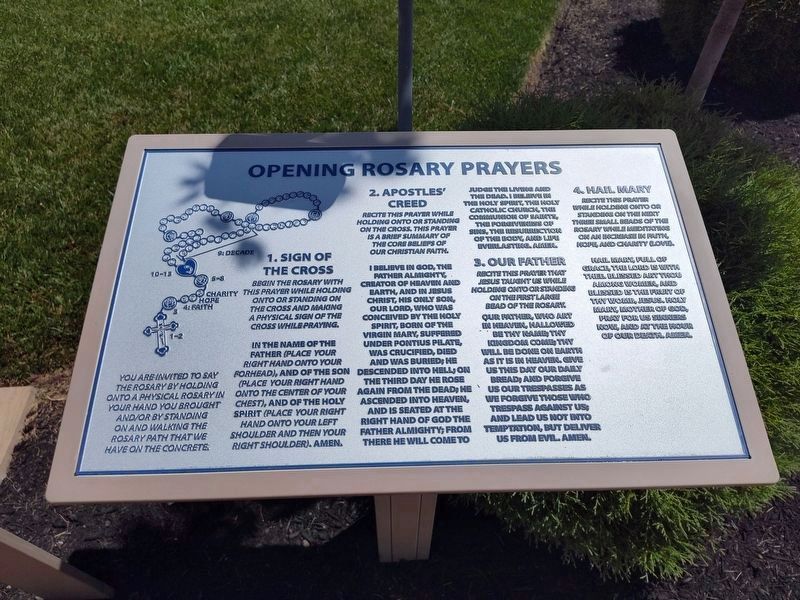
3. Opening Rosary Prayers
You are invited to say the rosary by holding onto a physical rosary in your hand you brought and/or by standing on and walking the rosary path that we have on the concrete.
1. Sign Of The Cross
begin the rosary with charity this prayer while holding hope onto or standing on the cross and making a physical sign of the cross while praying. In the name of the Father (place your right hand onto your forhead), and of the Son (place your right hand onto the center of your chest), and of the Holy Spirit (place your right hand onto your left shoulder and then your right shoulder). Amen. 2. Apostles' Creed
Recite this prayer while holding onto or standing on the cross. This prayer is a brief summary of the core beliefs of our christian faith.
I believe in God, the Father Almighty, Creator of Heaven and Earth, and in Jesus Christ, his only son, our Lord, who was conceived by the Holy Spirit, born of the Virgin Mary, suffered under pontius pilate, was crucified, died and was buried; he descended into hell on the third day he rose again from the dead; he ascended into heaven, and is seated at the right hand of god the father almighty; from there he will come to judge the living and the dead. I believe in the Holy Spirit, the Holy Catholic Church, the communion of saints, the forgiveness of sins, the resurrection of the body, and life everlasting. Amen.
3. Our Father
Recite this prayer that Jesus taught us while holding onto or standing on the first large bead of the rosary.
Our Father, who art in Heaven, hallowed be thy name thy kingdom come: thy will be done on earth as it is in heaven. give us this day our daily bread and forgive us our trespasses as we forgive those who trespass against us and lead us not into temptation, but deliver us from evil. Amen.
4. Hail Mary
Recite this prayer while holding onto or standing on the next three small beads of the rosary while meditating on an increase in faith, hope, and charity (love).
Hail Mary, full of grace, the Lord is with thee. Blessed art thou among women, and blessed is the fruit of thy womb, Jesus. Holy Mary, Mother of God, pray for us sinners now, and at the hour of our death. Amen.
1. Sign Of The Cross
begin the rosary with charity this prayer while holding hope onto or standing on the cross and making a physical sign of the cross while praying. In the name of the Father (place your right hand onto your forhead), and of the Son (place your right hand onto the center of your chest), and of the Holy Spirit (place your right hand onto your left shoulder and then your right shoulder). Amen. 2. Apostles' Creed
Recite this prayer while holding onto or standing on the cross. This prayer is a brief summary of the core beliefs of our christian faith.
I believe in God, the Father Almighty, Creator of Heaven and Earth, and in Jesus Christ, his only son, our Lord, who was conceived by the Holy Spirit, born of the Virgin Mary, suffered under pontius pilate, was crucified, died and was buried; he descended into hell on the third day he rose again from the dead; he ascended into heaven, and is seated at the right hand of god the father almighty; from there he will come to judge the living and the dead. I believe in the Holy Spirit, the Holy Catholic Church, the communion of saints, the forgiveness of sins, the resurrection of the body, and life everlasting. Amen.
3. Our Father
Recite this prayer that Jesus taught us while holding onto or standing on the first large bead of the rosary.
Our Father, who art in Heaven, hallowed be thy name thy kingdom come: thy will be done on earth as it is in heaven. give us this day our daily bread and forgive us our trespasses as we forgive those who trespass against us and lead us not into temptation, but deliver us from evil. Amen.
4. Hail Mary
Recite this prayer while holding onto or standing on the next three small beads of the rosary while meditating on an increase in faith, hope, and charity (love).
Hail Mary, full of grace, the Lord is with thee. Blessed art thou among women, and blessed is the fruit of thy womb, Jesus. Holy Mary, Mother of God, pray for us sinners now, and at the hour of our death. Amen.
In 1569, Saint Pope Pius V officially approved the rosary in this form: 15 decades of Hail Mary's introduced by the Our Father and concluded with the Glory Be. He established the devotion to the rosary in the Catholic Church.
The rosary gained great popularity in the 1500s, when Muslim (Moslem) Turks were ravaging Eastern Europe, With Muslims raiding the coast of Italy, the control of the Mediterranean was at stake, therefore Christianity itself was at stake.
In 1571, under the threat of Muslim attack, Saint Pope Pius V organized a fleet under the command of Don Juan of Austria, While preparations were underway, the Holy Father (Pope) asked all of the faithful to say the rosary and implore our Blessed Mother's prayers, under the title "Our Lady of Victory," that our Lord would grant victory to the Christians, With the Muslim fleet greatly outnumbering that of the Christians in both vessels and sailors, the forces were
Photographed by Craig Doda, July 6, 2024
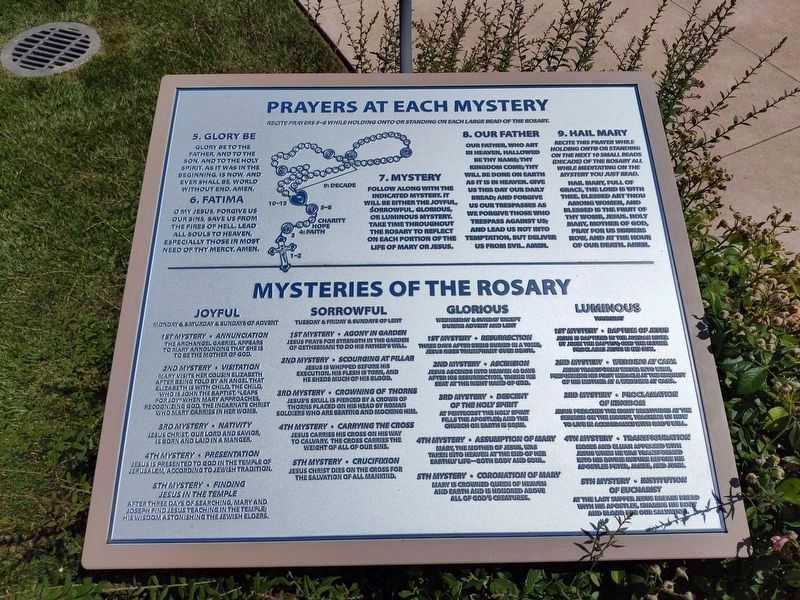
4. Prayers At Each Mystery
Recite prayers 5-8 while holding onto or standing on each large bead of the rosary.
5. Glory Be
Glory be to the Father, and to the Son, and to the Holy Spirit. As it was in the beginning, is now, and ever shall be world without end. Amen.
6. Fatima
O my Jesus, forgive us our sins, save us from the fires of Hell, lead all souls to Heaven especially those in most need of thy mercy. Amen.
7. Mystery
Follow along with the indicated mystery. It will be either the joyful, sorrowful, glorious, or luminous mystery. Take time throughout the rosary to reflect on each portion of the life of Mary or Jesus.
8. Our Father
Our Father, who art in Heaven, hallowed be thy name, thy kingdom come; thy will be done on earth as it is in heaven. Give us this day our daily bread; and forgive us our trespasses as we forgive those who trespass against us; and lead us not into temptation, but deliver us from evil. Amen.
9. Hail Mary
Recite this prayer while holding onto or standing on the next 10 small beads (decade of the rosary all while meditating on the mystery you just read.
Hail Mary, full of grace, the Lord is with thee, blessed art thou among women, and blessed is the fruit of thy womb, Jesus, Holy Mary, Mother of God, pray for us sinners now, and at the hour of our death. Amen.
Mysteries Of The Rosary
Joyful
Monday & Saturday & Sundays of Advent
1st Mystery • Annunciation
The Archangel Gabriel appears to Mary announcing that she is to be the Mother of God.
2nd Mystery • Visitation
Mary visits her cousin Elizabeth after being told by an angel that Elizabeth is with child, the child who is John the Baptist "leaps for joy" when Mary approaches, recognizing God, the Incarnate Christ who Mary carries in her womb.
3rd Mystery • Nativity
Jesus Christ, our Lord and Savior, is born and laid in a manger.
4th Mystery • Presentation
Jesus is presented to God in the temple of Jerusalem, according to Jewish tradition.
5th Mystery. Finding Jesus in the Temple
After three days of searching, Mary and Joseph find Jesus teaching in the temple; his wisdom astonishing the Jewish elders.
Sorrowful
Tuesday & Friday & Sundays of Lent
1st Mystery • Agony in Garden
Jesus prays for strength in the Garden of Gethsemani to do his father's will.
2nd Mystery • Scourging at Pillar
Jesus is whipped before his execution. His flesh is torn, and he sheds much of his blood.
3rd Mystery • Crowning of Thorns
Jesus's skull is pierced by a crown of thorns placed on his head by Roman soldiers who are beating and mocking him.
4th Mystery • Carrying the Cross
Jesus carries his cross on his way to calvary. The cross carries the weight of all of our sins.
5th Mystery • Crucifixion
Jesus Christ dies on the cross for the salvation of all mankind.
Glorious
Wednesday & Sunday except during Advent and Lent
1st Mystery • Resurrection
Three days after being buried in a tomb Jesus rises triumphant over death.
2nd Mystery • Ascension
Jesus ascends into Heaven 40 days after his resurrection, taking his seat at the right hand of God.
3rd Mystery • Descent of the Holy Spirit
At Pentecost the Holy Spirit fills the Apostles and the Church on Earth is born.
4th Mystery • Assumption of Mary
Mary, the Mother of Jesus, was taken into Heaven at the end of her earthly life-both body and soul.
5th Mystery • Coronation of Mary
Mary is crowned queen of Heaven and Earth and is honored above all of God's creatures.
5. Glory Be
Glory be to the Father, and to the Son, and to the Holy Spirit. As it was in the beginning, is now, and ever shall be world without end. Amen.
6. Fatima
O my Jesus, forgive us our sins, save us from the fires of Hell, lead all souls to Heaven especially those in most need of thy mercy. Amen.
7. Mystery
Follow along with the indicated mystery. It will be either the joyful, sorrowful, glorious, or luminous mystery. Take time throughout the rosary to reflect on each portion of the life of Mary or Jesus.
8. Our Father
Our Father, who art in Heaven, hallowed be thy name, thy kingdom come; thy will be done on earth as it is in heaven. Give us this day our daily bread; and forgive us our trespasses as we forgive those who trespass against us; and lead us not into temptation, but deliver us from evil. Amen.
9. Hail Mary
Recite this prayer while holding onto or standing on the next 10 small beads (decade of the rosary all while meditating on the mystery you just read.
Hail Mary, full of grace, the Lord is with thee, blessed art thou among women, and blessed is the fruit of thy womb, Jesus, Holy Mary, Mother of God, pray for us sinners now, and at the hour of our death. Amen.
Mysteries Of The Rosary
Joyful
Monday & Saturday & Sundays of Advent
1st Mystery • Annunciation
The Archangel Gabriel appears to Mary announcing that she is to be the Mother of God.
2nd Mystery • Visitation
Mary visits her cousin Elizabeth after being told by an angel that Elizabeth is with child, the child who is John the Baptist "leaps for joy" when Mary approaches, recognizing God, the Incarnate Christ who Mary carries in her womb.
3rd Mystery • Nativity
Jesus Christ, our Lord and Savior, is born and laid in a manger.
4th Mystery • Presentation
Jesus is presented to God in the temple of Jerusalem, according to Jewish tradition.
5th Mystery. Finding Jesus in the Temple
After three days of searching, Mary and Joseph find Jesus teaching in the temple; his wisdom astonishing the Jewish elders.
Sorrowful
Tuesday & Friday & Sundays of Lent
1st Mystery • Agony in Garden
Jesus prays for strength in the Garden of Gethsemani to do his father's will.
2nd Mystery • Scourging at Pillar
Jesus is whipped before his execution. His flesh is torn, and he sheds much of his blood.
3rd Mystery • Crowning of Thorns
Jesus's skull is pierced by a crown of thorns placed on his head by Roman soldiers who are beating and mocking him.
4th Mystery • Carrying the Cross
Jesus carries his cross on his way to calvary. The cross carries the weight of all of our sins.
5th Mystery • Crucifixion
Jesus Christ dies on the cross for the salvation of all mankind.
Glorious
Wednesday & Sunday except during Advent and Lent
1st Mystery • Resurrection
Three days after being buried in a tomb Jesus rises triumphant over death.
2nd Mystery • Ascension
Jesus ascends into Heaven 40 days after his resurrection, taking his seat at the right hand of God.
3rd Mystery • Descent of the Holy Spirit
At Pentecost the Holy Spirit fills the Apostles and the Church on Earth is born.
4th Mystery • Assumption of Mary
Mary, the Mother of Jesus, was taken into Heaven at the end of her earthly life-both body and soul.
5th Mystery • Coronation of Mary
Mary is crowned queen of Heaven and Earth and is honored above all of God's creatures.
By the end of the fifteenth century, the basic structure of the rosary was in place: Our Father's dividing decades of Hail Mary's, with meditations on the life of Christ and Mary. This prayer form became known as the rosarium ("rose garden").
In the sixteenth century, the five Joyful, Sorrowful, and Glorious Mysteries as we know them today began to emerge. The Glory Be was added to the end of every decade, and the second half of the Hail Mary was formalized: "Holy Mary, Mother of God, pray for us sinners now and at the hour of our death. Amen.
After the full development of the Hail Mary prayer, the term "rosary" was given in 1597, For 320 years, from 1597 until 1917, the form of both the Hail

Photographed by Craig Doda, July 6, 2024
5. Closing Rosary Prayers
Recite prayers 10-13 while holding onto or standing on the centerpiece of the rosary.
10. Glory Be
Glory be to the Gather, and to the Son, and to the Holy Spirit. As it was in the beginning, is now, and ever shall be, world without end. Amen.<Mbr>
11. Hail, Holy Queen
hail, holy queen, mother of mercy, our life, our sweetness, and our hope. to thee do we cry, poor banished children of eve, to thee do we send up our sighs, mourning and weeping in this valley of tears. turn then, most gracious advocate, thine eyes of mercy toward us; and, after this, our exile, show unto us the blessed fruit of thy womb, jesus. o clement, o loving, o sweet virgin mary. pray for us o holy mother of god, that we may be made worthy of the promises of christ. Amen.
12. Rosary Prayer
Let us pray. O God, whose only-begotten son by his life, death and resurrection, has purchased for us the rewards of eternal life; grant, we beseech thee, that by meditating upon these mysteries of the most holy rosary of the blessed Virgin Mary, we may imitate what they contain and obtain what they promise, through the same Christ our Lord. Amen.
13. Sign of the Cross
Conclude the rosary with this prayer while making a physical sign of the cross while praying.
In the name of the Father (place your right hand onto your forehead), and of the Son (place your right hand onto the center of your chest), and of the Holy Spirit (place your right hand onto your left shoulder and then your right shoulder). Amen.
10. Glory Be
Glory be to the Gather, and to the Son, and to the Holy Spirit. As it was in the beginning, is now, and ever shall be, world without end. Amen.<Mbr>
11. Hail, Holy Queen
hail, holy queen, mother of mercy, our life, our sweetness, and our hope. to thee do we cry, poor banished children of eve, to thee do we send up our sighs, mourning and weeping in this valley of tears. turn then, most gracious advocate, thine eyes of mercy toward us; and, after this, our exile, show unto us the blessed fruit of thy womb, jesus. o clement, o loving, o sweet virgin mary. pray for us o holy mother of god, that we may be made worthy of the promises of christ. Amen.
12. Rosary Prayer
Let us pray. O God, whose only-begotten son by his life, death and resurrection, has purchased for us the rewards of eternal life; grant, we beseech thee, that by meditating upon these mysteries of the most holy rosary of the blessed Virgin Mary, we may imitate what they contain and obtain what they promise, through the same Christ our Lord. Amen.
13. Sign of the Cross
Conclude the rosary with this prayer while making a physical sign of the cross while praying.
In the name of the Father (place your right hand onto your forehead), and of the Son (place your right hand onto the center of your chest), and of the Holy Spirit (place your right hand onto your left shoulder and then your right shoulder). Amen.
On May 13, 1917, Mary appeared to three shepherd children in Fatima, Portugal. She told them to come back to that exact place on the 13th day for the next six months. She promised she would appear to them each time and entrust a message to them. Mary told the children to pray f for world peace by reciting the rosary every day. On July 13, 1917, Mary asked the children to add a short prayer to the end of each decade of the rosary:"Oh my Jesus, forgive us our sins, save us from the fires of hell, Lead all souls. to heaven, especially those who are most in need of thy mercy."
Today this prayer is referred to as the Fatima Prayer, and many Catholics incorporate it into the rosary as Mary requested.
On October 16, 2002, almost 600 years after the original Mysteries of the rosary were established, Saint Pope John Paul II proposed adding a new set of mysteries called the Luminous Mysteries (the Mysteries of Light).
Today, Roman Catholics use a rosary made up of 59 beads. The 6 large beads are used for praying the Our Father prayer, and the 53 smaller beads are used for praying the Hail Mary prayer. Other prayers of the rosary include the Sign of the Cross, Apostles' Creed, Glory Be, Fatima Prayer, Hail, Holy Queen, and the Rosary Prayer.
Topics. This historical marker is listed in this topic list: Religion & Religious Structures. A significant historical date for this entry is May 13, 1917.
Location. 40° 20.337′ N, 84° 29.748′ W. Marker is in Osgood, Ohio, in Darke County. It is at the intersection of Patterson Street and North Street, on the right when traveling west on Patterson Street. Touch for map. Marker is at or near this postal address: 52 Patterson St, Yorkshire OH 45388, United States of America. Touch for directions.

Regionally, this marker is in Ohio’s Till Plains. It is also in the American Midwest and in the Corn Belt. Globally, it is in North America, the Western Hemisphere, the Western World, and the Anglosphere. Historically, it finds itself in what was once the Haudenosaunee (Iroquois) Confederacy, the territory of the Mississippian Culture, and the Northwest Territory.
Other nearby markers. At least 8 other markers are within walking distance of this marker: Foxglove (here, next to this marker); Our Lady's Mantle (here, next to this marker); Cyclamen (here, next to this marker); Basil (within shouting distance of this marker); False Solomon's Seal (within shouting distance of this marker); Yarrow (within shouting distance of this marker); History Of Stations Of The Cross (within shouting distance of this marker); Pinks (within shouting distance of this marker). Touch for a list and map of all markers in Osgood.
Credits. This page was last revised on September 19, 2024. It was originally submitted on September 17, 2024, by Craig Doda of Napoleon, Ohio. This page has been viewed 187 times since then and 17 times this year. Photos: 1, 2. submitted on September 17, 2024, by Craig Doda of Napoleon, Ohio. 3, 4, 5. submitted on September 18, 2024, by Craig Doda of Napoleon, Ohio. • Devry Becker Jones was the editor who published this page.
