Peenemünde in Vorpommern-Greifswald, Mecklenburg-Western Pomerania, Germany — Central Europe
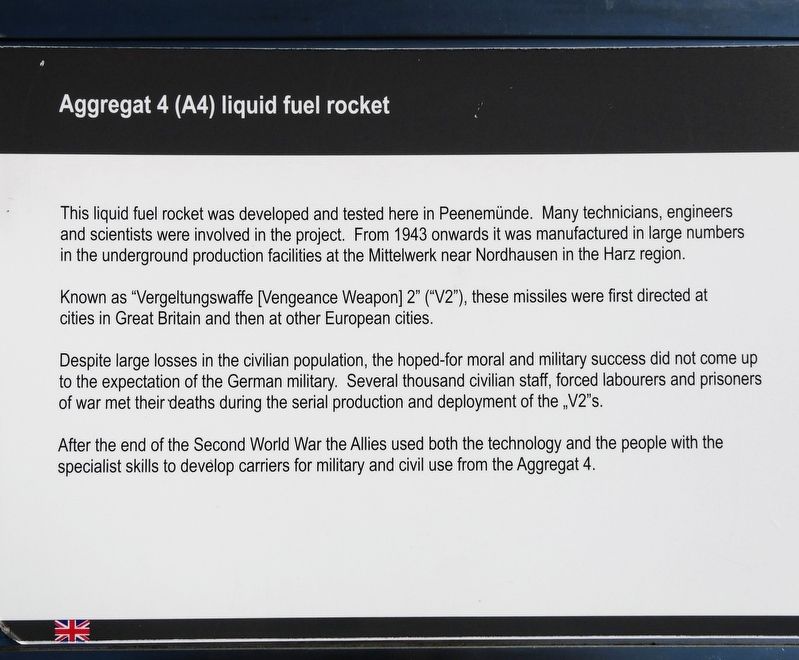
Aggregat 4 (A4) Liquid Fuel Rocket
Photographed by Roger W. Sinnott, September 6, 2024
1. Aggregat 4 (A4) Liquid Fuel Rocket Marker
Known as “Vergeltungswaffe [Vengeance Weapon] 2” (“V2”), these missiles were first directed at cities in Great Britain and then at other European cities.
Despite large losses in the civilian population, the hoped-for moral[e] and military success did not come up to the expectation of the German military. Several thousand civilian staff, forced labourers and prisoners of war met their deaths during the serial production and deployment of the “V2”s.
After the end of the Second World War the Allies used both the technology and the people with the specialist skills to develop carriers for military and civil use from the Aggregat 4.
Topics. This historical marker is listed in these topic lists: Air & Space • War, World II. A significant historical year for this entry is 1943.
Location. 54° 8.332′ N, 13° 46.071′ E. Marker is
this page online

Regionally, this marker is in German Pomerania. Globally, it is in Europe, the European Union, Atlantic Europe, Central Europe, the Schengen Area, Western Europe, and the Western World. Historically, it finds itself in what was once the Holy Roman Empire and also the former East Germany.
Other nearby markers. At least one other marker is within walking distance of this marker: Fieseler Fi 103 “Cherry Stone” FZG 76 (within shouting distance of this marker).
Regarding Aggregat 4 (A4) Liquid Fuel Rocket. More than 3,000 V2 rockets were launched by Germany against England and Belgium beginning in September 1944. They were the first true guided missiles, traveling at supersonic speed, and caused an estimated 5,000 Allied deaths during the
Photographed by Roger W. Sinnott, September 6, 2024
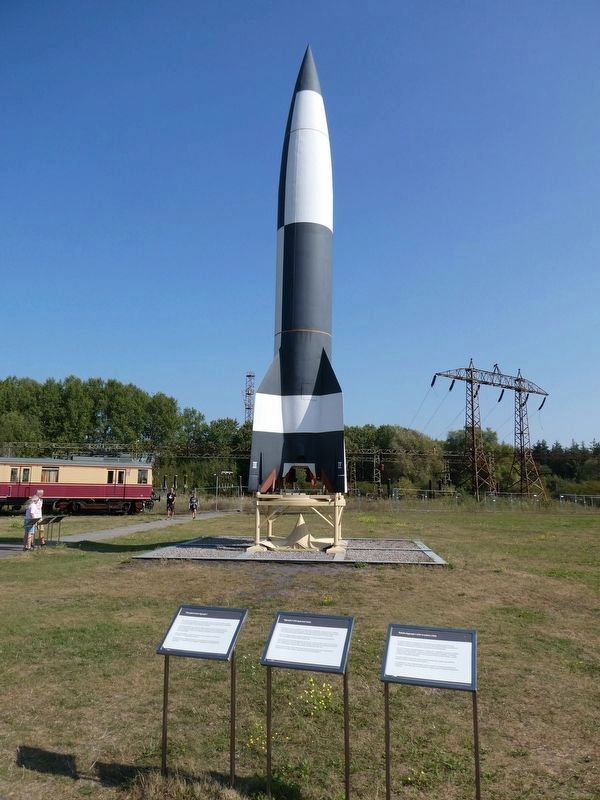
2. Aggregat 4 (A4), Better Known as the V2 Rocket
On the museum grounds is this full-size replica V2, assembled using some original parts. It stands 45 feet tall. When fired straight up, a V2 could attain heights approaching 60 miles. In the background at left is one car of the factory railway that moved tons of materials along with as many as 12,000 people each day within the Peenemünde test facilities.
After the end of World War 2, as part of Operation Paperclip, the United States Army brought about a hundred unused V2s to White Sands Proving Ground in New Mexico, along with dozens of German rocket scientists under Werner von Braun. The rockets were used in trail-blazing scientific studies of the upper atmosphere as well as in astronomy. Many of the German scientists later relocated to Huntsville, Alabama, where they had significant roles in developing America's intercontinental ballistic missiles and space program.
Also see . . . Wikipedia page on the V2 Rocket. (Submitted on September 22, 2024, by Roger W. Sinnott of Norwell, Massachusetts.)
Credits. This page was last revised on September 22, 2024. It was originally submitted on September 22, 2024, by Roger W. Sinnott of Norwell, Massachusetts. This page has been viewed 169 times since then and 19 times this year. Photos: 1, 2. submitted on September 22, 2024, by Roger W. Sinnott of Norwell, Massachusetts. • Andrew Ruppenstein was the editor who published this page.
