Downtown in Fairbanks in Fairbanks North Star Borough, Alaska — Northwest (North America)
The Military in the Interior
Vignettes in History
| — | Proud to be ALASKAN | — |

Photographed by William Fischer, Jr., August 17, 2024
1. The Military in the Interior Marker
we must have Greenland and Iceland to dominate the
North Atlantic and Alaska to dominate the North Pacific"
William Henry Seward
Secretary of State, 18[6]7
Since the United States purchased Alaska from Russia in 1867, the U.S. Army has played a major role in the territory's exploration, development, and defense. Ordered by Congress to establish law and order, Company F, 9th Infantry (Manchu) and Company H, 2d Artillery were the first units assigned to Alaska. Under the command of Major General Jefferson Davis, troops were formed into teams to explore, survey, and map the vast frontier.
The Gold Rush brought the Army a new mission in 1897: prevent lawlessness and assist the increasing number of stranded and destitute fortune seekers. New garrisons were established at the mouth of the Yukon River and confluence of the Yukon and Tanana Rivers. The Army Signal Corps began construction of the Washington-Alaska Military Cable and Telegraph System in 1900. Under the command of Brigadier General Adolphus Greely, troops of the 3rd, 7th, 8th, 10th, and 13th Infantry
this page online
Army development activities in Alaska were not confined to establishing a communications infrastructure. The Alaska Road Commission was established by the War Department in 1905 and headed by Major Wilds Richardson. Work began on a Valdez-Fairbanks route in 1906. Other projects included the Elliot Highway from Fairbanks to Livengood and the Gulkana-Nabesna mining camp road. A later commission president, Brigadier General James Steese, named the Valdez-Fairbanks road the Richardson Highway. With its transfer to the Department of the Interior in 1932, the road system in Alaska totaled 2,200 miles. The Army's participation in development of the Alaska Railroad is noteworthy. Then Colonel Steese became the first general manager of the system in 1923.
With the advent of WWII, the Army made the first of many large-scale commitments to the defense of Alaska. Construction of Fairbanks Army Airfield began in 1939. Fearing interdiction of air supply routes between the Lower
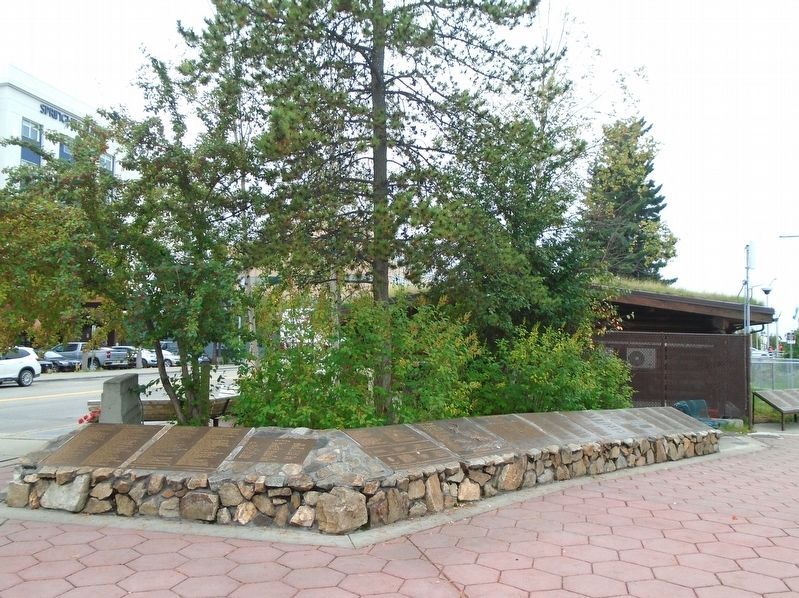
Photographed by William Fischer, Jr., August 17, 2024
2. The Military in the Interior Marker
During WWII, Army air and land forces, under the command of Major General Simon Buckner, Jr. successfully engaged Japanese forces at Dutch Harbor and the islands of Attu and Kiska. Later, air attacks against Japan were launched from retaken fields on Attu. Ladd Field served as transfer point for approximately 8,000 American aircraft provided Russia under Lend-Lease agreements. After the war, Ladd Field was renamed Ft. Wainwright in honor of Major General Jonathan Wainwright who led the delaying action against overwhelming Japanese forces on Bataan. The Army Arctic Indoctrination School was established at Ft. Greely in 1948.
Army assistance to communities in Alaska has proved crucial following two natural disasters; the Good Friday earthquake in 1964 and the Chena River flood in 1967. Aid, cleanup, reconstruction, and medical support provided by Army Engineers, 171st and 172nd Infantry Brigades were decisive in recovery.
U.S. Army contributions to the defense and development of Alaska continue. Due to Alaska's strategic value, the 6th Infantry Division (Light) was activated at Ft. Wainwright in March, 1986, to serve as this nation's Guardian of the North and as a force for world-wide commitment.
Although military aviation was a fact of life in the contiguous 48 states, the territory of Alaska did not entertain an active Army Air Corps site in the Interior until 1938. In that year, Fairbanks was established as the location of the Air Corps' Cold Weather Experimental Station. Originally named the Fairbanks Air Base, the aviation station was redesignated Ladd Field on 1 December 1939. Before the Second World War, B-17s and personnel were involved in cold weather testing at Ladd Field. Major Dale V. Gaffney (later General) was Ladd Field's first commanding officer. During World War II, Ladd Field and its auxiliary, Mile 26 Satellite Field [now Eielson Air Force Base], were used as aircraft staging locations in the supply of American aircraft and equipment to Russia. Mile 26 Field came into existence 1 October 1947 and was renamed Eielson Air Force Base (AFB) on 4 February 1948. Eielson AFB was named in honor of Colonel Carl Ben Eielson, an early pioneer in Alaskan aviation history. On 26 March 1948, Ladd Field was renamed Ladd AFB. In April 1953, the 11th Air Division was established at Ladd AFB with Brigadier General Donald B. Smith as its commander.
Military aircraft operations continued at Ladd AFB until the installation reverted back to US Army control in 1961. On 1 January 1961, Ladd AFB ceased to exist and the base was renamed Fort Jonathan M. Wainwright.
The pace of military construction picked up at Eielson in the early 1960s and the Air Force moved part of the personnel from the units at Ladd AFB to Eielson. Some airmen were transferred to Elmendorf AFB near Anchorage, Alaska. Initially a staging base for military equipment en route to Russia, the base hosted the 97th Bomb Wing until March 1948. Another Strategic Air Command (SAC) unit-the 43d Bomb Wing conducted winter training in 1948 and 1949. In early 1949, SAC maintained its first permanently assigned unit, the 375th Reconnaissance Squadron, at Eielson. The 65th Fighter-Interceptor Squadron arrived from Elmendorf in 1950 and provided the base with air defense. A reduction of Air Force units occurred in 1954 and the 375th Recon Squadron departed central Alaska. Headquarters US Air Force determined Eielson would still be a viable location and based two squadrons at the base in late 1954. The 720th Fighter-Bomber Squadron and the 58th Weather Reconnaissance Squadron were sent to Eielson for detached service. In 1958 the 58th Weather Recon Squadron halted operations at Eielson. The 5010th Air Base Wing, assigned to the Alaskan Air Command, existed as the host unit from 1954 to 1965, when it was redesignated the 5010th Combat Support Group. Aside from being the host unit for the 6th Strategic Wing, the 5010th Combat Support Group gained the 25th Tactical Air Support Squadron in July 1971. This unit provided Army forces with realistic forward air control training in the arctic environment. On 1 October 1981, the 5010th Combat Support Group ceased to exist and in its place the 343d Composite Wing was activated at Eielson. The first A-10A "Thunderbolt II” attack aircraft arrived 18 December 1981, and on 1 January 1982, the 18th Tactical Fighter Squadron was transferred from Elmendorf to Eielson. On 8 June 1984, the 343d Composite Wing was redesignated the 343d Tactical Fighter Wing, and this unit continues as the current host unit at Eielson. In mid 1986, the 25th Tactical Air Support Squadron changed primary aircraft as the unit halted use of the 0-2A "Super Skymaster” and began training operations with the OV-10A "Bronco" aircraft. Also in 1986, the Alaska Air National Guard activated the 168th Air Refueling Squadron at Eielson.
A lasting legacy of military forces in Alaska are those veterans who stay in the Great Land and continue to serve as civilians in their careers and affiliated organizations, especially: the Veterans of Foreign Wars, the American Legion, the Vietnam Veterans of Alaska-Fairbanks, the Disabled Veterans, the American Veterans, and Retired Military Councils.
Erected by Festival Fairbanks '84 and Veteran Service Organizations. (Marker Number 41.)
Topics. This historical marker is listed in these topic lists: Fraternal or Sororal Organizations • Military. A significant historical date for this entry is January 1, 1961.
Location. 64° 50.647′ N, 147° 43.189′ W. Marker is in Fairbanks, Alaska, in Fairbanks North Star Borough. It is in Downtown. It is on 1st Avenue east of Cushman Street, on the left when traveling east. Marker is in Golden Heart Plaza, east of the Yukon Quest headquarters. Touch for map. Marker is at or near this postal address: 516 1st Avenue, Fairbanks AK 99701, United States of America. Touch for directions.

Regionally, this marker is in the Alaska Railroad Corridor, in the Athabascan Region, and in Interior Alaska. It is also on the American Pacific Coast. Globally, it is in North America, on the Pacific Rim, in the Western Hemisphere, in the Western World, and in the Anglosphere. Historically, it finds itself in what was once the Russian Empire.
Other nearby markers. At least 8 other markers are within walking distance of this marker: North Slope Oil Benefits All Of Us (here, next to this marker); Fairbanks Aerie No. 1037 and Ladies Auxiliary (here, next to this marker); First National Bank of Fairbanks (here, next to this marker); Pioneer Missionary Activity In Interior Alaska (a few steps from this marker); Sled Dogs in the History of the Interior (a few steps from this marker); A History of Interior Alaska's Transportation (a few steps from this marker); University of Alaska—Fairbanks (a few steps from this marker); Construction Affecting Fairbanks (a few steps from this marker). Touch for a list and map of all markers in Fairbanks.
Credits. This page was last revised on September 22, 2024. It was originally submitted on September 22, 2024, by William Fischer, Jr. of Reynoldsburg, Ohio. This page has been viewed 302 times since then and 73 times this year. Photos: 1, 2. submitted on September 22, 2024, by William Fischer, Jr. of Reynoldsburg, Ohio.
